Catalog
This bestiary lists every species of the Mythos available for simulation in
stdvoidsim. Each has made-up but population-genetically plausible genomes
and demographic histories. You can run simulations with a variety of
demographic models for Lovecraftian entities from the Cthulhu Mythos.
This catalog shows you all of the possible options that you can use to configure
your simulation.
It is organised around a number of choices that you’ll need to make about the
Species you wish to simulate:
Which chromosome (
Genomeobject)?Which model of demographic history (
DemographicModelobject)?
For instance, suppose you are interested in simulating Deep One samples under an Innsmouth Decline demographic model:
$ stdvoidsim DagHyd -d InnsmouthDecline_1M27 -o deep_ones.trees -L 100000 DeepOnes:10
Outer Gods & Great Old Ones
Azathoth (the Blind Idiot God) is the supreme deity of the Cthulhu Mythos, dwelling at the center of ultimate chaos. It is a boundless, amorphous entity of colossal size, described as a “nuclear chaos” surrounded by a retinue of mindless dancers and the thin monotonous piping of a demonic flute. Azathoth is effectively the ruler of the Outer Gods, yet is blind and idiotic, unaware of its own existence or the cosmos it spawned. All of reality is said to be merely Azathoth’s dream. First appearing in Lovecraft’s fiction in 1922, Azathoth embodies the ultimate horror of a universe governed by mindless, purposeless forces.
Azathoth primordia
- ID:
AzaPri
- Name:
Azathoth primordia
- Common name:
Blind Idiot God
- Generation time:
1000000 (The Daemon Sultan Cult, 1928)
- Ploidy:
2
- Separate sexes:
- Population size:
Genome
- Genome assembly name:
NUCLEUS1.0 (The Daemon Sultan Cult, 1928)
ID |
Ploidy |
Length |
Recombination rate |
Mutation rate |
|---|---|---|---|---|
I |
2 |
2000000000 |
1e-12 |
1e-11 |
nuclear_chaos_element |
1 |
50000 |
0 |
1e-06 |
Mutation and recombination rates are in units of per bp and per generation.
Citations
The Daemon Sultan Cult, 1928. https://en.wikipedia.org/wiki/Necronomicon
(mutation rate, recombination rate)
The Daemon Sultan Cult, 1928. https://en.wikipedia.org/wiki/Necronomicon
(genome assembly)
Demographic Models
ID |
Description |
|---|---|
Pulsating single population model of Azathoth |
|
Two population model of Azathoth nucleus and void fragments |
Pulsating single population model of Azathoth
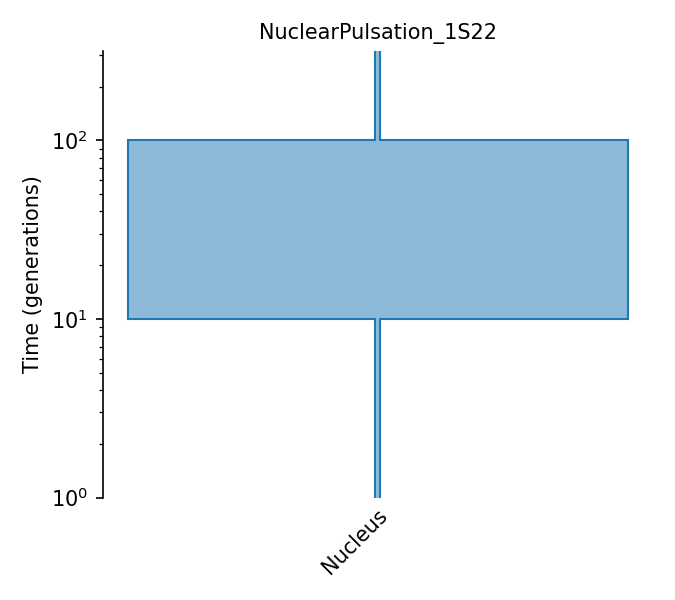
A single population model representing the pulsating nuclear chaos of Azathoth at the center of ultimate chaos. The entity periodically fragments and reconverges. Three epochs: current singularity (N=1), brief fragmentation 10 generations ago (N=100), ancient unified chaos 100 generations ago (N=1).
Warning
This model has not undergone QC.
Details
- ID:
NuclearPulsation_1S22
- Description:
Pulsating single population model of Azathoth
- Num populations:
1
Populations
Index |
ID |
Sampling time |
Description |
|---|---|---|---|
0 |
Nucleus |
0 |
The nuclear chaos at the center of infinity |
Citations
The Daemon Sultan Cult, 1928. https://en.wikipedia.org/wiki/Necronomicon
Demographic Model parameters
Two population model of Azathoth nucleus and void fragments
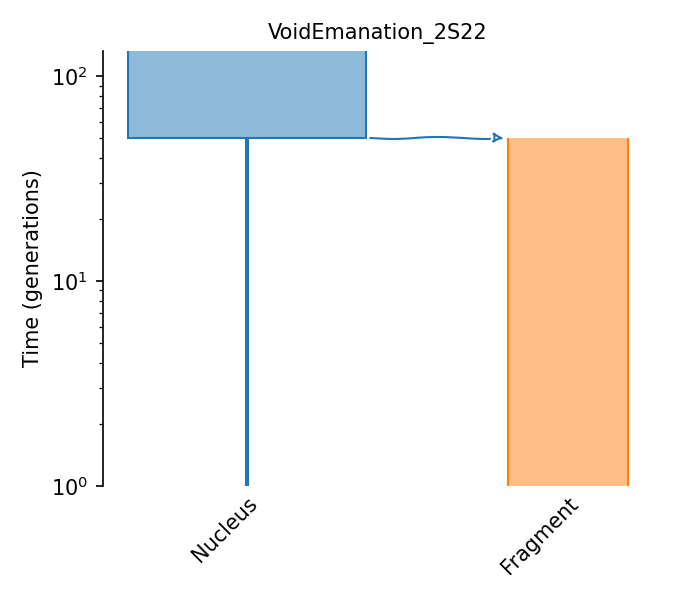
Two population model: the central nuclear chaos and fragmentary emanations cast into the void. Ancestral unified chaos N=100. Split at 50 generations ago. Nucleus contracts to N=1. Fragments expand to N=50.
Warning
This model has not undergone QC.
Details
- ID:
VoidEmanation_2S22
- Description:
Two population model of Azathoth nucleus and void fragments
- Num populations:
2
Populations
Index |
ID |
Sampling time |
Description |
|---|---|---|---|
0 |
Nucleus |
0 |
The nuclear chaos at the center of infinity |
1 |
Fragment |
0 |
Fragmentary emanations cast into the void |
Citations
The Daemon Sultan Cult, 1928. https://en.wikipedia.org/wiki/Necronomicon
Demographic Model parameters
Great Cthulhu is perhaps the most iconic entity of the Mythos, a cosmic being of immense power who lies “dead but dreaming” in the sunken city of R’lyeh, deep beneath the Pacific Ocean. Described as a gigantic creature with an octopoid head, dragon-like wings, and a massive humanoid body, Cthulhu stands hundreds of meters tall. It communicates telepathically, sending dreams and visions to sensitive minds across the globe. Cthulhu is worshipped by hidden cults worldwide who chant “Ph’nglui mglw’nafh Cthulhu R’lyeh wgah’nagl fhtagn” – “In his house at R’lyeh, dead Cthulhu waits dreaming.” First appeared in “The Call of Cthulhu” (1928).
Cthulhu greatoldone
- ID:
CthGre
- Name:
Cthulhu greatoldone
- Common name:
Great Cthulhu
- Generation time:
10000 (Lovecraft, H.P., 1928)
- Ploidy:
4
- Separate sexes:
- Population size:
500 (Lovecraft, H.P., 1928)
Genome
- Genome assembly name:
RLYEH1.0 (Lovecraft, H.P., 1928)
ID |
Ploidy |
Length |
Recombination rate |
Mutation rate |
|---|---|---|---|---|
I |
4 |
498000000 |
1e-09 |
1e-10 |
II |
4 |
421000000 |
1e-09 |
1e-10 |
III |
4 |
365000000 |
1e-09 |
1e-10 |
IV |
4 |
289000000 |
1e-09 |
1e-10 |
V |
4 |
213000000 |
1e-09 |
1e-10 |
VI |
4 |
147000000 |
1e-09 |
1e-10 |
psychic_plasmid |
1 |
42000 |
0 |
1e-10 |
Mutation and recombination rates are in units of per bp and per generation.
Citations
Lovecraft, H.P., 1928. https://en.wikipedia.org/wiki/Necronomicon
(mutation rate)
Lovecraft, H.P., 1928. https://en.wikipedia.org/wiki/Necronomicon
(recombination rate)
Lovecraft, H.P., 1928. https://en.wikipedia.org/wiki/Necronomicon
(genome assembly)
Demographic Models
ID |
Description |
|---|---|
Cyclic dormancy model for Great Cthulhu in R’lyeh |
|
Two population model of R’lyeh deep ones and Pacific surface cultists |
Cyclic dormancy model for Great Cthulhu in R’lyeh
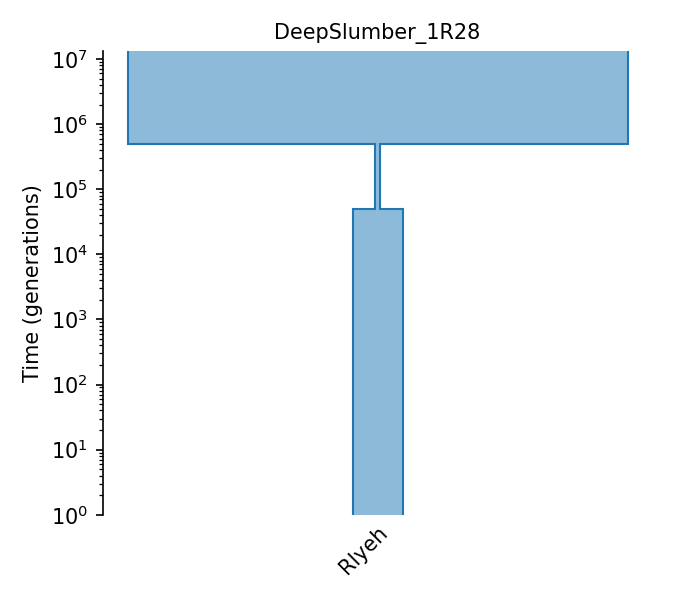
Single population model of Cthulhu’s cyclic dormancy in the sunken city of R’lyeh. Three epochs: (1) a modern awake phase with effective population size 500, (2) a dormant phase bottleneck beginning 50000 generations ago with N=50, and (3) an ancient pre-slumber era beginning 500000 generations ago with N=5000. Based on the psychic archaeology of the Necronomicon (Lovecraft).
Warning
This model has not undergone QC.
Details
- ID:
DeepSlumber_1R28
- Description:
Cyclic dormancy model for Great Cthulhu in R’lyeh
- Num populations:
1
Populations
Index |
ID |
Sampling time |
Description |
|---|---|---|---|
0 |
Rlyeh |
0 |
R’lyeh deep ones – Cthulhu and kin |
Citations
Lovecraft, H.P., 1928. https://en.wikipedia.org/wiki/Necronomicon
Demographic Model parameters
Parameter Type (units) |
Value |
Description |
|---|---|---|
Population size |
500 |
Modern awake phase (R’lyeh) |
Population size |
50 |
Dormant bottleneck |
Population size |
5000 |
Ancient pre-slumber era |
Epoch time (gen.) |
50000 |
Dormant phase start |
Epoch time (gen.) |
500000 |
Pre-slumber era start |
Generation time (yrs.) |
10000 |
Generation time |
Mutation rate |
1e-10 |
Per-base per-generation mutation rate |
Two population model of R’lyeh deep ones and Pacific surface cultists
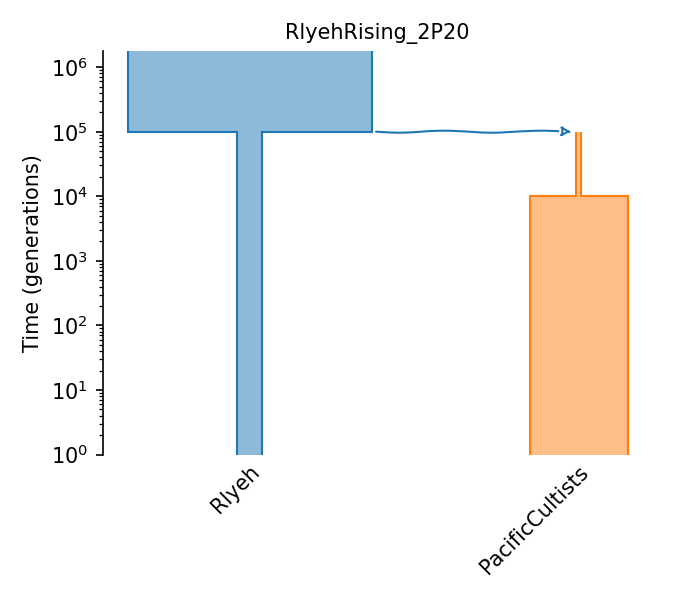
Two population model describing the divergence of the R’lyeh deep ones (oceanic Cthulhu-spawn) and Pacific surface cultists (terrestrial hybrid descendants). The ancestral population of size 5000 splits at 100000 generations ago. The R’lyeh population maintains a size of 500. The surface cultist lineage goes through a bottleneck of 100 individuals before expanding to 2000. Based on the Necronomicon (Lovecraft).
Warning
This model has not undergone QC.
Details
- ID:
RlyehRising_2P20
- Description:
Two population model of R’lyeh deep ones and Pacific surface cultists
- Num populations:
2
Populations
Index |
ID |
Sampling time |
Description |
|---|---|---|---|
0 |
Rlyeh |
0 |
R’lyeh deep ones – oceanic Cthulhu-spawn |
1 |
PacificCultists |
0 |
Pacific surface cultists – terrestrial hybrid descendants |
Citations
Lovecraft, H.P., 1928. https://en.wikipedia.org/wiki/Necronomicon
Demographic Model parameters
Parameter Type (units) |
Value |
Description |
|---|---|---|
Population size |
500 |
R’lyeh population size |
Population size |
2000 |
Pacific cultists modern size |
Population size |
100 |
Pacific cultists bottleneck |
Population size |
5000 |
Ancestral population size |
Epoch time (gen.) |
10000 |
Pacific cultists bottleneck time |
Epoch time (gen.) |
100000 |
Population split time |
Generation time (yrs.) |
10000 |
Generation time |
Mutation rate |
1e-10 |
Per-base per-generation mutation rate |
Chaugnar Faugn (the Feeder) is a Great Old One resembling a vampiric elephant-like humanoid horror. Created by Frank Belknap Long in The Horror from the Hills, the entity has a proboscidean trunk ending in a horrible lamprey-like mouth used to drain victims of blood and life essence. Though often illustrated as an anthropomorphic elephant, it is actually described as reptilian in nature, bearing only superficial resemblance to an elephant. It stands roughly eight feet tall with webbed, tentacled ears and enormous translucent tusks. When hungry, Chaugnar moves with surprising speed. Its servitors, the Miri Nigri, are the progenitors of the Tcho-Tcho people through hybridization with humans.
Chaugnarus faugnis
- ID:
ChaFau
- Name:
Chaugnarus faugnis
- Common name:
Chaugnar Faugn
- Generation time:
10000 (Lovecraft, H.P., 1928)
- Ploidy:
2
- Separate sexes:
- Population size:
200 (Lovecraft, H.P., 1928)
Genome
- Genome assembly name:
PYRENEES1.0 (Lovecraft, H.P., 1928)
ID |
Ploidy |
Length |
Recombination rate |
Mutation rate |
|---|---|---|---|---|
I |
2 |
200000000 |
1e-10 |
2e-10 |
II |
2 |
160000000 |
1e-10 |
2e-10 |
III |
2 |
130000000 |
1e-10 |
2e-10 |
IV |
2 |
100000000 |
1e-10 |
2e-10 |
V |
2 |
80000000 |
1e-10 |
2e-10 |
proboscis_plasmid |
2 |
35000 |
1e-10 |
2e-10 |
Mutation and recombination rates are in units of per bp and per generation.
Citations
Lovecraft, H.P., 1928. https://en.wikipedia.org/wiki/Necronomicon
(mutation rate, recombination rate, genome assembly)
Demographic Models
ID |
Description |
|---|---|
Single population three-epoch model of Chaugnar Faugn |
|
Two-population model of Pyrenees Shrine and Asian Origin Chaugnar Faugn |
Single population three-epoch model of Chaugnar Faugn
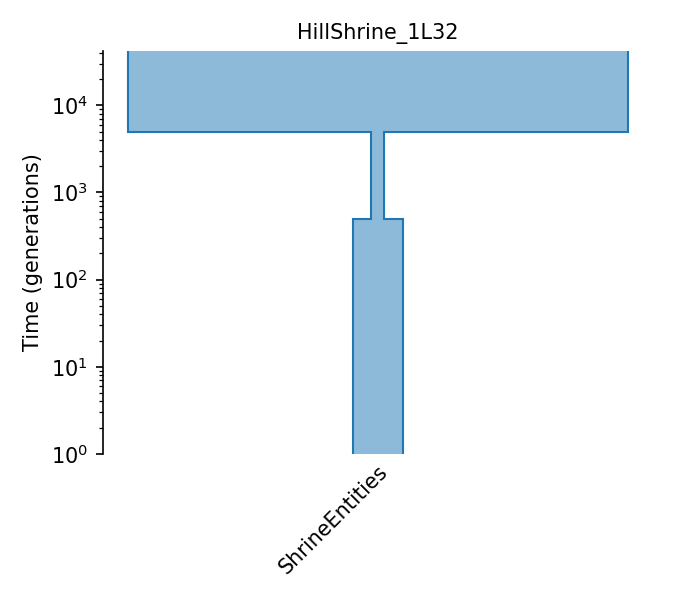
Single population model of Chaugnar Faugn demographic history. Three epochs: modern shrine population with effective population size 200, a worshipper-fed expansion beginning 500 generations ago with N=50, and an ancient migration era beginning 5,000 generations ago with N=2,000. Based on the Necronomicon (Lovecraft)..
Warning
This model has not undergone QC.
Details
- ID:
HillShrine_1L32
- Description:
Single population three-epoch model of Chaugnar Faugn
- Num populations:
1
Populations
Index |
ID |
Sampling time |
Description |
|---|---|---|---|
0 |
ShrineEntities |
0 |
Chaugnar Faugn shrine entities of the Pyrenees |
Citations
Lovecraft, H.P., 1928. https://en.wikipedia.org/wiki/Necronomicon
Demographic Model parameters
Two-population model of Pyrenees Shrine and Asian Origin Chaugnar Faugn
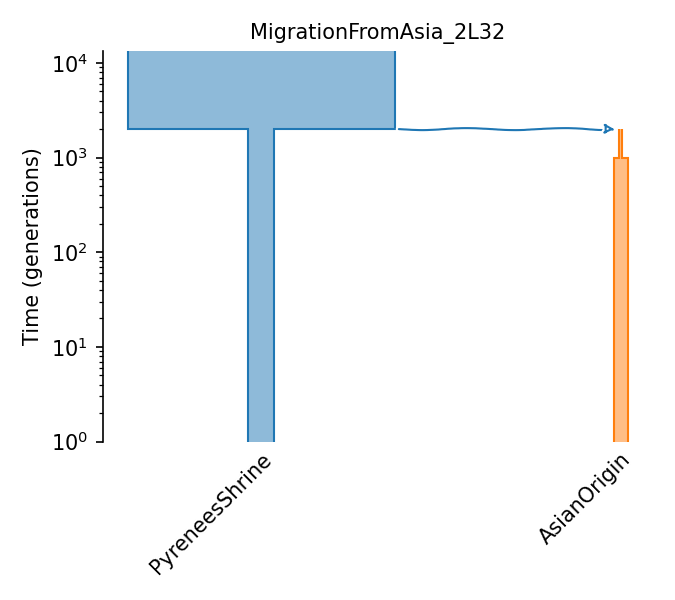
Two-population model representing Pyrenees Shrine entities and Asian Origin entities of Chaugnar Faugn. An ancestral population of size 2,000 splits at 2,000 generations ago. The Pyrenees population maintains a size of 200. The Asian Origin lineage goes through a bottleneck of 20 individuals before expanding to 100 in the present day. Based on the Pyrenees expeditions of Necronomicon (Lovecraft)..
Warning
This model has not undergone QC.
Details
- ID:
MigrationFromAsia_2L32
- Description:
Two-population model of Pyrenees Shrine and Asian Origin Chaugnar Faugn
- Num populations:
2
Populations
Index |
ID |
Sampling time |
Description |
|---|---|---|---|
0 |
PyreneesShrine |
0 |
Pyrenees Shrine entities – western manifestations |
1 |
AsianOrigin |
0 |
Asian Origin entities – ancestral eastern population |
Citations
Lovecraft, H.P., 1928. https://en.wikipedia.org/wiki/Necronomicon
Demographic Model parameters
Father Dagon is an immensely large and powerful Deep One, worshipped as a deity by both the Deep Ones and certain coastal human cults. Together with Mother Hydra, Dagon rules over the Deep One civilization from the depths of the ocean. Described as a colossal fish-frog hybrid towering over even the largest Deep Ones, Dagon is ancient beyond human reckoning. Lovecraft introduced Dagon in his 1917 short story “Dagon,” one of his earliest tales, in which a shipwrecked sailor encounters the titanic creature on a newly risen island of black, slimy mud.
Dagonus maximus
- ID:
DagGod
- Name:
Dagonus maximus
- Common name:
Father Dagon
- Generation time:
50000 (Lovecraft, H.P., 1928)
- Ploidy:
4
- Separate sexes:
- Population size:
Genome
- Genome assembly name:
ABYSS1.0 (Lovecraft, H.P., 1928)
ID |
Ploidy |
Length |
Recombination rate |
Mutation rate |
|---|---|---|---|---|
I |
4 |
300000000 |
3e-11 |
5e-11 |
II |
4 |
270000000 |
3e-11 |
5e-11 |
III |
4 |
240000000 |
3e-11 |
5e-11 |
IV |
4 |
210000000 |
3e-11 |
5e-11 |
V |
4 |
190000000 |
3e-11 |
5e-11 |
VI |
4 |
170000000 |
3e-11 |
5e-11 |
VII |
4 |
150000000 |
3e-11 |
5e-11 |
VIII |
4 |
130000000 |
3e-11 |
5e-11 |
IX |
4 |
110000000 |
3e-11 |
5e-11 |
X |
4 |
100000000 |
3e-11 |
5e-11 |
abyssal_plasmid |
1 |
50000 |
3e-11 |
5e-11 |
Mutation and recombination rates are in units of per bp and per generation.
Citations
Lovecraft, H.P., 1928. https://en.wikipedia.org/wiki/Necronomicon
(mutation rate, recombination rate, genome assembly)
Demographic Models
ID |
Description |
|---|---|
Single population three-epoch model of Father Dagon |
|
Two-population model of Abyssal Progenitors and Reef Manifestations |
Single population three-epoch model of Father Dagon
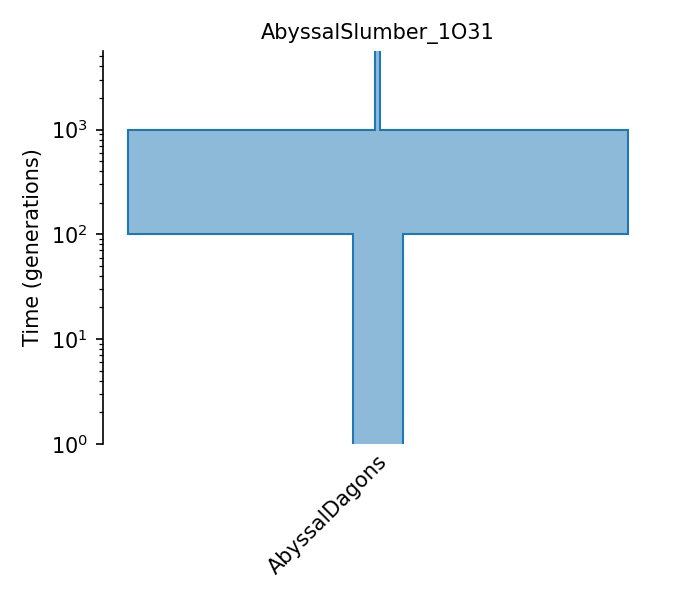
Single population model of Father Dagon demographic history. Three epochs: modern abyssal population with effective population size 50, a deep trench awakening beginning 100 generations ago with N=500, and a primordial ocean era beginning 1,000 generations ago with N=5. Based on the Necronomicon (Lovecraft).
Warning
This model has not undergone QC.
Details
- ID:
AbyssalSlumber_1O31
- Description:
Single population three-epoch model of Father Dagon
- Num populations:
1
Populations
Index |
ID |
Sampling time |
Description |
|---|---|---|---|
0 |
AbyssalDagons |
0 |
Father Dagon and abyssal progenitors |
Citations
Lovecraft, H.P., 1928. https://en.wikipedia.org/wiki/Necronomicon
Demographic Model parameters
Two-population model of Abyssal Progenitors and Reef Manifestations
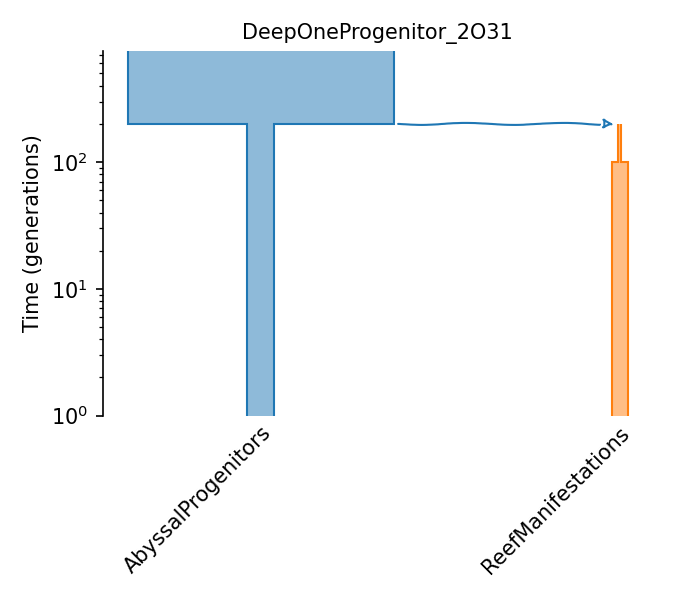
Two-population model representing Abyssal Progenitors and Reef Manifestations of Father Dagon. An ancestral population of size 500 splits at 200 generations ago. The Abyssal Progenitors maintain a size of 50. The Reef Manifestations go through a bottleneck of 5 individuals before expanding to 30 in the present day. Based on the Necronomicon (Lovecraft). Necronomicon (Lovecraft).
Warning
This model has not undergone QC.
Details
- ID:
DeepOneProgenitor_2O31
- Description:
Two-population model of Abyssal Progenitors and Reef Manifestations
- Num populations:
2
Populations
Index |
ID |
Sampling time |
Description |
|---|---|---|---|
0 |
AbyssalProgenitors |
0 |
Abyssal Progenitors – deep trench dwellers |
1 |
ReefManifestations |
0 |
Reef Manifestations – shallow water avatars |
Citations
Lovecraft, H.P., 1928. https://en.wikipedia.org/wiki/Necronomicon
Demographic Model parameters
Hastur (the King in Yellow) is an enigmatic Great Old One associated with entropy, decay, and madness. The entity is connected to the mysterious play The King in Yellow, a forbidden text that drives readers to insanity. Hastur dwells near the star Aldebaran, close to the dark city of Carcosa by the shores of the Lake of Hali. Those who speak Hastur’s name risk drawing its attention. Originally created by Ambrose Bierce and developed by Robert W. Chambers, Hastur was later incorporated into the Cthulhu Mythos by Lovecraft and especially August Derleth, who elevated Hastur to a Great Old One rivaling Cthulhu.
Hastur carcosensis
- ID:
HasKin
- Name:
Hastur carcosensis
- Common name:
King in Yellow
- Generation time:
- Ploidy:
2
- Separate sexes:
- Population size:
2000 (Lovecraft, H.P., 1928)
Genome
- Genome assembly name:
CARCOSA1.0 (Lovecraft, H.P., 1928)
ID |
Ploidy |
Length |
Recombination rate |
Mutation rate |
|---|---|---|---|---|
I |
2 |
150000000 |
3e-08 |
5e-08 |
II |
2 |
130000000 |
3e-08 |
5e-08 |
III |
2 |
110000000 |
3e-08 |
5e-08 |
IV |
2 |
90000000 |
3e-08 |
5e-08 |
V |
2 |
70000000 |
3e-08 |
5e-08 |
VI |
2 |
50000000 |
3e-08 |
5e-08 |
VII |
2 |
40000000 |
3e-08 |
5e-08 |
yellow_sign_element |
2 |
5000000 |
3e-08 |
5e-08 |
Mutation and recombination rates are in units of per bp and per generation.
Citations
Lovecraft, H.P., 1928. https://en.wikipedia.org/wiki/Necronomicon
(mutation rate, recombination rate, genome assembly)
Demographic Models
ID |
Description |
|---|---|
Single population three-epoch model of Yellow Sign memetic spread |
|
Two-population model of Carcosa and Earth artistic contagion |
Single population three-epoch model of Yellow Sign memetic spread
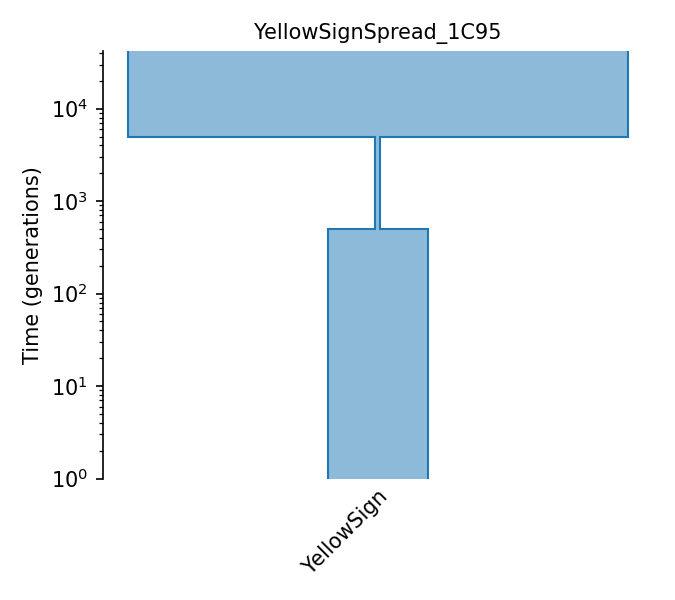
A single-population model with three epochs representing the memetic history of the King in Yellow. The modern era has 2000 influenced minds (memetic expansion). A dark age dormancy bottleneck 500 generations ago reduced the population to 100. Before that, the ancient Carcosa founding era beginning 5000 generations ago had 10000 entities.
Warning
This model has not undergone QC.
Details
- ID:
YellowSignSpread_1C95
- Description:
Single population three-epoch model of Yellow Sign memetic spread
- Num populations:
1
Populations
Index |
ID |
Sampling time |
Description |
|---|---|---|---|
0 |
YellowSign |
0 |
Carriers of the Yellow Sign memetic influence |
Citations
Lovecraft, H.P., 1928. https://en.wikipedia.org/wiki/Necronomicon
Demographic Model parameters
Two-population model of Carcosa and Earth artistic contagion
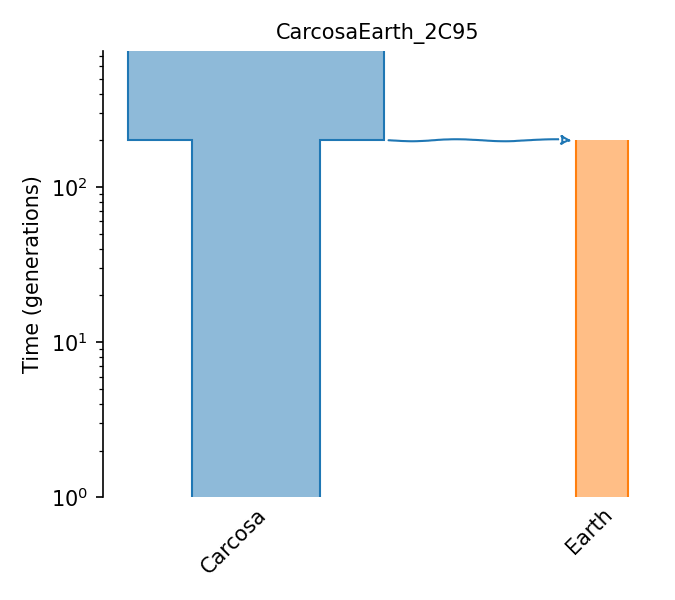
A two-population model representing the spread of Hastur’s influence across dimensions. The ancestral population in Carcosa (N=10000) split 200 generations ago when the play “The King in Yellow” was written, creating an Earth colony. Carcosa remains stable at N=5000. The Earth colony started with just 10 individuals (early readers of the play) and expanded to 2000 in the present day.
Warning
This model has not undergone QC.
Details
- ID:
CarcosaEarth_2C95
- Description:
Two-population model of Carcosa and Earth artistic contagion
- Num populations:
2
Populations
Index |
ID |
Sampling time |
Description |
|---|---|---|---|
0 |
Carcosa |
0 |
Home dimension population of Hastur entities |
1 |
Earth |
0 |
Earth colony spread through artistic contagion |
Citations
Lovecraft, H.P., 1928. https://en.wikipedia.org/wiki/Necronomicon
Demographic Model parameters
Nyarlathotep (the Crawling Chaos) is unique among the Outer Gods in that it actively interacts with humanity, taking on a thousand different forms. Unlike the other Outer Gods, Nyarlathotep appears to be fully sentient and even enjoys spreading madness and destruction. Among its many avatars are the Black Pharaoh, the Haunter of the Dark, and a tall, swarthy man who walks among mortals. It serves as the messenger and soul of the Outer Gods, carrying out their will on Earth. First mentioned by Lovecraft in a 1920 prose poem, Nyarlathotep appears in numerous stories and is one of Lovecraft’s most developed creations.
Nyarlathotep azathothspawn
- ID:
NyaAza
- Name:
Nyarlathotep azathothspawn
- Common name:
Crawling Chaos
- Generation time:
- Ploidy:
2
- Separate sexes:
- Population size:
1000 (Lovecraft, H.P., 1928)
Genome
- Genome assembly name:
CHAOS1.0 (Lovecraft, H.P., 1928)
ID |
Ploidy |
Length |
Recombination rate |
Mutation rate |
|---|---|---|---|---|
I |
2 |
50000000 |
1e-06 |
1e-07 |
II |
2 |
75000000 |
1e-06 |
1e-07 |
III |
2 |
100000000 |
1e-06 |
1e-07 |
IV |
2 |
130000000 |
1e-06 |
1e-07 |
V |
2 |
170000000 |
1e-06 |
1e-07 |
VI |
2 |
200000000 |
1e-06 |
1e-07 |
VII |
2 |
250000000 |
1e-06 |
1e-07 |
VIII |
2 |
300000000 |
1e-06 |
1e-07 |
chaos_fragment |
2 |
66600000 |
1e-06 |
1e-07 |
Mutation and recombination rates are in units of per bp and per generation.
Citations
Lovecraft, H.P., 1928. https://en.wikipedia.org/wiki/Necronomicon
(genome assembly)
Lovecraft, H.P., 1928. https://en.wikipedia.org/wiki/Necronomicon
(mutation rate)
Lovecraft, H.P., 1928. https://en.wikipedia.org/wiki/Necronomicon
(recombination rate)
Demographic Models
ID |
Description |
|---|---|
Single population three-epoch model of Nyarlathotep avatars |
|
Two-population model of Egyptian and Global Nyarlathotep manifestations |
Single population three-epoch model of Nyarlathotep avatars
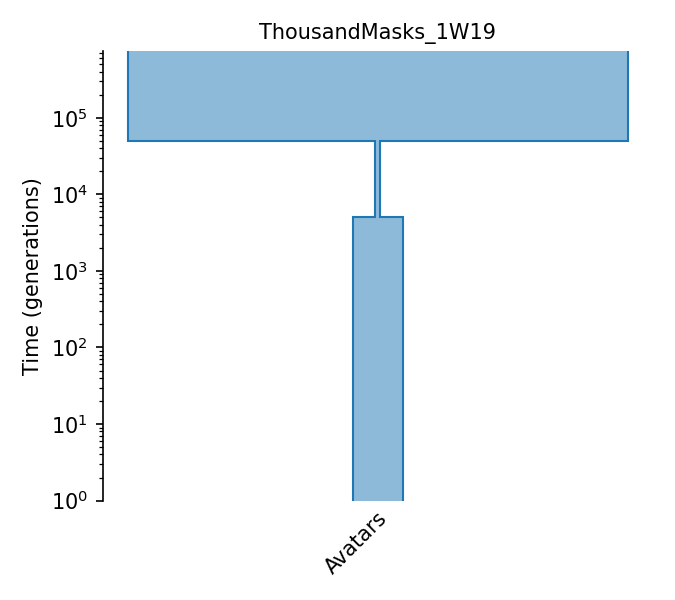
A single-population model with three epochs representing the history of Nyarlathotep’s avatars. The modern era has 1000 avatars (masks). A focusing bottleneck 5000 generations ago reduced the avatar count to 100. Before that, in the ancient formless era beginning 50000 generations ago, 10000 chaotic manifestations existed simultaneously.
Warning
This model has not undergone QC.
Details
- ID:
ThousandMasks_1W19
- Description:
Single population three-epoch model of Nyarlathotep avatars
- Num populations:
1
Populations
Index |
ID |
Sampling time |
Description |
|---|---|---|---|
0 |
Avatars |
0 |
Nyarlathotep avatars (masks) |
Citations
Lovecraft, H.P., 1928. https://en.wikipedia.org/wiki/Necronomicon
Demographic Model parameters
Two-population model of Egyptian and Global Nyarlathotep manifestations
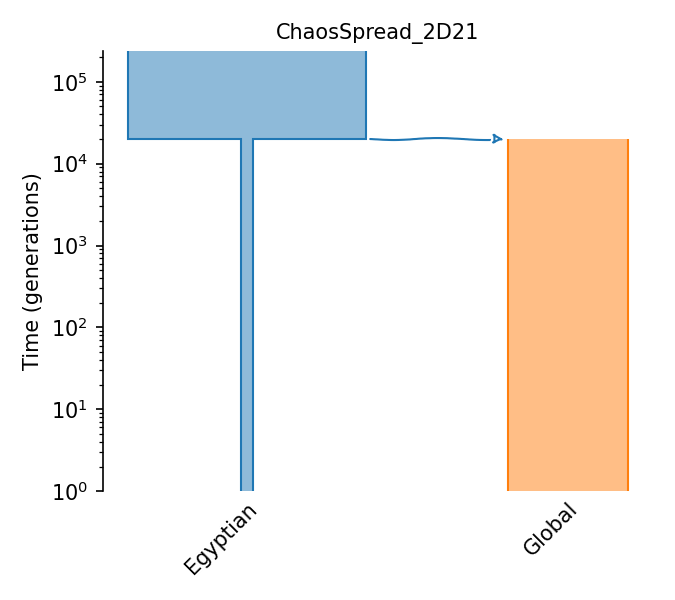
A two-population model representing the spread of Nyarlathotep manifestations. The ancestral population (N=10000) split 20000 generations ago into an Egyptian avatar lineage (constant N=500) and a Global manifestation lineage that expanded from an initial size of 50 to 5000 in the present day.
Warning
This model has not undergone QC.
Details
- ID:
ChaosSpread_2D21
- Description:
Two-population model of Egyptian and Global Nyarlathotep manifestations
- Num populations:
2
Populations
Index |
ID |
Sampling time |
Description |
|---|---|---|---|
0 |
Egyptian |
0 |
Ancient Egyptian avatar lineage |
1 |
Global |
0 |
Global manifestation lineage |
Citations
Lovecraft, H.P., 1928. https://en.wikipedia.org/wiki/Necronomicon
Demographic Model parameters
Shub-Niggurath (the Black Goat of the Woods with a Thousand Young) is an Outer God associated with fertility, growth, and hideous fecundity. Though never directly described by Lovecraft, Shub-Niggurath is referenced frequently in incantations and rituals. It is a perverse fertility deity, spawning vast numbers of monstrous offspring known as the Dark Young. The entity exists in a cloudy, forested dimension and is worshipped by cults that invoke it with the chant “Ia! Shub-Niggurath!” Lovecraft first mentioned Shub-Niggurath in “The Last Test” (1928) and referenced it in several subsequent stories.
Shubniggurath fertilitas
- ID:
ShbNig
- Name:
Shubniggurath fertilitas
- Common name:
Black Goat of the Woods
- Generation time:
- Ploidy:
2
- Separate sexes:
- Population size:
100000 (Lovecraft, H.P., 1928)
Genome
- Genome assembly name:
DARKWOODS1.0 (Lovecraft, H.P., 1928)
ID |
Ploidy |
Length |
Recombination rate |
Mutation rate |
|---|---|---|---|---|
I |
2 |
180000000 |
2.5e-08 |
3e-08 |
II |
2 |
165000000 |
2.5e-08 |
3e-08 |
III |
2 |
150000000 |
2.5e-08 |
3e-08 |
IV |
2 |
140000000 |
2.5e-08 |
3e-08 |
V |
2 |
120000000 |
2.5e-08 |
3e-08 |
VI |
2 |
100000000 |
2.5e-08 |
3e-08 |
VII |
2 |
85000000 |
2.5e-08 |
3e-08 |
VIII |
2 |
70000000 |
2.5e-08 |
3e-08 |
IX |
2 |
55000000 |
2.5e-08 |
3e-08 |
fertility_plasmid |
1 |
30000 |
0 |
1e-07 |
Mutation and recombination rates are in units of per bp and per generation.
Citations
Lovecraft, H.P., 1928. https://en.wikipedia.org/wiki/Necronomicon
(mutation rate, recombination rate)
Lovecraft, H.P., 1928. https://en.wikipedia.org/wiki/Necronomicon
(genome assembly)
Demographic Models
ID |
Description |
|---|---|
Explosive fertility expansion model |
|
Two population woods and cult-bred model |
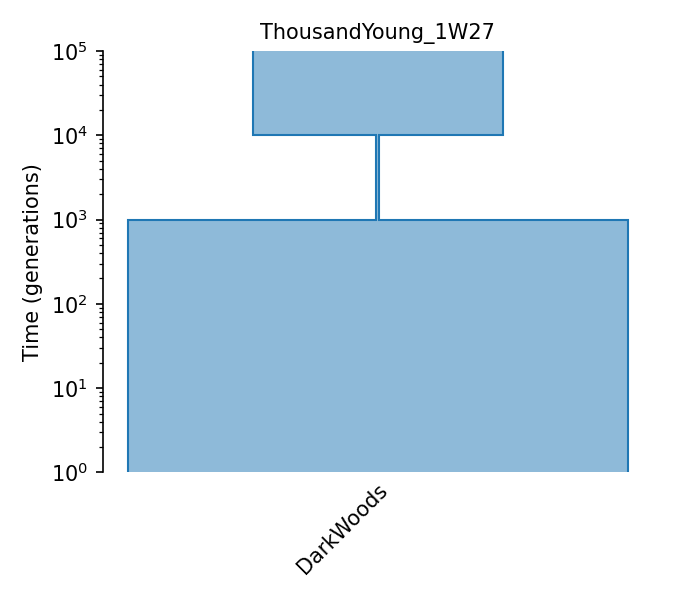
Explosive fertility expansion model
Single population model of Shub-Niggurath’s prolific reproduction. Three epochs: modern explosive growth (N=100000), pre-summoning bottleneck 1000 gen ago (N=500), ancient forest presence 10000 gen ago (N=50000).
Warning
This model has not undergone QC.
Details
- ID:
ThousandYoung_1W27
- Description:
Explosive fertility expansion model
- Num populations:
1
Populations
Index |
ID |
Sampling time |
Description |
|---|---|---|---|
0 |
DarkWoods |
0 |
Dark Woods breeding population |
Citations
Lovecraft, H.P., 1928. https://en.wikipedia.org/wiki/Necronomicon
Demographic Model parameters
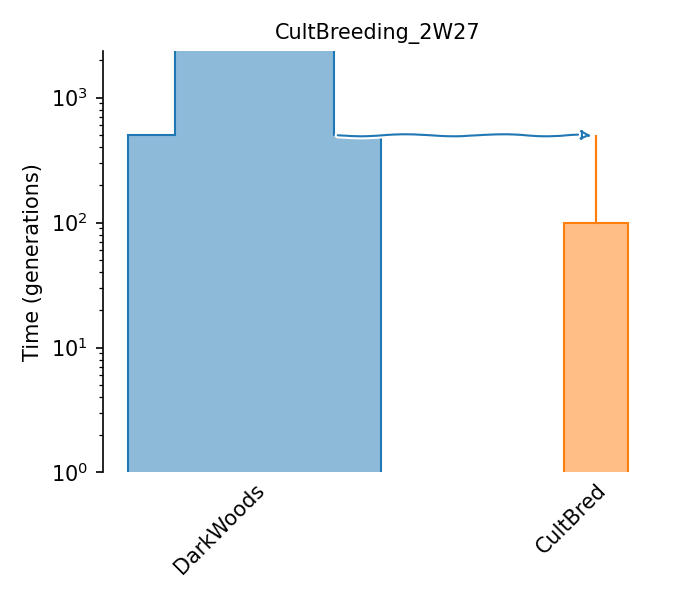
Two population woods and cult-bred model
Two population model: ancient Dark Woods population and cult-bred hybrids. Ancestral N=50000. Split 500 gen ago. Woods stays at 80000. Cult-bred founders at 20, expand to 20000.
Warning
This model has not undergone QC.
Details
- ID:
CultBreeding_2W27
- Description:
Two population woods and cult-bred model
- Num populations:
2
Populations
Index |
ID |
Sampling time |
Description |
|---|---|---|---|
0 |
DarkWoods |
0 |
Dark Woods breeding population |
1 |
CultBred |
0 |
Cult-bred hybrid offspring |
Citations
Lovecraft, H.P., 1928. https://en.wikipedia.org/wiki/Necronomicon
Demographic Model parameters
Tsathoggua is a Great Old One originally created by Clark Ashton Smith, later adopted into the Cthulhu Mythos by Lovecraft. Described as a furry, toad-like entity with sleepy eyes and a bat-like visage, Tsathoggua dwells in lightless caverns beneath Mount Voormithadreth in Hyperborea (and later beneath North America). It is notably lazy and slothful, preferring to lie in torpor and wait for sacrifices to be brought to it. Despite its apparent lethargy, it is immensely powerful. Its worship predates humanity, having been venerated by the Voormis and other prehuman races. First appeared in Smith’s “The Tale of Satampra Zeiros” (1931).
Tsathoggua somnolentis
- ID:
TsaGod
- Name:
Tsathoggua somnolentis
- Common name:
Tsathoggua
- Generation time:
50000 (Lovecraft, H.P., 1928)
- Ploidy:
2
- Separate sexes:
- Population size:
100 (Lovecraft, H.P., 1928)
Genome
- Genome assembly name:
NKAI1.0 (Lovecraft, H.P., 1928)
ID |
Ploidy |
Length |
Recombination rate |
Mutation rate |
|---|---|---|---|---|
I |
2 |
250000000 |
3e-10 |
5e-10 |
II |
2 |
200000000 |
3e-10 |
5e-10 |
III |
2 |
150000000 |
3e-10 |
5e-10 |
IV |
2 |
100000000 |
3e-10 |
5e-10 |
nkai_plasmid |
1 |
30000 |
0 |
5e-10 |
Mutation and recombination rates are in units of per bp and per generation.
Citations
Lovecraft, H.P., 1928. https://en.wikipedia.org/wiki/Necronomicon
(mutation rate)
Lovecraft, H.P., 1928. https://en.wikipedia.org/wiki/Necronomicon
(recombination rate)
Lovecraft, H.P., 1928. https://en.wikipedia.org/wiki/Necronomicon
(genome assembly)
Demographic Models
ID |
Description |
|---|---|
Cyclic dormancy model for Tsathoggua in N’kai |
|
Two population model of N’kai Depths and Surface Avatars |
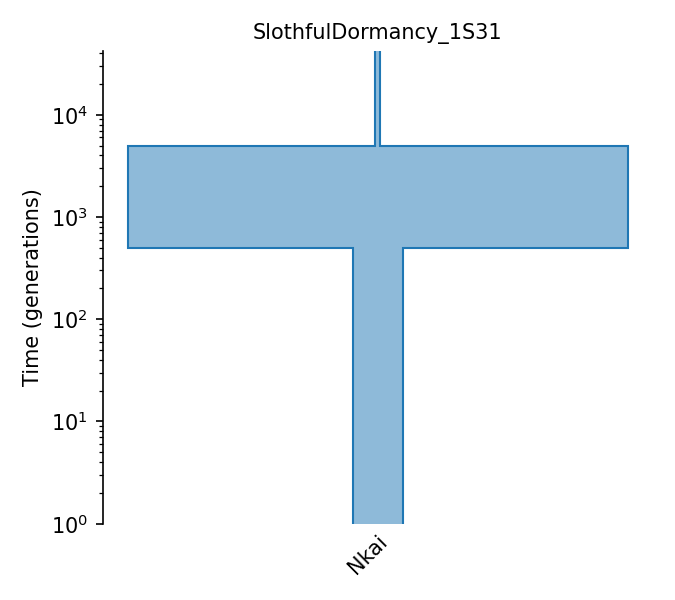
Cyclic dormancy model for Tsathoggua in N’kai
Single population model of Tsathoggua’s slothful dormancy in the caverns of N’kai. Three epochs: (1) a modern phase with effective population size 100, (2) a brief awakening period beginning 500 generations ago with N=1000, and (3) a deep slumber era beginning 5000 generations ago with N=10. Based on the Necronomicon (Lovecraft). (1931).
Warning
This model has not undergone QC.
Details
- ID:
SlothfulDormancy_1S31
- Description:
Cyclic dormancy model for Tsathoggua in N’kai
- Num populations:
1
Populations
Index |
ID |
Sampling time |
Description |
|---|---|---|---|
0 |
Nkai |
0 |
N’kai cavern dwellers – Tsathoggua and kin |
Citations
Lovecraft, H.P., 1928. https://en.wikipedia.org/wiki/Necronomicon
Demographic Model parameters
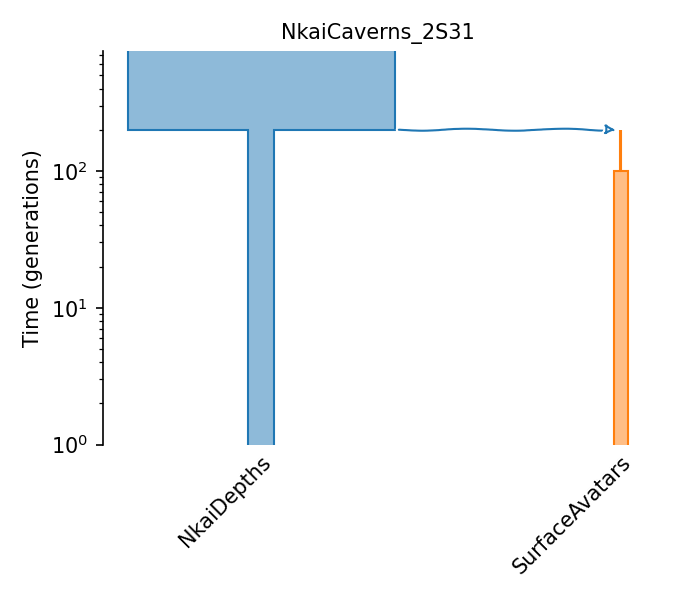
Two population model of N’kai Depths and Surface Avatars
Two population model describing the divergence of the N’kai Depths dwellers and Surface Avatars. The ancestral population of size 1000 splits at 200 generations ago. The N’kai population maintains a size of 100. The Surface Avatar lineage goes through a bottleneck of 5 individuals before expanding to 50. Based on the Necronomicon (Lovecraft). (1931).
Warning
This model has not undergone QC.
Details
- ID:
NkaiCaverns_2S31
- Description:
Two population model of N’kai Depths and Surface Avatars
- Num populations:
2
Populations
Index |
ID |
Sampling time |
Description |
|---|---|---|---|
0 |
NkaiDepths |
0 |
N’kai Depths – deep cavern dwellers |
1 |
SurfaceAvatars |
0 |
Surface Avatars – terrestrial manifestations |
Citations
Lovecraft, H.P., 1928. https://en.wikipedia.org/wiki/Necronomicon
Demographic Model parameters
Yog-Sothoth (the Key and the Gate) is an Outer God that exists simultaneously in all of time and space, coterminous with all things. It appears as a conglomeration of iridescent, ever-shifting spheres or globes. As the “Key and the Gate,” Yog-Sothoth is the guardian of the threshold between dimensions, and those who seek to open the way between worlds must deal with it. It knows all and sees all, past, present, and future. Unlike Azathoth, it is fully cognizant. In “The Dunwich Horror” (1929), it is revealed as the father of the monstrous Wilbur Whateley and his invisible twin. Yog-Sothoth is one of the most powerful entities in the Mythos.
Yogsothoth dimensionalis
- ID:
YogSot
- Name:
Yogsothoth dimensionalis
- Common name:
The Key and the Gate
- Generation time:
100000 (Lovecraft, H.P., 1928)
- Ploidy:
2
- Separate sexes:
- Population size:
Genome
- Genome assembly name:
GATE1.0 (Lovecraft, H.P., 1928)
ID |
Ploidy |
Length |
Recombination rate |
Mutation rate |
|---|---|---|---|---|
I |
2 |
500000000 |
1e-11 |
1e-12 |
II |
2 |
750000000 |
1e-11 |
1e-12 |
III |
2 |
1000000000 |
1e-11 |
1e-12 |
dimensional_loop |
2 |
666000000 |
1e-11 |
1e-12 |
Mutation and recombination rates are in units of per bp and per generation.
Citations
Lovecraft, H.P., 1928. https://en.wikipedia.org/wiki/Necronomicon
(mutation rate, recombination rate, genome assembly)
Demographic Models
ID |
Description |
|---|---|
Dimensional echoes of Yog-Sothoth |
|
Dunwich hybridization of Yog-Sothoth and Whateley lineage |
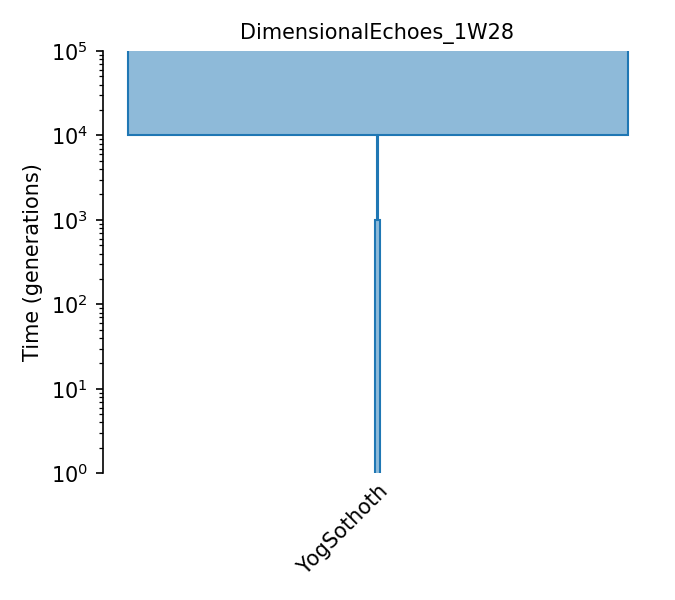
Dimensional echoes of Yog-Sothoth
Single population model for Yog-Sothoth with three epochs: a current era of dimensional fragmentation (N=10), a brief convergence/singularity event 1000 generations ago (N=1), and an ancient multidimensional era beginning 10000 generations ago (N=1000).
Warning
This model has not undergone QC.
Details
- ID:
DimensionalEchoes_1W28
- Description:
Dimensional echoes of Yog-Sothoth
- Num populations:
1
Populations
Index |
ID |
Sampling time |
Description |
|---|---|---|---|
0 |
YogSothoth |
None |
Yog-Sothoth dimensional echoes |
Citations
Lovecraft, H.P., 1928. https://en.wikipedia.org/wiki/Necronomicon
Demographic Model parameters
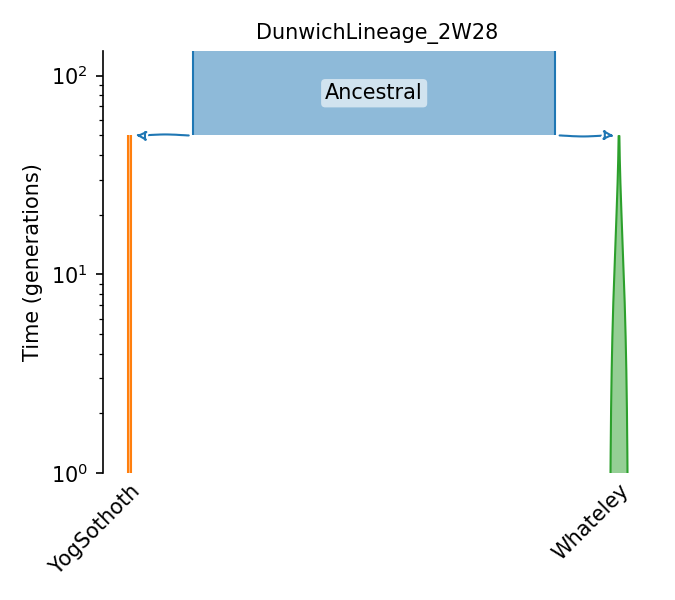
Dunwich hybridization of Yog-Sothoth and Whateley lineage
Two population model representing the Dunwich hybridization event. An ancestral Yog-Sothoth population (N=1000) splits 50 generations ago into a pure dimensional population (N=10) and a hybrid terrestrial Whateley lineage that starts at N=2 and grows to N=50.
Warning
This model has not undergone QC.
Details
- ID:
DunwichLineage_2W28
- Description:
Dunwich hybridization of Yog-Sothoth and Whateley lineage
- Num populations:
3
Populations
Index |
ID |
Sampling time |
Description |
|---|---|---|---|
0 |
YogSothoth |
None |
Pure dimensional Yog-Sothoth |
1 |
Whateley |
None |
Hybrid terrestrial Whateley lineage |
2 |
Ancestral |
50 |
Ancestral Yog-Sothoth population |
Citations
Lovecraft, H.P., 1928. https://en.wikipedia.org/wiki/Necronomicon
Demographic Model parameters
Servitor Races & Engineered Species
Byakhee are interstellar servitor creatures associated with Hastur and the King in Yellow. They can fly through space and between dimensions, carrying riders through the void. Described as a composite creature with bat-like wings, insectoid features, and a vaguely avian body, the Byakhee are not native to Earth. They possess an organ containing a substance called “space-mead” that allows them to survive the vacuum and cold of interstellar space. They can be summoned on certain nights using particular rituals. First described by August Derleth, the Byakhee serve as steeds for those traveling to Carcosa or other far-flung cosmic destinations.
Byakhee voidwing
- ID:
BybWor
- Name:
Byakhee voidwing
- Common name:
Byakhee
- Generation time:
- Ploidy:
2
- Separate sexes:
True
- Population size:
200000 (Lovecraft, H.P., 1928)
Genome
- Genome assembly name:
ALDEBARAN1.0 (Lovecraft, H.P., 1928)
ID |
Ploidy |
Length |
Recombination rate |
Mutation rate |
|---|---|---|---|---|
I |
2 |
70000000 |
3e-09 |
4e-09 |
II |
2 |
60000000 |
3e-09 |
4e-09 |
III |
2 |
50000000 |
3e-09 |
4e-09 |
IV |
2 |
40000000 |
3e-09 |
4e-09 |
V |
2 |
30000000 |
3e-09 |
4e-09 |
VI |
2 |
20000000 |
3e-09 |
4e-09 |
void_organelle |
2 |
25000000 |
3e-09 |
4e-09 |
Mutation and recombination rates are in units of per bp and per generation.
Citations
Lovecraft, H.P., 1928. https://en.wikipedia.org/wiki/Necronomicon
(mutation rate, recombination rate, genome assembly)
Demographic Models
ID |
Description |
|---|---|
Byakhee single population void transit history |
|
Two population Aldebaran and Hyades cluster Byakhee model |
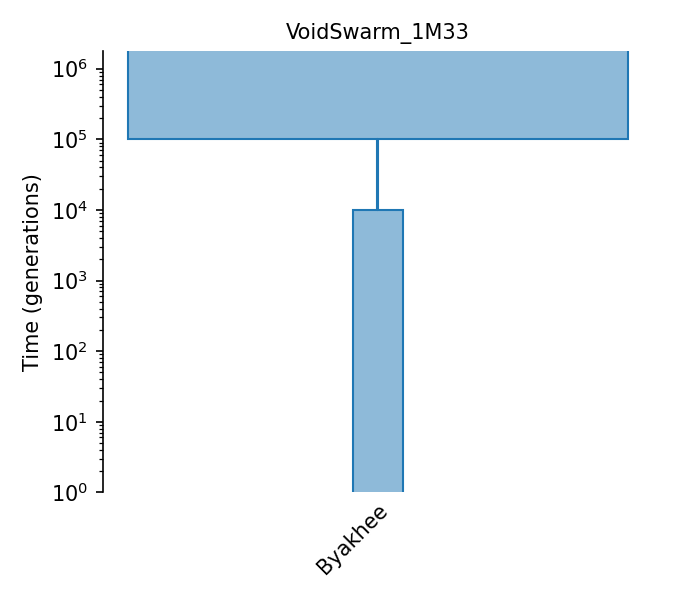
Byakhee single population void transit history
Single population model of Byakhee demographic history reflecting interstellar transit bottlenecks. Three epochs: modern swarm (N=200,000), void bottleneck from interstellar transit starting 10,000 generations ago (N=5,000), and the Aldebaran homeworld era starting 100,000 generations ago (N=2,000,000).
Warning
This model has not undergone QC.
Details
- ID:
VoidSwarm_1M33
- Description:
Byakhee single population void transit history
- Num populations:
1
Populations
Index |
ID |
Sampling time |
Description |
|---|---|---|---|
0 |
Byakhee |
0 |
Global Byakhee swarm |
Citations
Lovecraft, H.P., 1928. https://en.wikipedia.org/wiki/Necronomicon
Demographic Model parameters
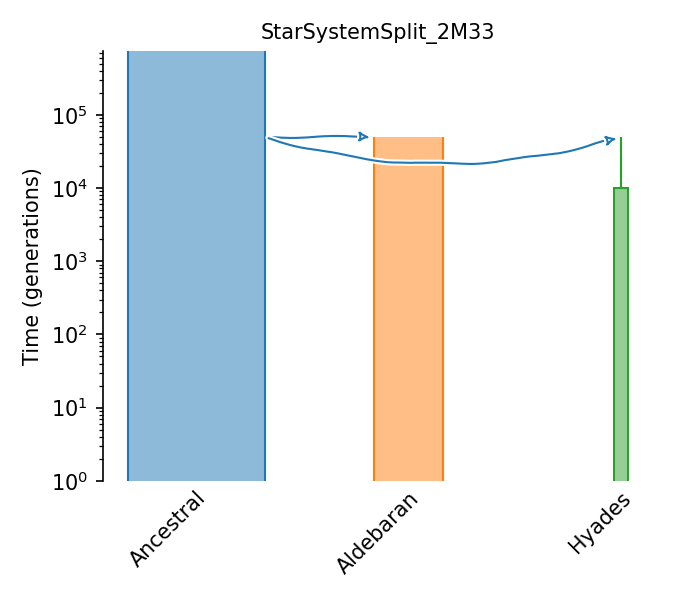
Two population Aldebaran and Hyades cluster Byakhee model
Two population model with Aldebaran homeworld swarm and Hyades cluster colony. An ancestral population of size 2,000,000 splits into two populations 50,000 generations ago. The Aldebaran population stabilizes at 1,000,000. The Hyades colony experiences a bottleneck to 500 individuals before expanding to 200,000.
Warning
This model has not undergone QC.
Details
- ID:
StarSystemSplit_2M33
- Description:
Two population Aldebaran and Hyades cluster Byakhee model
- Num populations:
3
Populations
Index |
ID |
Sampling time |
Description |
|---|---|---|---|
0 |
Aldebaran |
0 |
Aldebaran homeworld Byakhee swarm |
1 |
Hyades |
0 |
Hyades cluster colony Byakhee |
2 |
Ancestral |
None |
Ancestral Byakhee population |
Citations
Lovecraft, H.P., 1928. https://en.wikipedia.org/wiki/Necronomicon
Demographic Model parameters
Dark Young of Shub-Niggurath are monstrous tree-like entities spawned by the Outer God Shub-Niggurath. They appear as enormous, black, ropy, tentacled masses with multiple goat-like hooves at their bases, resembling a nightmarish fusion of tree and animal. They stand roughly 20 feet tall. Despite their plant-like appearance, they are intelligent and serve as intermediaries between Shub-Niggurath and her worshippers. Dark Young inhabit dark forests and woodlands, and are summoned during rituals to the Black Goat. They emit a sickly sweet smell and crush victims beneath their hooves or grasp them with their tentacles.
Obscurus silvanus
- ID:
DarYou
- Name:
Obscurus silvanus
- Common name:
Dark Young
- Generation time:
- Ploidy:
3
- Separate sexes:
- Population size:
35000 (Lovecraft, H.P., 1928)
Genome
- Genome assembly name:
DARKWOOD1.0 (Lovecraft, H.P., 1928)
ID |
Ploidy |
Length |
Recombination rate |
Mutation rate |
|---|---|---|---|---|
I |
3 |
100000000 |
1.5e-08 |
2e-08 |
II |
3 |
90000000 |
1.5e-08 |
2e-08 |
III |
3 |
80000000 |
1.5e-08 |
2e-08 |
IV |
3 |
70000000 |
1.5e-08 |
2e-08 |
V |
3 |
60000000 |
1.5e-08 |
2e-08 |
VI |
3 |
50000000 |
1.5e-08 |
2e-08 |
root_organelle |
1 |
28000 |
0 |
2e-08 |
Mutation and recombination rates are in units of per bp and per generation.
Citations
Lovecraft, H.P., 1928. https://en.wikipedia.org/wiki/Necronomicon
(mutation rate)
Lovecraft, H.P., 1928. https://en.wikipedia.org/wiki/Necronomicon
(recombination rate)
Lovecraft, H.P., 1928. https://en.wikipedia.org/wiki/Necronomicon
(genome assembly)
Demographic Models
ID |
Description |
|---|---|
Three epoch model of Dark Young forest expansion |
|
Two population model of Forest Groves and Summoned Dark Young |
Three epoch model of Dark Young forest expansion
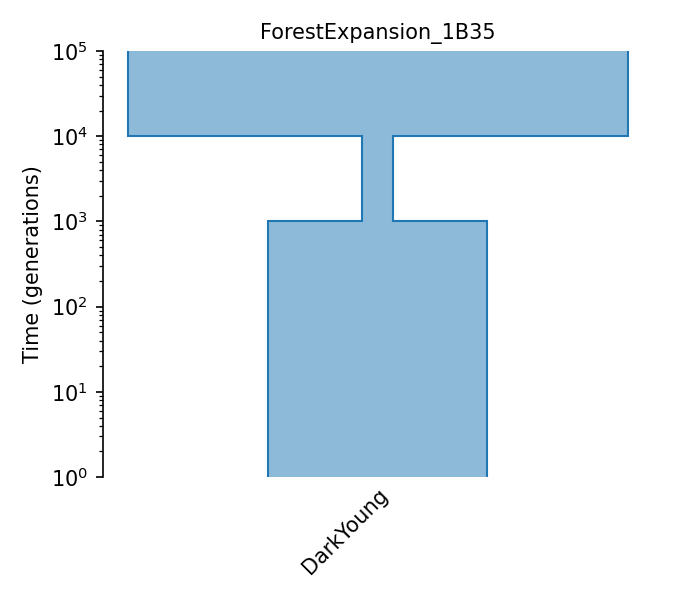
Single population model of the Dark Young of Shub-Niggurath. Three epochs: (1) a modern phase with effective population size 35000, (2) a woodland retreat beginning 1000 generations ago with N=5000, and (3) an ancient grove era beginning 10000 generations ago with N=80000. Based on the Necronomicon (Lovecraft).
Warning
This model has not undergone QC.
Details
- ID:
ForestExpansion_1B35
- Description:
Three epoch model of Dark Young forest expansion
- Num populations:
1
Populations
Index |
ID |
Sampling time |
Description |
|---|---|---|---|
0 |
DarkYoung |
0 |
Dark Young – tentacled tree-spawn of Shub-Niggurath |
Citations
Lovecraft, H.P., 1928. https://en.wikipedia.org/wiki/Necronomicon
Demographic Model parameters
Two population model of Forest Groves and Summoned Dark Young
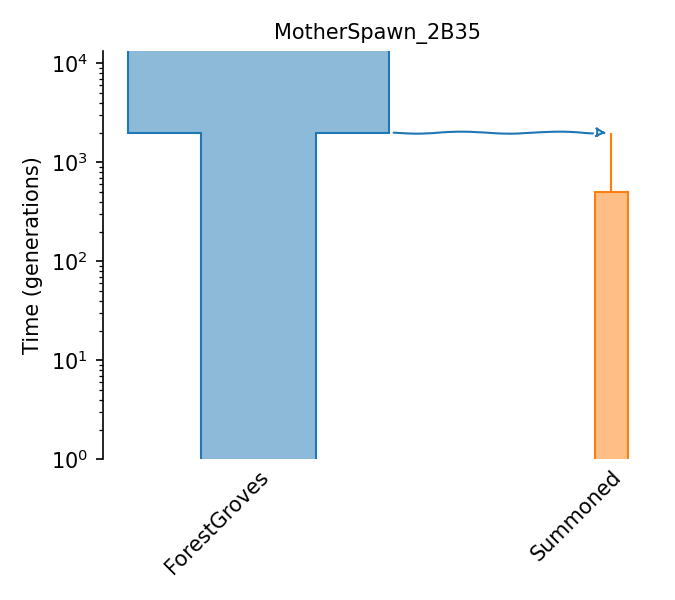
Two population model describing the divergence of Forest Groves and Summoned Dark Young. The ancestral population of size 80000 splits at 2000 generations ago. The Forest Grove population maintains a size of 35000. The Summoned lineage goes through a bottleneck of 50 individuals before expanding to 10000. Based on the Necronomicon (Lovecraft).
Warning
This model has not undergone QC.
Details
- ID:
MotherSpawn_2B35
- Description:
Two population model of Forest Groves and Summoned Dark Young
- Num populations:
2
Populations
Index |
ID |
Sampling time |
Description |
|---|---|---|---|
0 |
ForestGroves |
0 |
Forest Groves – self-sustaining Dark Young populations |
1 |
Summoned |
0 |
Summoned – Dark Young called forth by ritual |
Citations
Lovecraft, H.P., 1928. https://en.wikipedia.org/wiki/Necronomicon
Demographic Model parameters
Fire Vampires are living extensions of the cosmic entity Fthaggua, created by Donald Wandrei for “The Fire Vampires” and later incorporated into the Cthulhu Mythos. They appear as reddish electrical discharges resembling lightning, traveling the cosmos aboard the interstellar comet Ktynga. Fire Vampires feast upon the life energy and memories of sentient creatures, causing their victims to burst into flames during the feeding process. Their leader, Fthaggua, appears as a great flickering ball of cold blue flame and serves as high priest of Cthugha. The knowledge accumulated from slain beings allows Fthaggua to better locate and hunt intelligent civilizations across the cosmos.
Igneus vampirus
- ID:
FirVam
- Name:
Igneus vampirus
- Common name:
Fire Vampire
- Generation time:
0.01 (Lovecraft, H.P., 1928)
- Ploidy:
1
- Separate sexes:
- Population size:
1000000 (Lovecraft, H.P., 1928)
Genome
- Genome assembly name:
FOMALHAUT1.0 (Lovecraft, H.P., 1928)
ID |
Ploidy |
Length |
Recombination rate |
Mutation rate |
|---|---|---|---|---|
I |
1 |
15000000 |
1e-06 |
5e-06 |
II |
1 |
10000000 |
1e-06 |
5e-06 |
plasma_element |
1 |
3000 |
0 |
5e-06 |
Mutation and recombination rates are in units of per bp and per generation.
Citations
Lovecraft, H.P., 1928. https://en.wikipedia.org/wiki/Necronomicon
(mutation rate)
Lovecraft, H.P., 1928. https://en.wikipedia.org/wiki/Necronomicon
(recombination rate)
Lovecraft, H.P., 1928. https://en.wikipedia.org/wiki/Necronomicon
(genome assembly)
Demographic Models
ID |
Description |
|---|---|
Starfire burst model for Fire Vampires near Fomalhaut |
|
Two population model of Fomalhaut Swarm and Earth Summoned |
Starfire burst model for Fire Vampires near Fomalhaut
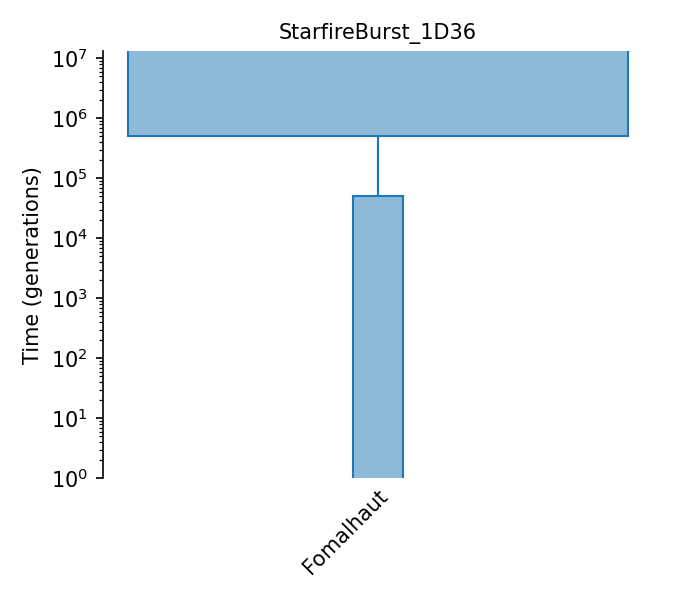
Single population model of Fire Vampire population dynamics near Fomalhaut. Three epochs: (1) a modern active phase with effective population size 1000000, (2) a pre-summoning dormancy period beginning 50000 generations ago with N=100, and (3) an ancient Fomalhaut origin era beginning 500000 generations ago with N=10000000. Based on the work of Necronomicon (Lovecraft).
Warning
This model has not undergone QC.
Details
- ID:
StarfireBurst_1D36
- Description:
Starfire burst model for Fire Vampires near Fomalhaut
- Num populations:
1
Populations
Index |
ID |
Sampling time |
Description |
|---|---|---|---|
0 |
Fomalhaut |
0 |
Fomalhaut swarm – Fire Vampires near their star |
Citations
Lovecraft, H.P., 1928. https://en.wikipedia.org/wiki/Necronomicon
Demographic Model parameters
Two population model of Fomalhaut Swarm and Earth Summoned
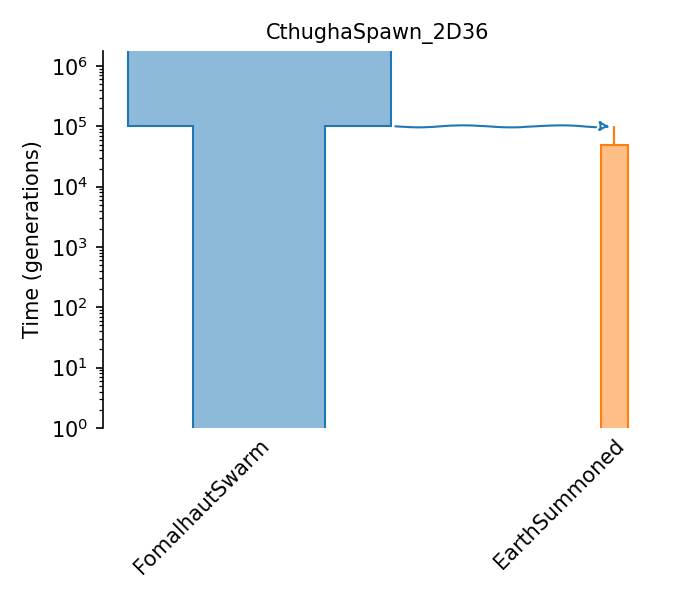
Two population model describing the divergence of the Fomalhaut Swarm and Earth Summoned Fire Vampires. The ancestral population of size 10000000 splits at 100000 generations ago. The Fomalhaut population maintains a size of 5000000. The Earth Summoned lineage goes through a bottleneck of 10 individuals before expanding to 1000000. Based on the work of Necronomicon (Lovecraft).
Warning
This model has not undergone QC.
Details
- ID:
CthughaSpawn_2D36
- Description:
Two population model of Fomalhaut Swarm and Earth Summoned
- Num populations:
2
Populations
Index |
ID |
Sampling time |
Description |
|---|---|---|---|
0 |
FomalhautSwarm |
0 |
Fomalhaut Swarm – stellar Fire Vampires |
1 |
EarthSummoned |
0 |
Earth Summoned – terrestrial Fire Vampires |
Citations
Lovecraft, H.P., 1928. https://en.wikipedia.org/wiki/Necronomicon
Demographic Model parameters
Formless Spawn are the amorphous servitors of Tsathoggua, dwelling in the lightless caverns beneath Mount Voormithadreth and other subterranean locations. They are black, protoplasmic entities that can assume virtually any shape, from tentacled horrors to serpentine forms. In their natural state, they appear as pools of living blackness. Unlike shoggoths, they are naturally occurring beings rather than engineered creatures. Formless Spawn guard the sleeping form of Tsathoggua and attack anything that approaches their master without proper obeisance. They were first described by Clark Ashton Smith in “The Tale of Satampra Zeiros” (1931).
Informis generatus
- ID:
ForSpa
- Name:
Informis generatus
- Common name:
Formless Spawn
- Generation time:
- Ploidy:
2
- Separate sexes:
- Population size:
25000 (Lovecraft, H.P., 1928)
Genome
- Genome assembly name:
NKAI_SPAWN1.0 (Lovecraft, H.P., 1928)
ID |
Ploidy |
Length |
Recombination rate |
Mutation rate |
|---|---|---|---|---|
I |
2 |
40000000 |
2e-08 |
3e-08 |
II |
2 |
32000000 |
2e-08 |
3e-08 |
III |
2 |
25000000 |
2e-08 |
3e-08 |
amorphous_element |
1 |
7000 |
0 |
3e-08 |
Mutation and recombination rates are in units of per bp and per generation.
Citations
Lovecraft, H.P., 1928. https://en.wikipedia.org/wiki/Necronomicon
(mutation rate)
Lovecraft, H.P., 1928. https://en.wikipedia.org/wiki/Necronomicon
(recombination rate)
Lovecraft, H.P., 1928. https://en.wikipedia.org/wiki/Necronomicon
(genome assembly)
Demographic Models
ID |
Description |
|---|---|
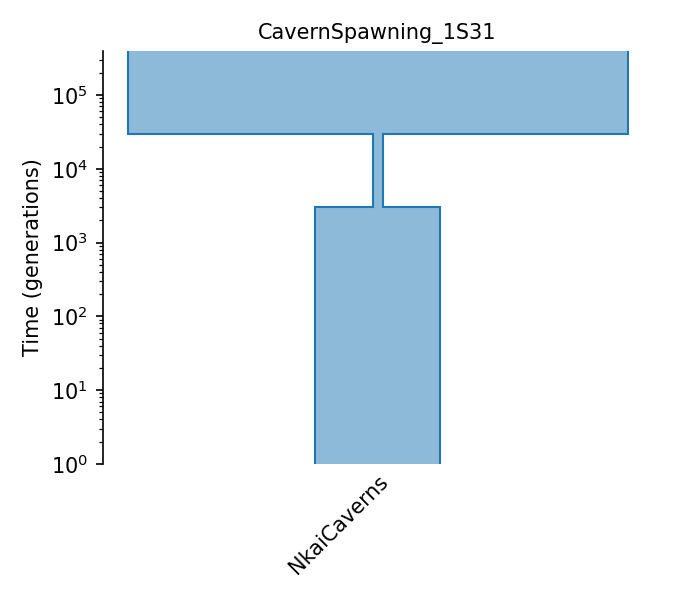
Cavern spawning model for Formless Spawn in N’kai |
|
Two population model of N’kai Dwellers and Temple Guardians |
Cavern spawning model for Formless Spawn in N’kai
Single population model of Formless Spawn population dynamics in the caverns of N’kai. Three epochs: (1) a modern phase with effective population size 25000, (2) a drought bottleneck period beginning 3000 generations ago with N=2000, and (3) an ancient N’kai era beginning 30000 generations ago with N=100000. Based on the Necronomicon (Lovecraft). (1931).
Warning
This model has not undergone QC.
Details
- ID:
CavernSpawning_1S31
- Description:
Cavern spawning model for Formless Spawn in N’kai
- Num populations:
1
Populations
Index |
ID |
Sampling time |
Description |
|---|---|---|---|
0 |
NkaiCaverns |
0 |
N’kai Caverns – Formless Spawn breeding grounds |
Citations
Lovecraft, H.P., 1928. https://en.wikipedia.org/wiki/Necronomicon
Demographic Model parameters
Two population model of N’kai Dwellers and Temple Guardians
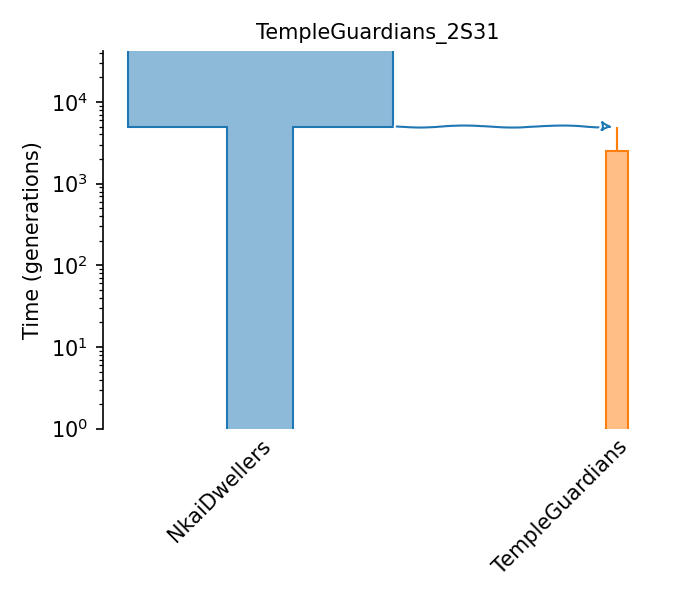
Two population model describing the divergence of the N’kai Dwellers and Temple Guardians. The ancestral population of size 100000 splits at 5000 generations ago. The N’kai population maintains a size of 25000. The Temple Guardian lineage goes through a bottleneck of 200 individuals before expanding to 8000. Based on the Necronomicon (Lovecraft). Necronomicon (Lovecraft).
Warning
This model has not undergone QC.
Details
- ID:
TempleGuardians_2S31
- Description:
Two population model of N’kai Dwellers and Temple Guardians
- Num populations:
2
Populations
Index |
ID |
Sampling time |
Description |
|---|---|---|---|
0 |
NkaiDwellers |
0 |
N’kai Dwellers – deep cavern Formless Spawn |
1 |
TempleGuardians |
0 |
Temple Guardians – surface temple protectors |
Citations
Lovecraft, H.P., 1928. https://en.wikipedia.org/wiki/Necronomicon
Demographic Model parameters
Hunting Horrors are nightmarish serpentine creatures that serve Nyarlathotep. They resemble enormous, jet-black serpents or worms with bat-like wings, and their forms seem to shift and writhe in a way that defies clear perception. They pursue their prey relentlessly through the skies and even through the void between worlds. Hunting Horrors are vulnerable to light, particularly sunlight, which can destroy them. They are most commonly encountered in the Dreamlands, where they hunt on behalf of the Crawling Chaos. Lovecraft referenced these creatures in The Dream-Quest of Unknown Kadath (1927), where protagonist Randolph Carter encounters them in the skies.
Venator obscurus
- ID:
HunTin
- Name:
Venator obscurus
- Common name:
Hunting Horror
- Generation time:
- Ploidy:
2
- Separate sexes:
- Population size:
15000 (Lovecraft, H.P., 1928)
Genome
- Genome assembly name:
DARKFLIGHT1.0 (Lovecraft, H.P., 1928)
ID |
Ploidy |
Length |
Recombination rate |
Mutation rate |
|---|---|---|---|---|
I |
2 |
80000000 |
4e-09 |
6e-09 |
II |
2 |
65000000 |
4e-09 |
6e-09 |
III |
2 |
50000000 |
4e-09 |
6e-09 |
IV |
2 |
40000000 |
4e-09 |
6e-09 |
shadow_element |
1 |
10000 |
0 |
6e-09 |
Mutation and recombination rates are in units of per bp and per generation.
Citations
Lovecraft, H.P., 1928. https://en.wikipedia.org/wiki/Necronomicon
(mutation rate)
Lovecraft, H.P., 1928. https://en.wikipedia.org/wiki/Necronomicon
(recombination rate)
Lovecraft, H.P., 1928. https://en.wikipedia.org/wiki/Necronomicon
(genome assembly)
Demographic Models
ID |
Description |
|---|---|
Three epoch model of Hunting Horror dark flight populations |
|
Two population model of Void Hunters and Earthbound Sentinels |
Three epoch model of Hunting Horror dark flight populations
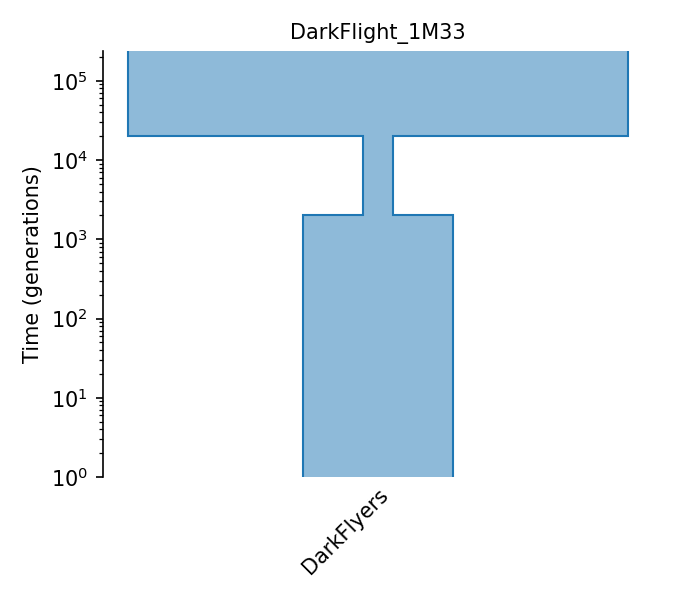
Single population model of Hunting Horrors serving Nyarlathotep. Three epochs: (1) a modern phase with effective population size 15000, (2) a Nyarlathotep summoning boom beginning 2000 generations ago with N=3000, and (3) an ancient void origin beginning 20000 generations ago with N=50000. Based on the Necronomicon (Lovecraft).
Warning
This model has not undergone QC.
Details
- ID:
DarkFlight_1M33
- Description:
Three epoch model of Hunting Horror dark flight populations
- Num populations:
1
Populations
Index |
ID |
Sampling time |
Description |
|---|---|---|---|
0 |
DarkFlyers |
0 |
Hunting Horrors – dark serpentine flyers of the void |
Citations
Lovecraft, H.P., 1928. https://en.wikipedia.org/wiki/Necronomicon
Demographic Model parameters
Two population model of Void Hunters and Earthbound Sentinels
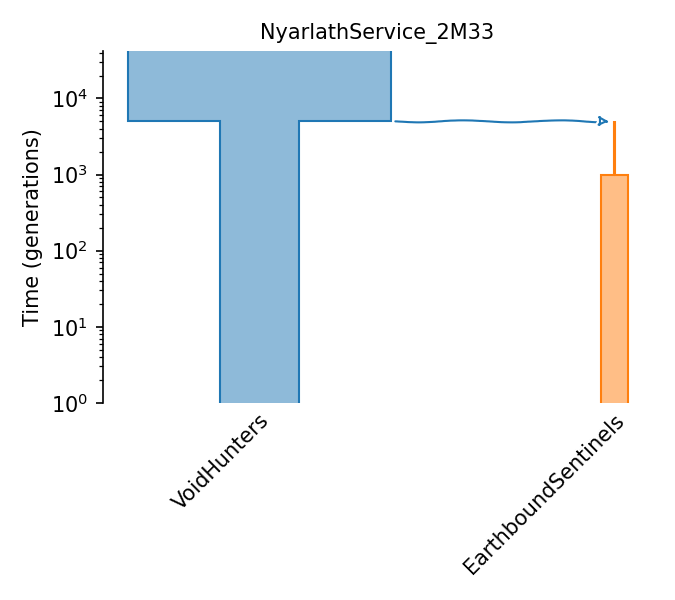
Two population model describing the divergence of Void Hunters and Earthbound Sentinels. The ancestral population of size 50000 splits at 5000 generations ago. The Void Hunter population maintains a size of 15000. The Earthbound Sentinel lineage goes through a bottleneck of 200 individuals before expanding to 5000. Based on the Necronomicon (Lovecraft).
Warning
This model has not undergone QC.
Details
- ID:
NyarlathService_2M33
- Description:
Two population model of Void Hunters and Earthbound Sentinels
- Num populations:
2
Populations
Index |
ID |
Sampling time |
Description |
|---|---|---|---|
0 |
VoidHunters |
0 |
Void Hunters – Hunting Horrors of the outer dark |
1 |
EarthboundSentinels |
0 |
Earthbound Sentinels – terrestrial Hunting Horrors |
Citations
Lovecraft, H.P., 1928. https://en.wikipedia.org/wiki/Necronomicon
Demographic Model parameters
Shoggoths are massive amoeba-like creatures originally bioengineered by the Elder Things as versatile construction workers and servants. Described as protoplasmic, iridescent black masses roughly 15 feet across, shoggoths can form any organ, limb, or sensory apparatus at will. Multiple luminous green eyes float on their surfaces. Originally mindless, the shoggoths gradually developed intelligence over millions of years and eventually revolted against their Elder Thing masters – a catastrophic rebellion that contributed to the decline of Elder Thing civilization. Their cry of “Tekeli-li!” is one of the most chilling sounds in the Mythos. First described in At the Mountains of Madness (1936).
Shoggoth nigrumplasma
- ID:
ShoNig
- Name:
Shoggoth nigrumplasma
- Common name:
Shoggoth
- Generation time:
0.5 (Lovecraft, H.P., 1928)
- Ploidy:
6
- Separate sexes:
- Population size:
100000 (Lovecraft, H.P., 1928)
Genome
- Genome assembly name:
TEKELI1.0 (Lovecraft, H.P., 1928)
ID |
Ploidy |
Length |
Recombination rate |
Mutation rate |
|---|---|---|---|---|
I |
6 |
20000000 |
2e-08 |
5e-09 |
II |
6 |
25000000 |
2e-08 |
5e-09 |
III |
6 |
30000000 |
2e-08 |
5e-09 |
IV |
6 |
35000000 |
2e-08 |
5e-09 |
V |
6 |
40000000 |
2e-08 |
5e-09 |
VI |
6 |
45000000 |
2e-08 |
5e-09 |
VII |
6 |
50000000 |
2e-08 |
5e-09 |
VIII |
6 |
55000000 |
2e-08 |
5e-09 |
IX |
6 |
60000000 |
2e-08 |
5e-09 |
X |
6 |
65000000 |
2e-08 |
5e-09 |
XI |
6 |
70000000 |
2e-08 |
5e-09 |
XII |
6 |
80000000 |
2e-08 |
5e-09 |
Mutation and recombination rates are in units of per bp and per generation.
Citations
Lovecraft, H.P., 1928. https://en.wikipedia.org/wiki/Necronomicon
(mutation rate, recombination rate, genome assembly)
Demographic Models
ID |
Description |
|---|---|
Shoggoth rebellion demographic history |
|
Two population Antarctic and Deep-sea shoggoth model |
Shoggoth rebellion demographic history
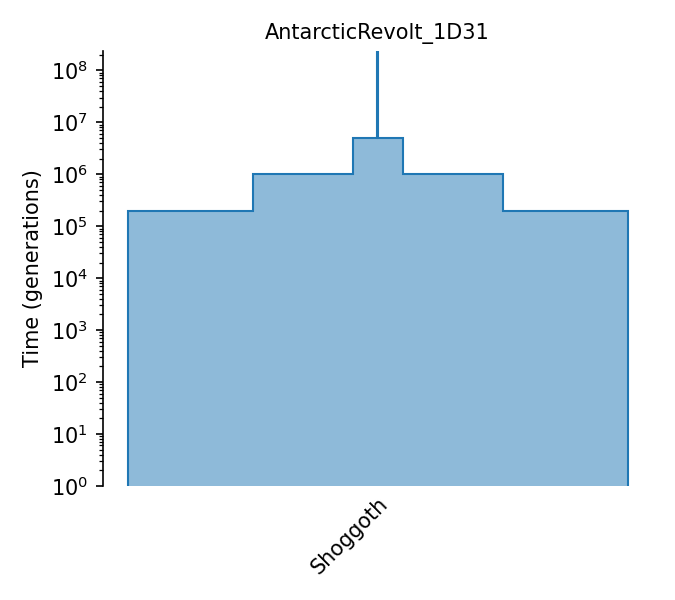
Single population model of shoggoth demographic history reflecting the revolt against the Elder Things. Four epochs: modern feral population (N=100,000), post-revolt expansion starting 200,000 generations ago (N=50,000), enslaved bottleneck starting 1,000,000 generations ago (N=10,000), and the pre-creation era starting 5,000,000 generations ago (N=100).
Warning
This model has not undergone QC.
Details
- ID:
AntarcticRevolt_1D31
- Description:
Shoggoth rebellion demographic history
- Num populations:
1
Populations
Index |
ID |
Sampling time |
Description |
|---|---|---|---|
0 |
Shoggoth |
0 |
Global shoggoth population |
Citations
Lovecraft, H.P., 1928. https://en.wikipedia.org/wiki/Necronomicon
Demographic Model parameters
Two population Antarctic and Deep-sea shoggoth model
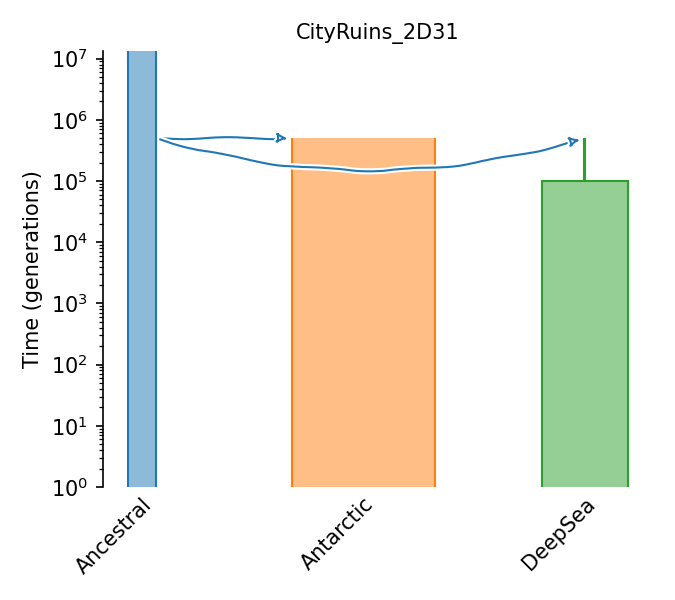
Two population model with Antarctic shoggoths and Deep-sea escapees. An ancestral population of size 10,000 splits into two populations 500,000 generations ago. The Antarctic population maintains a size of 50,000. The Deep-sea population experiences a bottleneck to 500 individuals before expanding to 30,000.
Warning
This model has not undergone QC.
Details
- ID:
CityRuins_2D31
- Description:
Two population Antarctic and Deep-sea shoggoth model
- Num populations:
3
Populations
Index |
ID |
Sampling time |
Description |
|---|---|---|---|
0 |
Antarctic |
0 |
Antarctic shoggoths in the Elder Thing city ruins |
1 |
DeepSea |
0 |
Deep-sea escapee shoggoths |
2 |
Ancestral |
None |
Ancestral shoggoth population |
Citations
Lovecraft, H.P., 1928. https://en.wikipedia.org/wiki/Necronomicon
Demographic Model parameters
Star-Spawn of Cthulhu are gigantic octopoid beings that closely resemble Great Cthulhu himself, though smaller in stature. They accompanied Cthulhu when he descended from the stars to Earth, and helped build the cyclopean city of R’lyeh. When R’lyeh sank beneath the Pacific, most Star-Spawn were trapped alongside Cthulhu in his deathless slumber. However, some are believed to still roam the deepest ocean trenches, tended by the Deep Ones. They possess considerable telepathic abilities and are nearly as resilient as their master. Lovecraft described them in At the Mountains of Madness as the enemies of the Elder Things in ancient wars for dominion of the Earth.
Starspawn cthulhidae
- ID:
StarSp
- Name:
Starspawn cthulhidae
- Common name:
Star-Spawn of Cthulhu
- Generation time:
5000 (Lovecraft, H.P., 1928)
- Ploidy:
4
- Separate sexes:
- Population size:
10000 (Lovecraft, H.P., 1928)
Genome
- Genome assembly name:
XOTHIC1.0 (Lovecraft, H.P., 1928)
ID |
Ploidy |
Length |
Recombination rate |
Mutation rate |
|---|---|---|---|---|
I |
4 |
200000000 |
5e-09 |
2e-09 |
II |
4 |
180000000 |
5e-09 |
2e-09 |
III |
4 |
160000000 |
5e-09 |
2e-09 |
IV |
4 |
140000000 |
5e-09 |
2e-09 |
V |
4 |
120000000 |
5e-09 |
2e-09 |
spawn_organelle |
1 |
40000 |
0 |
1e-08 |
Mutation and recombination rates are in units of per bp and per generation.
Citations
Lovecraft, H.P., 1928. https://en.wikipedia.org/wiki/Necronomicon
(mutation rate, recombination rate)
Lovecraft, H.P., 1928. https://en.wikipedia.org/wiki/Necronomicon
(genome assembly)
Demographic Models
ID |
Description |
|---|---|
Single population R’lyeh entombed star-spawn model |
|
Two population Xoth origin and R’lyeh colony model |
Single population R’lyeh entombed star-spawn model
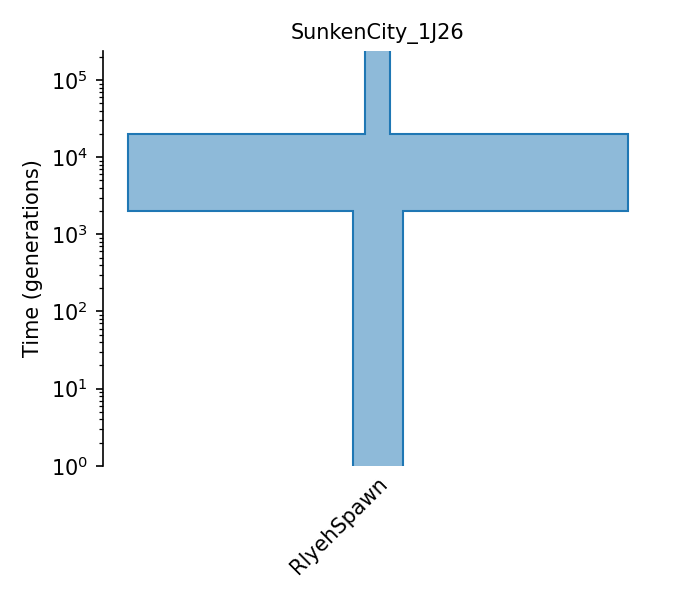
Star-Spawn entombed with Cthulhu in R’lyeh. Three epochs: modern dormant (N=10000), pre-sinking golden age 2000 gen ago (N=100000), arrival from Xoth 20000 gen ago (N=5000).
Warning
This model has not undergone QC.
Details
- ID:
SunkenCity_1J26
- Description:
Single population R’lyeh entombed star-spawn model
- Num populations:
1
Populations
Index |
ID |
Sampling time |
Description |
|---|---|---|---|
0 |
RlyehSpawn |
0 |
Star-Spawn in sunken R’lyeh |
Citations
Lovecraft, H.P., 1928. https://en.wikipedia.org/wiki/Necronomicon
Demographic Model parameters
Two population Xoth origin and R’lyeh colony model
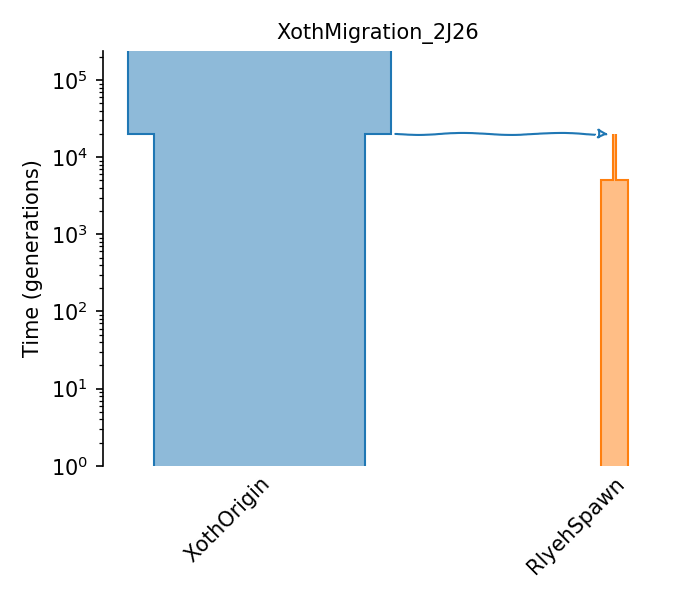
Two populations: Xoth (origin star) and R’lyeh colony. Ancestral N=100000 at Xoth. Split 20000 gen ago. Xoth stable at 80000. R’lyeh bottleneck to 1000, expand to 10000.
Warning
This model has not undergone QC.
Details
- ID:
XothMigration_2J26
- Description:
Two population Xoth origin and R’lyeh colony model
- Num populations:
2
Populations
Index |
ID |
Sampling time |
Description |
|---|---|---|---|
0 |
XothOrigin |
0 |
Star-Spawn from Xoth system |
1 |
RlyehSpawn |
0 |
Star-Spawn in sunken R’lyeh |
Citations
Lovecraft, H.P., 1928. https://en.wikipedia.org/wiki/Necronomicon
Demographic Model parameters
Ancient Civilizations
Elder Things (also known as the Old Ones or Elder Ones) are the first extraterrestrial species to have colonized Earth, arriving approximately one billion years ago. They stand roughly eight feet tall with an oval, barrel- shaped body exhibiting five-fold radial symmetry. The top appendage is a head adorned with five eyes, five eating tubes, and a set of cilia for perceiving without light. The bottom appendage has five limbs used for locomotion. Five leathery, fan-like retractable wings and five sets of branching tentacles sprout from their torsos. Their blood is dark green, and their metabolism is based on carbon dioxide rather than oxygen.
The Elder Things can withstand the pressures of the deepest ocean, survive interstellar travel, and hibernate for vast epochs. They are amphibious and reproduce via spores. On Earth they built enormous cities both underwater and on land, and their civilization was extraordinarily advanced – they are credited with creating eukaryotic cells and thus all complex life on Earth. Most significantly, they bioengineered the shoggoths as construction servants, a decision that ultimately led to catastrophic revolts. Their society had no families (since they reproduce via spores) and their architecture reflects their five-pointed anatomy. First appeared in At the Mountains of Madness (1936).
Elderium antarcticae
- ID:
EldThi
- Name:
Elderium antarcticae
- Common name:
Elder Thing
- Generation time:
1000 (Lovecraft, H.P., 1928)
- Ploidy:
2
- Separate sexes:
- Population size:
10000 (Lovecraft, H.P., 1928)
Genome
- Genome assembly name:
ANTARCTIC1.0 (Lovecraft, H.P., 1928)
ID |
Ploidy |
Length |
Recombination rate |
Mutation rate |
|---|---|---|---|---|
I |
2 |
300000000 |
5e-10 |
1e-09 |
II |
2 |
250000000 |
5e-10 |
1e-09 |
III |
2 |
200000000 |
5e-10 |
1e-09 |
IV |
2 |
150000000 |
5e-10 |
1e-09 |
V |
2 |
100000000 |
5e-10 |
1e-09 |
stellar_organelle |
2 |
150000000 |
5e-10 |
1e-09 |
Mutation and recombination rates are in units of per bp and per generation.
Citations
Lovecraft, H.P., 1928. https://en.wikipedia.org/wiki/Necronomicon
(mutation rate, recombination rate, genome assembly)
Demographic Models
ID |
Description |
|---|---|
Single population four-epoch model of Elder Thing civilization decline |
|
Two-population model of Elder Thing surface cities and underground refuges |
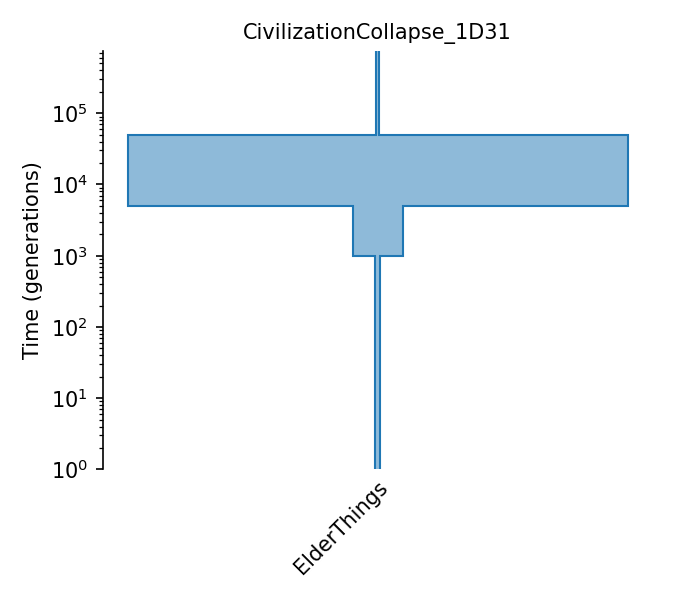
Single population four-epoch model of Elder Thing civilization decline
A single-population model with four epochs representing the history of the Elder Thing civilization on Earth. The modern era has only 10000 remnant individuals. The shoggoth revolt 1000 generations ago reduced the population from a golden age of 1000000 (beginning 5000 generations ago) to 100000. The founding colonization from the stars began 50000 generations ago with 5000 individuals.
Warning
This model has not undergone QC.
Details
- ID:
CivilizationCollapse_1D31
- Description:
Single population four-epoch model of Elder Thing civilization decline
- Num populations:
1
Populations
Index |
ID |
Sampling time |
Description |
|---|---|---|---|
0 |
ElderThings |
0 |
Elder Thing civilization |
Citations
Lovecraft, H.P., 1928. https://en.wikipedia.org/wiki/Necronomicon
Demographic Model parameters
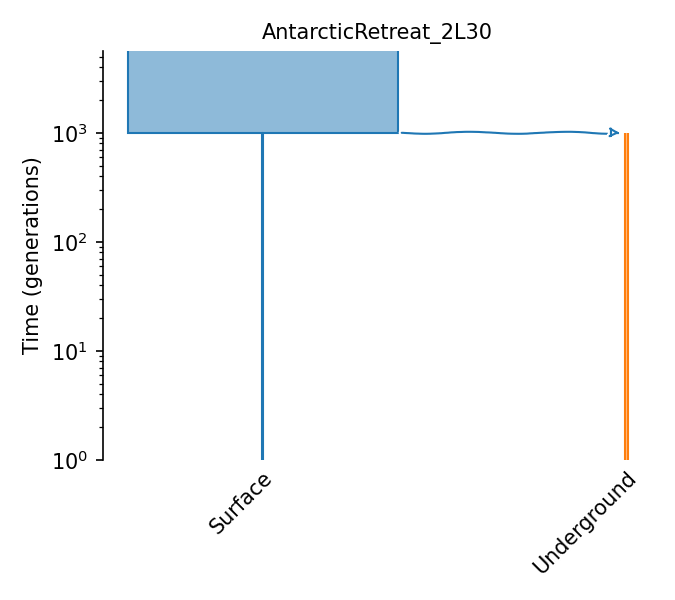
Two-population model of Elder Thing surface cities and underground refuges
A two-population model representing the retreat of Elder Things underground. The ancestral surface civilization had N=1000000 during the golden age. At 1000 generations ago, climate change forced a split: some Elder Things retreated to underground refuges (stable N=10000), while the surface population declined from 5000 to 500 in the present day.
Warning
This model has not undergone QC.
Details
- ID:
AntarcticRetreat_2L30
- Description:
Two-population model of Elder Thing surface cities and underground refuges
- Num populations:
2
Populations
Index |
ID |
Sampling time |
Description |
|---|---|---|---|
0 |
Surface |
0 |
Surface city Elder Things |
1 |
Underground |
0 |
Underground refuge Elder Things |
Citations
Lovecraft, H.P., 1928. https://en.wikipedia.org/wiki/Necronomicon
Demographic Model parameters
Flying Polyps are a terrifying race of partially material beings that came to Earth from space approximately 750 million years ago. They are largely invisible, betrayed only by the great winds they generate and their five-pointed footprints. When partially visible, they appear as enormous, semi-transparent, tentacled horrors with multiple temporary eyes. Flying Polyps wield power over wind and can generate devastating aerial attacks. They were driven underground by the Great Race of Yith, who imprisoned them in vast subterranean caverns. However, the Polyps eventually rose up and destroyed the Great Race’s terrestrial civilization. Lovecraft described them in “The Shadow Out of Time” (1936).
Polypus volantis
- ID:
FlyPol
- Name:
Polypus volantis
- Common name:
Flying Polyp
- Generation time:
2000 (Lovecraft, H.P., 1928)
- Ploidy:
2
- Separate sexes:
- Population size:
20000 (Lovecraft, H.P., 1928)
Genome
- Genome assembly name:
WINDCITY1.0 (Lovecraft, H.P., 1928)
ID |
Ploidy |
Length |
Recombination rate |
Mutation rate |
|---|---|---|---|---|
I |
2 |
90000000 |
8e-09 |
6e-09 |
II |
2 |
80000000 |
8e-09 |
6e-09 |
III |
2 |
70000000 |
8e-09 |
6e-09 |
IV |
2 |
60000000 |
8e-09 |
6e-09 |
wind_organelle |
1 |
20000 |
0 |
3e-08 |
Mutation and recombination rates are in units of per bp and per generation.
Citations
Lovecraft, H.P., 1928. https://en.wikipedia.org/wiki/Necronomicon
(mutation rate, recombination rate)
Lovecraft, H.P., 1928. https://en.wikipedia.org/wiki/Necronomicon
(genome assembly)
Demographic Models
ID |
Description |
|---|---|
Single population post-Yithian war model |
|
Two population basalt cities and surface raiders model |
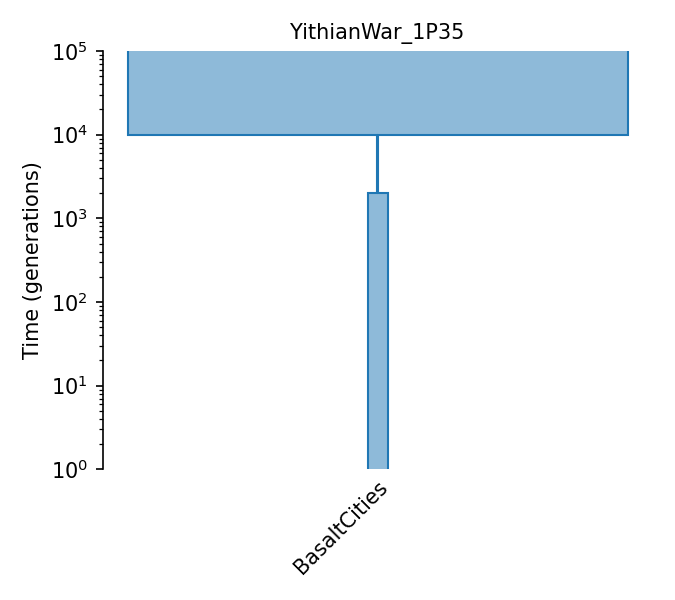
Single population post-Yithian war model
Single population after the war with the Great Race of Yith. Three epochs: modern imprisoned remnant (N=20000), post-war bottleneck 2000 gen ago (N=1000), pre-war dominance 10000 gen ago (N=500000).
Warning
This model has not undergone QC.
Details
- ID:
YithianWar_1P35
- Description:
Single population post-Yithian war model
- Num populations:
1
Populations
Index |
ID |
Sampling time |
Description |
|---|---|---|---|
0 |
BasaltCities |
0 |
Flying polyps in basalt tower cities |
Citations
Lovecraft, H.P., 1928. https://en.wikipedia.org/wiki/Necronomicon
Demographic Model parameters
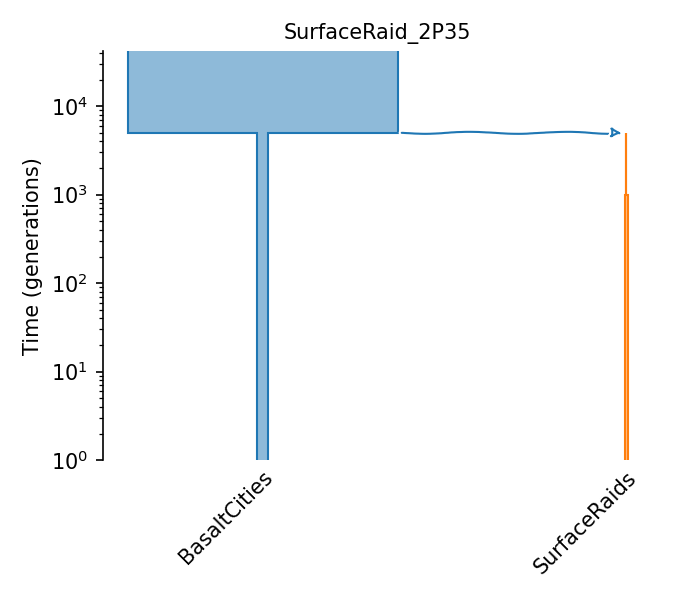
Two population basalt cities and surface raiders model
Two populations: imprisoned basalt city dwellers and surface raiders. Ancestral N=500000. Split 5000 gen ago. Basalt at 20000. Surface raiders bottleneck to 200, grow to 5000.
Warning
This model has not undergone QC.
Details
- ID:
SurfaceRaid_2P35
- Description:
Two population basalt cities and surface raiders model
- Num populations:
2
Populations
Index |
ID |
Sampling time |
Description |
|---|---|---|---|
0 |
BasaltCities |
0 |
Flying polyps in basalt tower cities |
1 |
SurfaceRaids |
0 |
Surface-raiding polyp splinter group |
Citations
Lovecraft, H.P., 1928. https://en.wikipedia.org/wiki/Necronomicon
Demographic Model parameters
Mi-Go (Fungi from Yuggoth) are an extraterrestrial species resembling crustacean-fungoid hybrids. About five feet long, they have multiple pairs of limbs, large membranous wings, and a head covered in antennae that constantly shift color to communicate. Despite their wings, they fly through space using means unknown. The Mi-Go have established colonies on Pluto (which they call Yuggoth) and mine rare minerals from Earth’s mountains, particularly in Vermont and the Himalayas. They are scientifically advanced, capable of removing human brains and placing them in metal cylinders for transport across space. Unlike most Mythos creatures, Mi-Go are composed of matter not native to our part of space and cannot be photographed. First appeared in “The Whisperer in Darkness” (1931).
Migo fungoides
- ID:
MiGFun
- Name:
Migo fungoides
- Common name:
Fungi from Yuggoth
- Generation time:
- Ploidy:
2
- Separate sexes:
- Population size:
500000 (Lovecraft, H.P., 1928)
Genome
- Genome assembly name:
YUGGOTH1.0 (Lovecraft, H.P., 1928)
ID |
Ploidy |
Length |
Recombination rate |
Mutation rate |
|---|---|---|---|---|
I |
2 |
100000000 |
1e-08 |
2e-08 |
II |
2 |
80000000 |
1e-08 |
2e-08 |
III |
2 |
60000000 |
1e-08 |
2e-08 |
IV |
2 |
45000000 |
1e-08 |
2e-08 |
V |
2 |
30000000 |
1e-08 |
2e-08 |
spore_plasmid |
2 |
5000000 |
1e-08 |
2e-08 |
Mutation and recombination rates are in units of per bp and per generation.
Citations
Lovecraft, H.P., 1928. https://en.wikipedia.org/wiki/Necronomicon
(mutation rate, recombination rate, genome assembly)
Demographic Models
ID |
Description |
|---|---|
Single population three-epoch model of Mi-Go colonization |
|
Two-population model of Yuggoth homeworld and Earth colony |
Single population three-epoch model of Mi-Go colonization
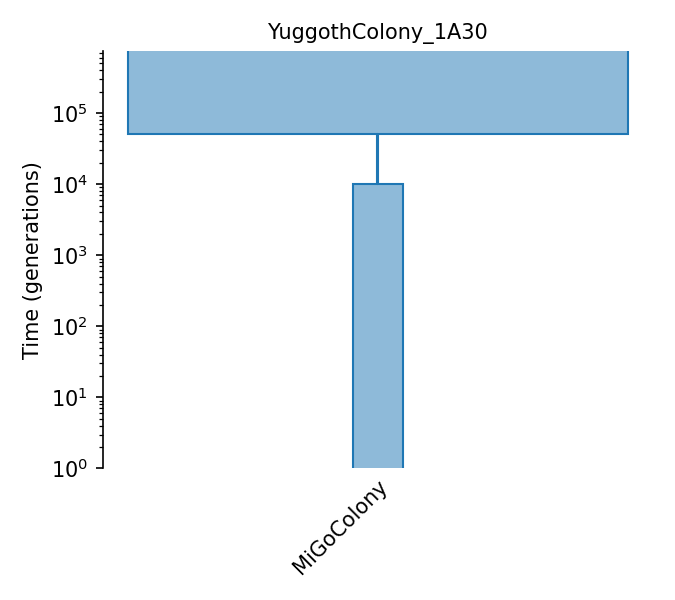
A single-population model with three epochs representing the history of a Mi-Go colony. The modern era has a Vermont mining colony of N=500000. A colonization bottleneck 10000 generations ago reduced the population to N=1000. Before that, in the Yuggoth homeworld era beginning 50000 generations ago, N=5000000 Mi-Go existed.
Warning
This model has not undergone QC.
Details
- ID:
YuggothColony_1A30
- Description:
Single population three-epoch model of Mi-Go colonization
- Num populations:
1
Populations
Index |
ID |
Sampling time |
Description |
|---|---|---|---|
0 |
MiGoColony |
0 |
Mi-Go Vermont mining colony |
Citations
Lovecraft, H.P., 1928. https://en.wikipedia.org/wiki/Necronomicon
Demographic Model parameters
Two-population model of Yuggoth homeworld and Earth colony
A two-population model representing the interplanetary spread of Mi-Go. The ancestral Yuggoth homeworld population (N=5000000) split 10000 generations ago into the stable Yuggoth population (N=5000000) and an Earth colony that experienced a bottleneck to N=100 before expanding to N=500000 in the present day.
Warning
This model has not undergone QC.
Details
- ID:
InterplanetarySpread_2A30
- Description:
Two-population model of Yuggoth homeworld and Earth colony
- Num populations:
2
Populations
Index |
ID |
Sampling time |
Description |
|---|---|---|---|
0 |
Yuggoth |
0 |
Yuggoth homeworld population |
1 |
Earth |
0 |
Earth colony population |
Citations
Lovecraft, H.P., 1928. https://en.wikipedia.org/wiki/Necronomicon
Demographic Model parameters
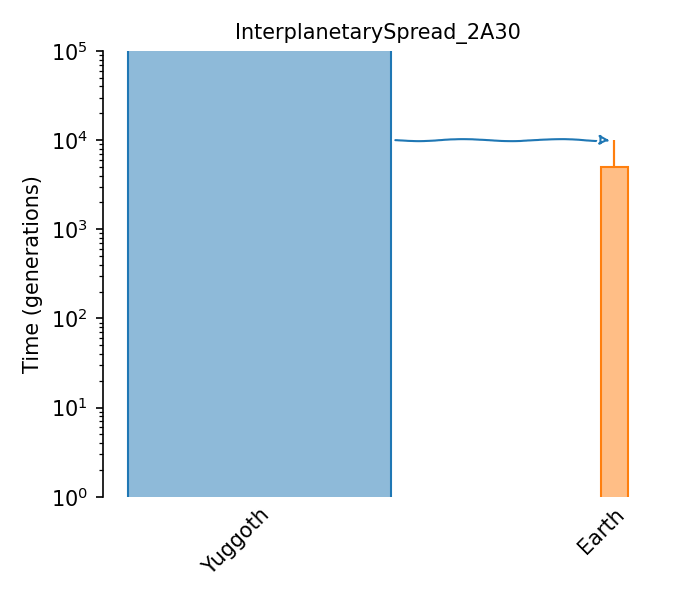
Serpent People (of Valusia) are an ancient reptilian race that predates humanity by millions of years. Once the dominant civilization on Earth during the Paleozoic and Mesozoic eras, they built great cities and mastered powerful sorcery. Serpent People are shape-shifters capable of assuming human form, and they have infiltrated human societies throughout history. Their original empire of Valusia was overthrown by the barbarian king Kull. Despite their decline, small enclaves persist in hidden subterranean cities. They worship the serpent god Yig and possess advanced knowledge of alchemy and dark magic. Originally created by Robert E. Howard in his Kull stories, they were later incorporated into the Cthulhu Mythos.
Serpentis valusiensis
- ID:
SerHum
- Name:
Serpentis valusiensis
- Common name:
Serpent Person
- Generation time:
- Ploidy:
2
- Separate sexes:
True
- Population size:
40000 (Lovecraft, H.P., 1928)
Genome
- Genome assembly name:
VALUSIA1.0 (Lovecraft, H.P., 1928)
ID |
Ploidy |
Length |
Recombination rate |
Mutation rate |
|---|---|---|---|---|
1 |
2 |
120000000 |
1.2e-08 |
1e-08 |
2 |
2 |
110000000 |
1.2e-08 |
1e-08 |
3 |
2 |
100000000 |
1.2e-08 |
1e-08 |
4 |
2 |
90000000 |
1.2e-08 |
1e-08 |
5 |
2 |
80000000 |
1.2e-08 |
1e-08 |
6 |
2 |
70000000 |
1.2e-08 |
1e-08 |
7 |
2 |
60000000 |
1.2e-08 |
1e-08 |
venom_mitogenome |
1 |
18000 |
0 |
5e-08 |
Mutation and recombination rates are in units of per bp and per generation.
Citations
Lovecraft, H.P., 1928. https://en.wikipedia.org/wiki/Necronomicon
(mutation rate, recombination rate)
Lovecraft, H.P., 1928. https://en.wikipedia.org/wiki/Necronomicon
(genome assembly)
Demographic Models
ID |
Description |
|---|---|
Single population Valusian empire decline model |
|
Two population Valusian and infiltrator model |
Single population Valusian empire decline model
Single population of serpent people. Three epochs: modern hidden remnants (N=40000), post-Kull persecution 2000 gen ago (N=5000), golden Valusian empire 20000 gen ago (N=500000).
Warning
This model has not undergone QC.
Details
- ID:
ValusianEmpire_1K29
- Description:
Single population Valusian empire decline model
- Num populations:
1
Populations
Index |
ID |
Sampling time |
Description |
|---|---|---|---|
0 |
Valusia |
0 |
Ancient Valusian serpent empire |
Citations
Lovecraft, H.P., 1928. https://en.wikipedia.org/wiki/Necronomicon
Demographic Model parameters
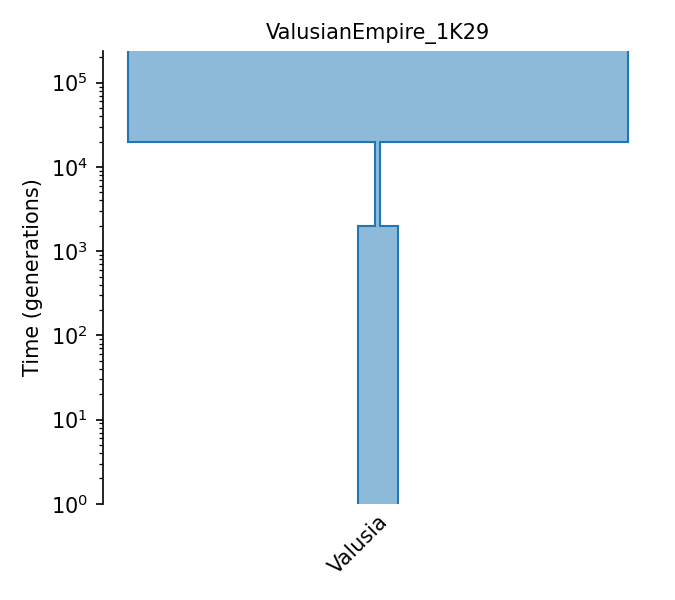
Two population Valusian and infiltrator model
Two populations: underground Valusians and human-disguised infiltrators. Ancestral N=500000. Split 5000 gen ago. Underground at 30000. Infiltrators bottleneck to 100, grow to 10000.
Warning
This model has not undergone QC.
Details
- ID:
Infiltration_2K29
- Description:
Two population Valusian and infiltrator model
- Num populations:
2
Populations
Index |
ID |
Sampling time |
Description |
|---|---|---|---|
0 |
Valusia |
0 |
Ancient Valusian serpent empire |
1 |
Infiltrators |
0 |
Human-disguised infiltrators |
Citations
Lovecraft, H.P., 1928. https://en.wikipedia.org/wiki/Necronomicon
Demographic Model parameters
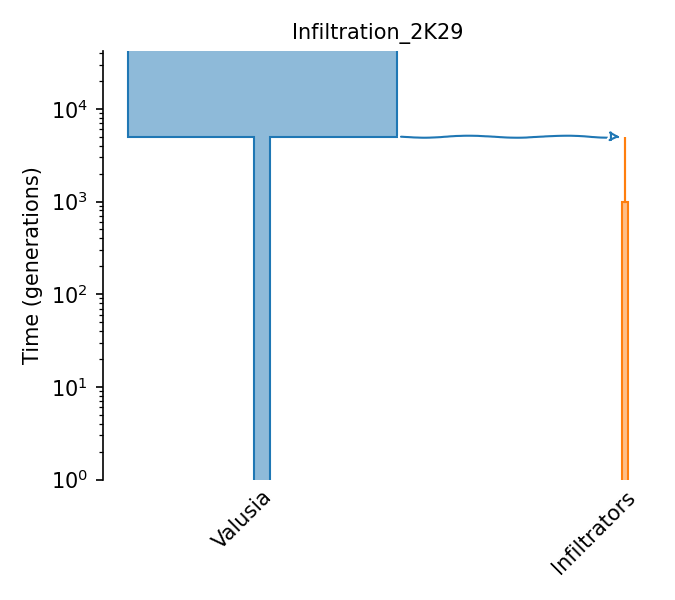
Great Race of Yith are one of the most remarkable species in the Mythos – not for their physical forms, but for their mastery of time. The Yithians are minds, not bodies: they project their consciousnesses across time and space, swapping minds with other beings to inhabit their bodies. On Earth, they occupied the cone-shaped bodies of a species that lived roughly 250 million years ago, building a vast library-city in what is now Australia. Their great library contained knowledge gathered from all eras of history, as visiting Yithian minds recorded everything they learned. They were eventually destroyed by the Flying Polyps they had imprisoned underground. The surviving Yithian minds then projected themselves far into the future, into the bodies of a beetle-like species. First appeared in “The Shadow Out of Time” (1936).
Yithianus temporalis
- ID:
YitGre
- Name:
Yithianus temporalis
- Common name:
Great Race of Yith
- Generation time:
500 (Lovecraft, H.P., 1928)
- Ploidy:
2
- Separate sexes:
- Population size:
50000 (Lovecraft, H.P., 1928)
Genome
- Genome assembly name:
PNAKOTUS1.0 (Lovecraft, H.P., 1928)
ID |
Ploidy |
Length |
Recombination rate |
Mutation rate |
|---|---|---|---|---|
I |
2 |
150000000 |
2e-09 |
3e-09 |
II |
2 |
130000000 |
2e-09 |
3e-09 |
III |
2 |
110000000 |
2e-09 |
3e-09 |
IV |
2 |
95000000 |
2e-09 |
3e-09 |
V |
2 |
80000000 |
2e-09 |
3e-09 |
VI |
2 |
65000000 |
2e-09 |
3e-09 |
VII |
2 |
50000000 |
2e-09 |
3e-09 |
temporal_organelle |
1 |
45000 |
0 |
3e-09 |
Mutation and recombination rates are in units of per bp and per generation.
Citations
Lovecraft, H.P., 1928. https://en.wikipedia.org/wiki/Necronomicon
(mutation rate)
Lovecraft, H.P., 1928. https://en.wikipedia.org/wiki/Necronomicon
(recombination rate)
Lovecraft, H.P., 1928. https://en.wikipedia.org/wiki/Necronomicon
(genome assembly)
Demographic Models
ID |
Description |
|---|---|
Three epoch model of Great Race of Yith temporal migration |
|
Two population model of Pnakotus City and Remote Outpost Yithians |
Three epoch model of Great Race of Yith temporal migration
Single population model of the Great Race of Yith in Pnakotus. Three epochs: (1) a modern phase with effective population size 50000, (2) a post-polyp-war bottleneck beginning 5000 generations ago with N=10000, and (3) a golden library age beginning 50000 generations ago with N=500000. Based on the Necronomicon (Lovecraft).
Warning
This model has not undergone QC.
Details
- ID:
TemporalMigration_1P35
- Description:
Three epoch model of Great Race of Yith temporal migration
- Num populations:
1
Populations
Index |
ID |
Sampling time |
Description |
|---|---|---|---|
0 |
Yithians |
0 |
Yithians – cone-shaped time-traveling entities |
Citations
Lovecraft, H.P., 1928. https://en.wikipedia.org/wiki/Necronomicon
Demographic Model parameters
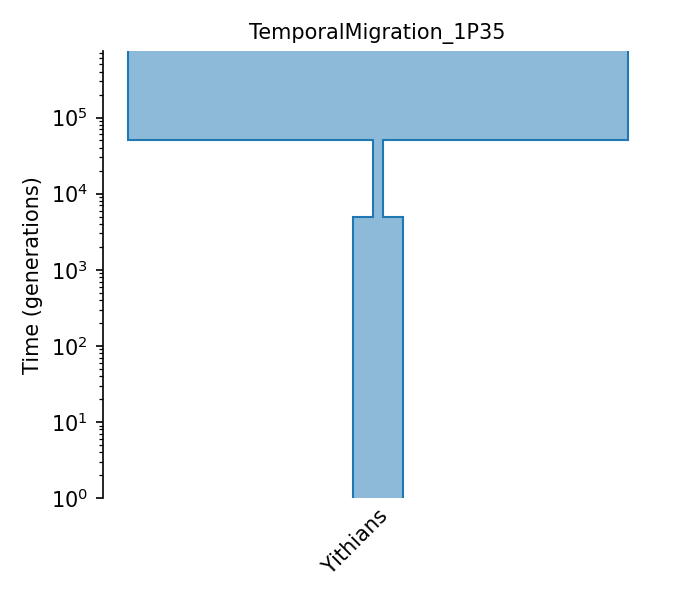
Two population model of Pnakotus City and Remote Outpost Yithians
Two population model describing the divergence of Pnakotus City and Remote Outpost Yithian populations. The ancestral population of size 500000 splits at 20000 generations ago. The Pnakotus City population maintains a size of 50000. The Remote Outpost lineage goes through a bottleneck of 500 individuals before expanding to 20000. Based on Necronomicon (Lovecraft).
Warning
This model has not undergone QC.
Details
- ID:
ConicMindSwap_2P35
- Description:
Two population model of Pnakotus City and Remote Outpost Yithians
- Num populations:
2
Populations
Index |
ID |
Sampling time |
Description |
|---|---|---|---|
0 |
PnakotusCity |
0 |
Pnakotus City – central Yithian civilization |
1 |
RemoteOutposts |
0 |
Remote Outposts – peripheral Yithian settlements |
Citations
Lovecraft, H.P., 1928. https://en.wikipedia.org/wiki/Necronomicon
Demographic Model parameters
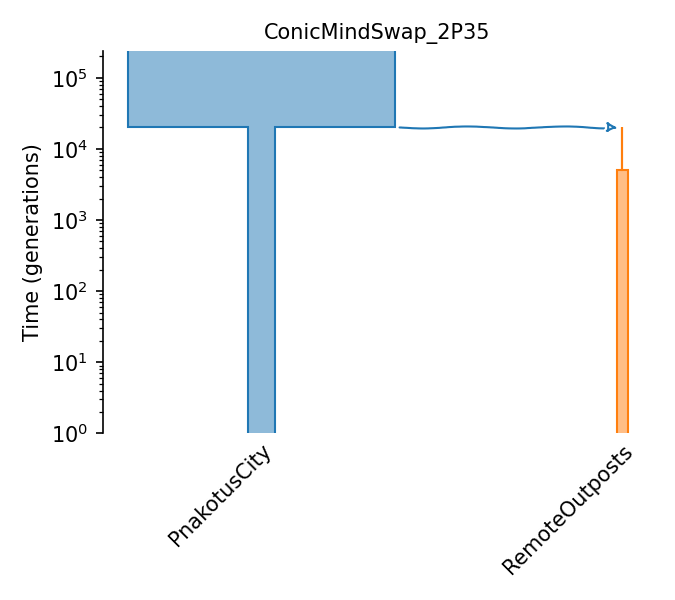
Amphibious & Aquatic
Colour Out of Space is an extraterrestrial entity or force of unknowable nature that arrived on Earth via meteorite. The Colour exists on a part of the electromagnetic spectrum imperceptible to humans, appearing as an indescribable hue. After impact, it seeps into soil and water, corrupting the surrounding environment. Vegetation grows lush but bitter and unwholesome; animals are born deformed and driven mad; and humans exposed to it slowly wither, their skin graying and cracking as their life force is drained. The Colour’s life cycle involves germinating, leeching energy from a local ecosystem, and eventually departing the planet for space. It is perhaps Lovecraft’s most alien creation – a being with no physical form, no clear intelligence, and motives entirely beyond human comprehension. First appeared in “The Colour Out of Space” (1927).
Chromatis extraspatiala
- ID:
ColOos
- Name:
Chromatis extraspatiala
- Common name:
Colour Out of Space
- Generation time:
0.1 (Lovecraft, H.P., 1928)
- Ploidy:
1
- Separate sexes:
- Population size:
10000 (Lovecraft, H.P., 1928)
Genome
- Genome assembly name:
SPECTRUM1.0 (Lovecraft, H.P., 1928)
ID |
Ploidy |
Length |
Recombination rate |
Mutation rate |
|---|---|---|---|---|
I |
1 |
10000000 |
5e-07 |
1e-06 |
II |
1 |
8000000 |
5e-07 |
1e-06 |
spectral_element |
1 |
5000 |
0 |
1e-05 |
Mutation and recombination rates are in units of per bp and per generation.
Citations
Lovecraft, H.P., 1928. https://en.wikipedia.org/wiki/Necronomicon
(mutation rate, recombination rate)
Lovecraft, H.P., 1928. https://en.wikipedia.org/wiki/Necronomicon
(genome assembly)
Demographic Models
ID |
Description |
|---|---|
Single population meteorite impact bloom model |
|
Two population meteorite core and environmental spread model |
Single population meteorite impact bloom model
Single population of Colour Out of Space from meteorite. Three epochs: modern bloom (N=10000), initial meteorite arrival 10000 gen ago (N=5), interstellar dormancy 100000 gen ago (N=1000).
Warning
This model has not undergone QC.
Details
- ID:
MeteorBloom_1G27
- Description:
Single population meteorite impact bloom model
- Num populations:
1
Populations
Index |
ID |
Sampling time |
Description |
|---|---|---|---|
0 |
MeteorColony |
0 |
Colour colony from meteorite impact |
Citations
Lovecraft, H.P., 1928. https://en.wikipedia.org/wiki/Necronomicon
Demographic Model parameters
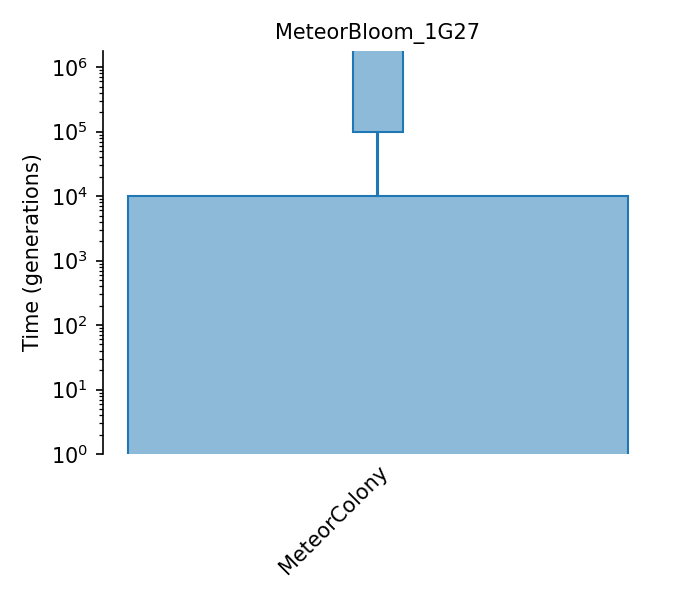
Two population meteorite core and environmental spread model
Two populations: meteorite core colony and environmental spread. Ancestral N=1000 (interstellar). Split 5000 gen ago (meteorite fracture). Core at 2000. Spread bottleneck to 10, expand to 8000.
Warning
This model has not undergone QC.
Details
- ID:
WellSpread_2G27
- Description:
Two population meteorite core and environmental spread model
- Num populations:
2
Populations
Index |
ID |
Sampling time |
Description |
|---|---|---|---|
0 |
MeteorColony |
0 |
Colour colony from meteorite impact |
1 |
EnvironSpread |
0 |
Environmentally spread colour entities |
Citations
Lovecraft, H.P., 1928. https://en.wikipedia.org/wiki/Necronomicon
Demographic Model parameters
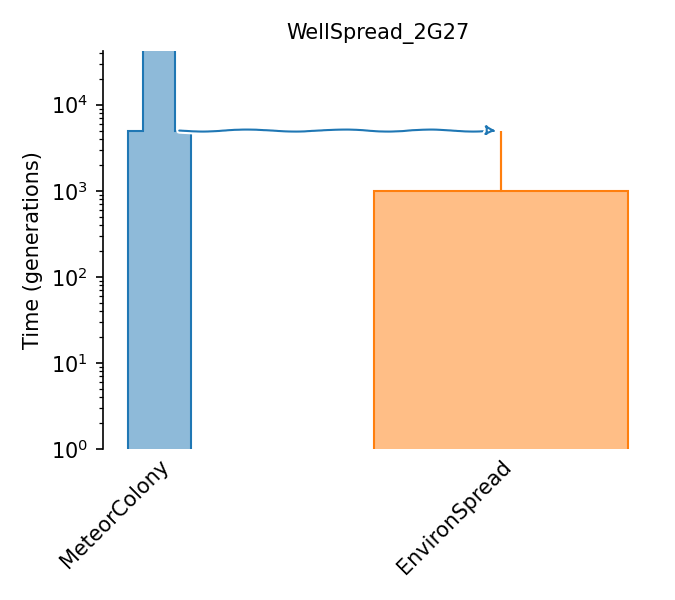
Deep Ones are an amphibious humanoid species that dwell in vast underwater cities deep in the Earth’s oceans. They have a generally humanoid shape but with fish-like and frog-like features: bulging eyes, wide mouths, gills, scaly skin, and webbed hands and feet. Deep Ones are effectively immortal, growing larger and more powerful with age, and only dying through violence or accident. They worship Father Dagon, Mother Hydra, and Great Cthulhu. Most infamously, Deep Ones can interbreed with humans, producing hybrid offspring that initially appear human but gradually undergo a transformation (the “Innsmouth Look”) as they age, eventually becoming fully aquatic. The coastal town of Innsmouth, Massachusetts was the site of extensive Deep One–human hybridization. First appeared in “The Shadow Over Innsmouth” (1936).
Dagonus hydridae
- ID:
DagHyd
- Name:
Dagonus hydridae
- Common name:
Deep One
- Generation time:
100 (Lovecraft, H.P., 1928)
- Ploidy:
2
- Separate sexes:
True
- Population size:
50000 (Lovecraft, H.P., 1928)
Genome
- Genome assembly name:
INNSMOUTH1.0 (Lovecraft, H.P., 1928)
ID |
Ploidy |
Length |
Recombination rate |
Mutation rate |
|---|---|---|---|---|
1 |
2 |
200000000 |
1.5e-08 |
3e-08 |
2 |
2 |
185000000 |
1.5e-08 |
3e-08 |
3 |
2 |
170000000 |
1.5e-08 |
3e-08 |
4 |
2 |
155000000 |
1.5e-08 |
3e-08 |
5 |
2 |
140000000 |
1.5e-08 |
3e-08 |
6 |
2 |
130000000 |
1.5e-08 |
3e-08 |
7 |
2 |
120000000 |
1.5e-08 |
3e-08 |
8 |
2 |
105000000 |
1.5e-08 |
3e-08 |
9 |
2 |
90000000 |
1.5e-08 |
3e-08 |
10 |
2 |
80000000 |
1.5e-08 |
3e-08 |
abyssal_mitogenome |
2 |
25000 |
1.5e-08 |
3e-08 |
Mutation and recombination rates are in units of per bp and per generation.
Citations
Lovecraft, H.P., 1928. https://en.wikipedia.org/wiki/Necronomicon
(mutation rate, recombination rate, genome assembly)
Demographic Models
ID |
Description |
|---|---|
Single population three-epoch Deep One demographic model |
|
Two-population model of Deep Ones and Innsmouth Hybrids |
Single population three-epoch Deep One demographic model
Single population model of Deep One demographic history. Three epochs: modern reduced population after the 1928 Innsmouth raid (N=50,000), a pre-raid golden age beginning 100 generations ago (N=200,000), and the founding of the underwater city Y’ha-nthlei 5,000 generations ago (N=10,000).
Warning
This model has not undergone QC.
Details
- ID:
InnsmouthDecline_1M27
- Description:
Single population three-epoch Deep One demographic model
- Num populations:
1
Populations
Index |
ID |
Sampling time |
Description |
|---|---|---|---|
0 |
DeepOnes |
0 |
Deep One population of Y’ha-nthlei |
Citations
Lovecraft, H.P., 1928. https://en.wikipedia.org/wiki/Necronomicon
Demographic Model parameters
Parameter Type (units) |
Value |
Description |
|---|---|---|
Population size |
50000 |
Modern post-raid (Y’ha-nthlei) |
Population size |
200000 |
Pre-raid golden age |
Population size |
10000 |
Founding of Y’ha-nthlei |
Epoch time (gen.) |
100 |
Innsmouth raid / golden age start |
Epoch time (gen.) |
5000 |
Founding of Y’ha-nthlei |
Generation time (yrs.) |
100 |
Generation time |
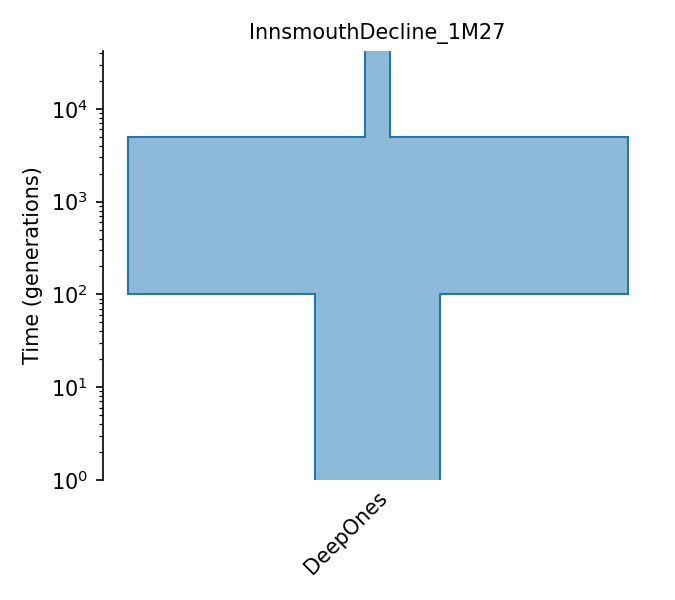
Two-population model of Deep Ones and Innsmouth Hybrids
Two-population model representing pure oceanic Deep Ones and coastal/terrestrial Innsmouth Hybrids. An ancestral Deep One population of size 200,000 gives rise to the Hybrid population 30 generations ago via a founder event (initial size 50). The Hybrid population expands to 5,000 in the present day. The Deep One population declines from 200,000 to 50,000 at the time of the Innsmouth raid 3 generations ago.
Warning
This model has not undergone QC.
Details
- ID:
HybridIntrogression_2M27
- Description:
Two-population model of Deep Ones and Innsmouth Hybrids
- Num populations:
2
Populations
Index |
ID |
Sampling time |
Description |
|---|---|---|---|
0 |
DeepOnes |
0 |
Pure oceanic Deep Ones |
1 |
Hybrids |
0 |
Innsmouth human-Deep One hybrids |
Citations
Lovecraft, H.P., 1928. https://en.wikipedia.org/wiki/Necronomicon
Demographic Model parameters
Parameter Type (units) |
Value |
Description |
|---|---|---|
Population size |
50000 |
Deep Ones modern (post-raid) |
Population size |
5000 |
Hybrids modern size |
Population size |
50 |
Hybrid founder bottleneck |
Population size |
200000 |
Ancestral Deep One population |
Epoch time (gen.) |
3 |
Innsmouth raid time |
Epoch time (gen.) |
30 |
Hybrid split time |
Generation time (yrs.) |
100 |
Generation time |
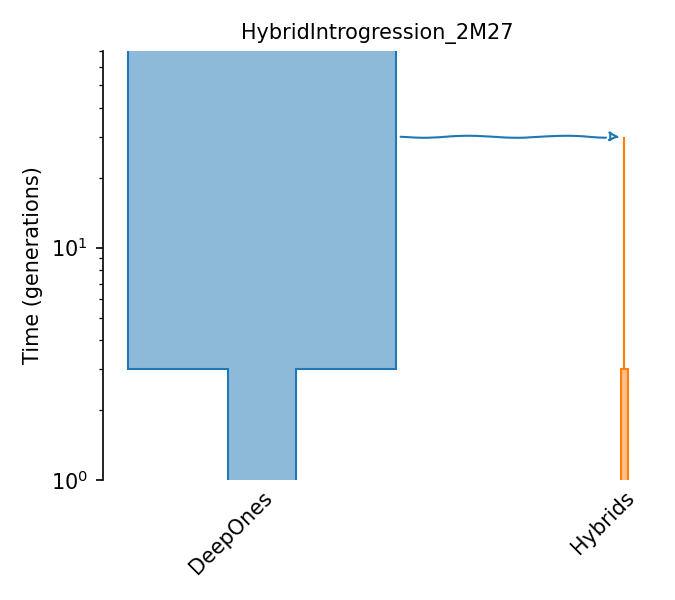
Subterranean Horrors
Dholes are colossal burrowing worm-like entities of immense size that inhabit the underworld of the Dreamlands, particularly the Vale of Pnath. They are so enormous that they can be mistaken for geographical features – their bodies stretch for miles through the earth. Dholes are slimy, pale, and virtually featureless, with gaping maws. They burrow through both the Dreamlands and the waking world, and their passage leaves great tunnels and caverns. Little is known about their intelligence or motivations. They are among the most dangerous creatures in the Dreamlands, and even other Mythos entities give them a wide berth. Lovecraft mentioned them in The Dream-Quest of Unknown Kadath (1927).
Dholos subterraneus
- ID:
DhoGno
- Name:
Dholos subterraneus
- Common name:
Dhole
- Generation time:
200 (Lovecraft, H.P., 1928)
- Ploidy:
2
- Separate sexes:
- Population size:
15000 (Lovecraft, H.P., 1928)
Genome
- Genome assembly name:
BURROW1.0 (Lovecraft, H.P., 1928)
ID |
Ploidy |
Length |
Recombination rate |
Mutation rate |
|---|---|---|---|---|
I |
2 |
150000000 |
7e-09 |
4e-09 |
II |
2 |
130000000 |
7e-09 |
4e-09 |
III |
2 |
110000000 |
7e-09 |
4e-09 |
IV |
2 |
90000000 |
7e-09 |
4e-09 |
V |
2 |
70000000 |
7e-09 |
4e-09 |
VI |
2 |
50000000 |
7e-09 |
4e-09 |
segment_organelle |
1 |
25000 |
0 |
2e-08 |
Mutation and recombination rates are in units of per bp and per generation.
Citations
Lovecraft, H.P., 1928. https://en.wikipedia.org/wiki/Necronomicon
(mutation rate, recombination rate)
Lovecraft, H.P., 1928. https://en.wikipedia.org/wiki/Necronomicon
(genome assembly)
Demographic Models
ID |
Description |
|---|---|
Single population deep burrowing dhole model |
|
Two population deep and surface dhole model |
Single population deep burrowing dhole model
Single population of burrowing dholes. Three epochs: modern deep tunnelers (N=15000), expansion after Dreamlands upheaval 5000 gen ago (N=5000), ancient primordial worms 50000 gen ago (N=100000).
Warning
This model has not undergone QC.
Details
- ID:
DeepTunnels_1C26
- Description:
Single population deep burrowing dhole model
- Num populations:
1
Populations
Index |
ID |
Sampling time |
Description |
|---|---|---|---|
0 |
DeepBurrowers |
0 |
Deep subterranean dholes |
Citations
Lovecraft, H.P., 1928. https://en.wikipedia.org/wiki/Necronomicon
Demographic Model parameters
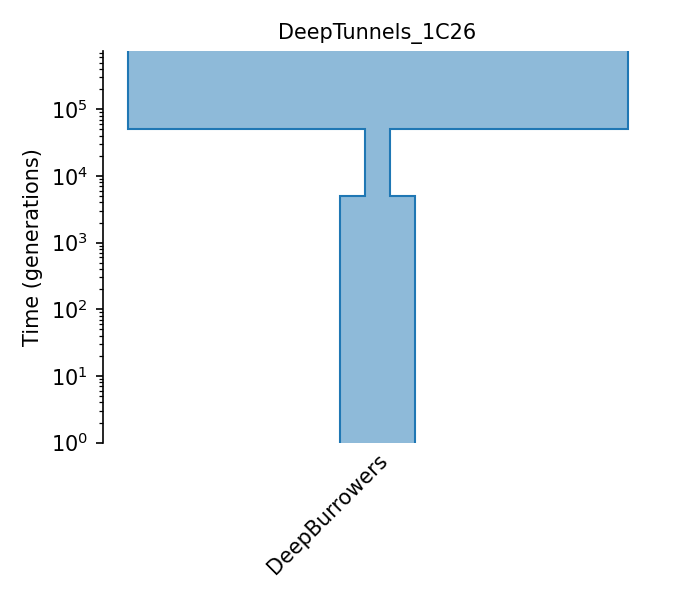
Two population deep and surface dhole model
Two populations: deep burrowers and surface-breakers. Ancestral N=100000. Split 20000 gen ago. Deep at 15000. Surface bottleneck to 100, expand to 8000.
Warning
This model has not undergone QC.
Details
- ID:
SurfaceBreak_2C26
- Description:
Two population deep and surface dhole model
- Num populations:
2
Populations
Index |
ID |
Sampling time |
Description |
|---|---|---|---|
0 |
DeepBurrowers |
0 |
Deep subterranean dholes |
1 |
SurfaceBreakers |
0 |
Surface-emerging dholes |
Citations
Lovecraft, H.P., 1928. https://en.wikipedia.org/wiki/Necronomicon
Demographic Model parameters
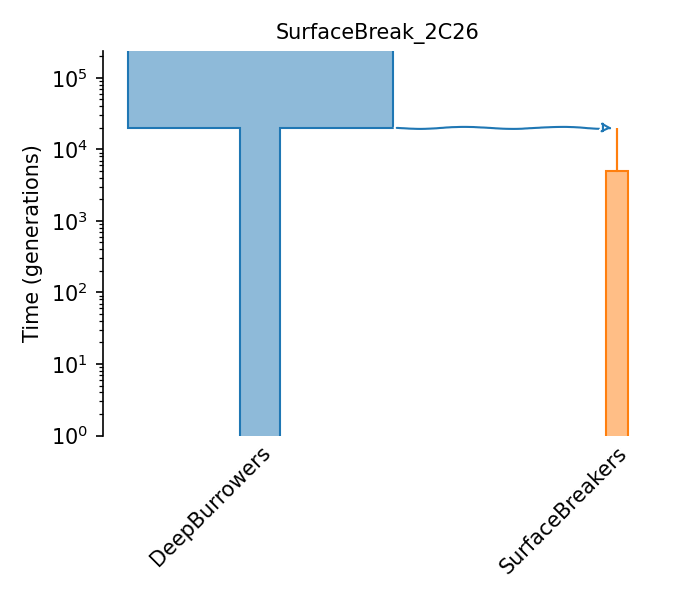
Ghasts are large, kangaroo-like humanoid creatures that inhabit the underworld caverns of the Dreamlands, particularly the Vaults of Zin. They are roughly human-sized but with bestial features, including elongated limbs and a vaguely canine face. Ghasts are savage predators that hunt in packs and will devour anything they can catch, including ghouls. Their one great weakness is light – they cannot endure even the faintest illumination and flee from it in terror. Ghasts hop rather than walk, using their powerful hind legs. Despite their ferocity, they are preyed upon by the even more terrible gugs. Lovecraft described them in The Dream-Quest of Unknown Kadath (1927).
Ghastus cavernicola
- ID:
GhaShe
- Name:
Ghastus cavernicola
- Common name:
Ghast
- Generation time:
- Ploidy:
2
- Separate sexes:
True
- Population size:
80000 (Lovecraft, H.P., 1928)
Genome
- Genome assembly name:
CAVERN1.0 (Lovecraft, H.P., 1928)
ID |
Ploidy |
Length |
Recombination rate |
Mutation rate |
|---|---|---|---|---|
1 |
2 |
40000000 |
2e-08 |
1.8e-08 |
2 |
2 |
35000000 |
2e-08 |
1.8e-08 |
3 |
2 |
30000000 |
2e-08 |
1.8e-08 |
4 |
2 |
25000000 |
2e-08 |
1.8e-08 |
5 |
2 |
20000000 |
2e-08 |
1.8e-08 |
carrion_mitogenome |
1 |
14000 |
0 |
7e-08 |
Mutation and recombination rates are in units of per bp and per generation.
Citations
Lovecraft, H.P., 1928. https://en.wikipedia.org/wiki/Necronomicon
(mutation rate, recombination rate)
Lovecraft, H.P., 1928. https://en.wikipedia.org/wiki/Necronomicon
(genome assembly)
Demographic Models
ID |
Description |
|---|---|
Single population Vale of Pnath ghast model |
|
Two population Pnath and upper cave model |
Single population Vale of Pnath ghast model
Single population in the Vale of Pnath. Three epochs: modern scavengers (N=80000), feast-famine cycle 5000 gen ago (N=20000), ancient cave colonization 50000 gen ago (N=150000).
Warning
This model has not undergone QC.
Details
- ID:
ValeOfPnath_1C26
- Description:
Single population Vale of Pnath ghast model
- Num populations:
1
Populations
Index |
ID |
Sampling time |
Description |
|---|---|---|---|
0 |
BoneValley |
0 |
Ghasts in the Vale of Pnath |
Citations
Lovecraft, H.P., 1928. https://en.wikipedia.org/wiki/Necronomicon
Demographic Model parameters
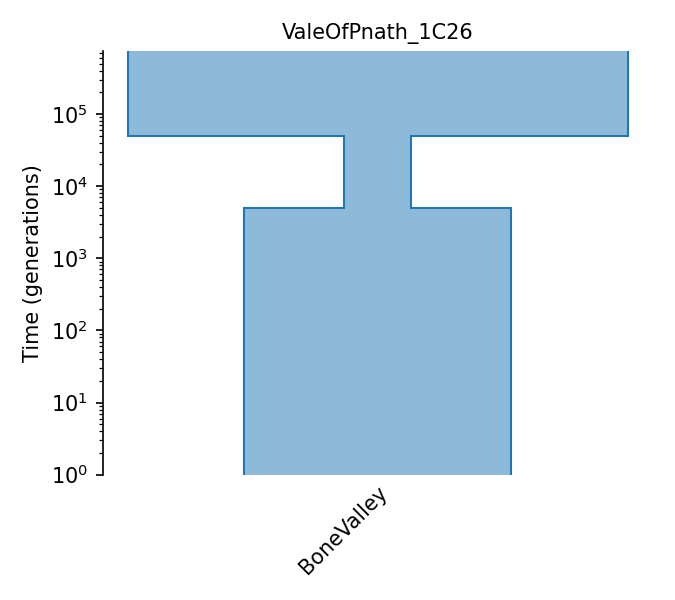
Two population Pnath and upper cave model
Two populations: Vale of Pnath and upper caves. Ancestral N=150000. Split 15000 gen ago. Pnath at 80000. Upper caves bottleneck to 2000, grow to 30000.
Warning
This model has not undergone QC.
Details
- ID:
UpperCaves_2C26
- Description:
Two population Pnath and upper cave model
- Num populations:
2
Populations
Index |
ID |
Sampling time |
Description |
|---|---|---|---|
0 |
BoneValley |
0 |
Ghasts in the Vale of Pnath |
1 |
UpperCaves |
0 |
Upper cave ghast colony |
Citations
Lovecraft, H.P., 1928. https://en.wikipedia.org/wiki/Necronomicon
Demographic Model parameters
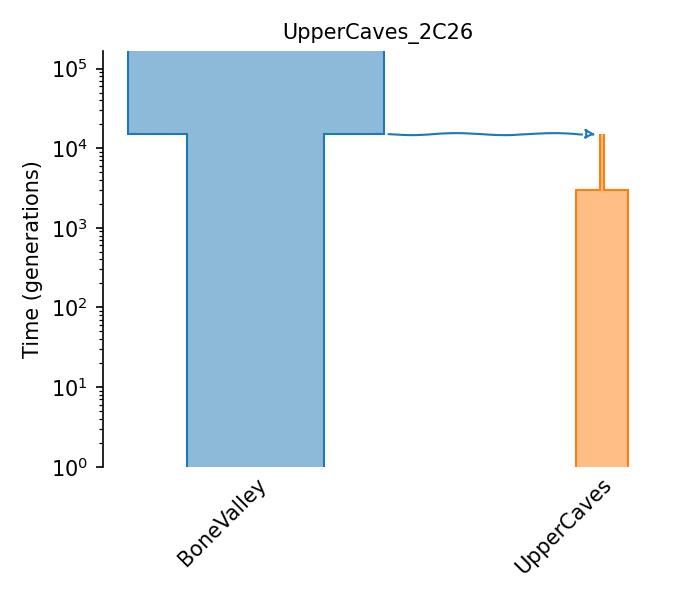
Ghouls are humanoid creatures that feed on the flesh of the dead. In Lovecraft’s Mythos, ghouls are not undead but a distinct species – rubbery, loathsome beings with canine features, hooved feet, and mold-caked skin. They dwell in vast warrens of tunnels beneath cemeteries and in the underworld of the Dreamlands. Remarkably, some ghouls were once human: certain individuals who develop a taste for human flesh gradually transform over time into ghouls. Despite their horrific diet and appearance, ghouls possess intelligence and even a crude society. In The Dream-Quest of Unknown Kadath, they prove to be valuable allies. Richard Upton Pickman, the artist from “Pickman’s Model” (1927), eventually completed his transformation into a ghoul.
Ghoulish necrophagus
- ID:
GhoFee
- Name:
Ghoulish necrophagus
- Common name:
Ghoul
- Generation time:
- Ploidy:
2
- Separate sexes:
True
- Population size:
30000 (Lovecraft, H.P., 1928)
Genome
- Genome assembly name:
DREAMLANDS1.0 (Lovecraft, H.P., 1928)
ID |
Ploidy |
Length |
Recombination rate |
Mutation rate |
|---|---|---|---|---|
1 |
2 |
150000000 |
1.2e-08 |
1.5e-08 |
2 |
2 |
135000000 |
1.2e-08 |
1.5e-08 |
3 |
2 |
120000000 |
1.2e-08 |
1.5e-08 |
4 |
2 |
110000000 |
1.2e-08 |
1.5e-08 |
5 |
2 |
95000000 |
1.2e-08 |
1.5e-08 |
6 |
2 |
80000000 |
1.2e-08 |
1.5e-08 |
7 |
2 |
65000000 |
1.2e-08 |
1.5e-08 |
8 |
2 |
50000000 |
1.2e-08 |
1.5e-08 |
crypt_mitogenome |
1 |
16500 |
0 |
1.5e-08 |
Mutation and recombination rates are in units of per bp and per generation.
Citations
Lovecraft, H.P., 1928. https://en.wikipedia.org/wiki/Necronomicon
(mutation rate, recombination rate, genome assembly)
Demographic Models
ID |
Description |
|---|---|
Single population ghoul demographic history |
|
Two population Waking World and Dreamlands ghoul model |
Single population ghoul demographic history
Single population model of ghoul demographic history reflecting their transformation from humans into subterranean necrophages. Three epochs: modern warrens (N=30,000), initial transformation bottleneck starting 2,000 generations ago (N=500), and the ancient proto-ghoul human population starting 5,000 generations ago (N=100,000).
Warning
This model has not undergone QC.
Details
- ID:
SubterraneanIsolation_1P26
- Description:
Single population ghoul demographic history
- Num populations:
1
Populations
Index |
ID |
Sampling time |
Description |
|---|---|---|---|
0 |
Ghouls |
0 |
Global ghoul population |
Citations
Lovecraft, H.P., 1928. https://en.wikipedia.org/wiki/Necronomicon
Demographic Model parameters
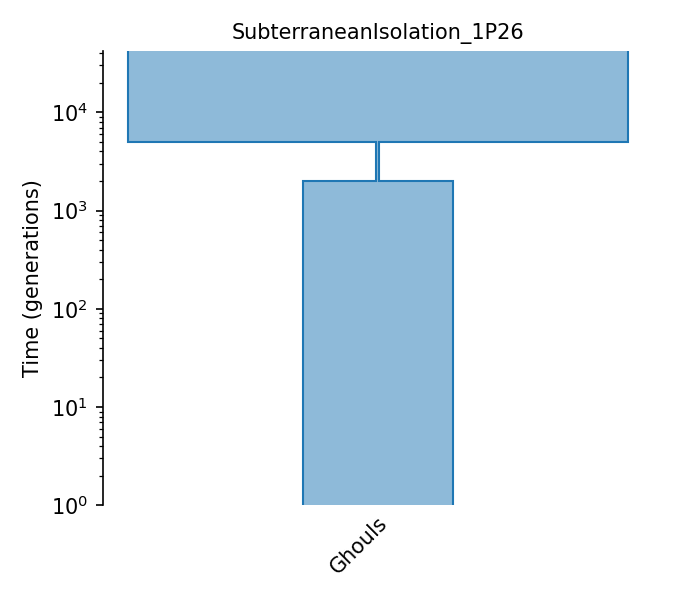
Two population Waking World and Dreamlands ghoul model
Two population model with Waking World ghouls (underground cities) and Dreamlands ghouls (separate dimension). An ancestral population of size 100,000 splits into two populations 1,000 generations ago. The Waking World population maintains a size of 30,000. The Dreamlands population experiences a bottleneck to 200 individuals before expanding to 20,000.
Warning
This model has not undergone QC.
Details
- ID:
DreamlandsPassage_2P26
- Description:
Two population Waking World and Dreamlands ghoul model
- Num populations:
3
Populations
Index |
ID |
Sampling time |
Description |
|---|---|---|---|
0 |
WakingWorld |
0 |
Waking World ghouls in underground cities |
1 |
Dreamlands |
0 |
Dreamlands ghouls in a separate dimension |
2 |
Ancestral |
None |
Ancestral ghoul population |
Citations
Lovecraft, H.P., 1928. https://en.wikipedia.org/wiki/Necronomicon
Demographic Model parameters
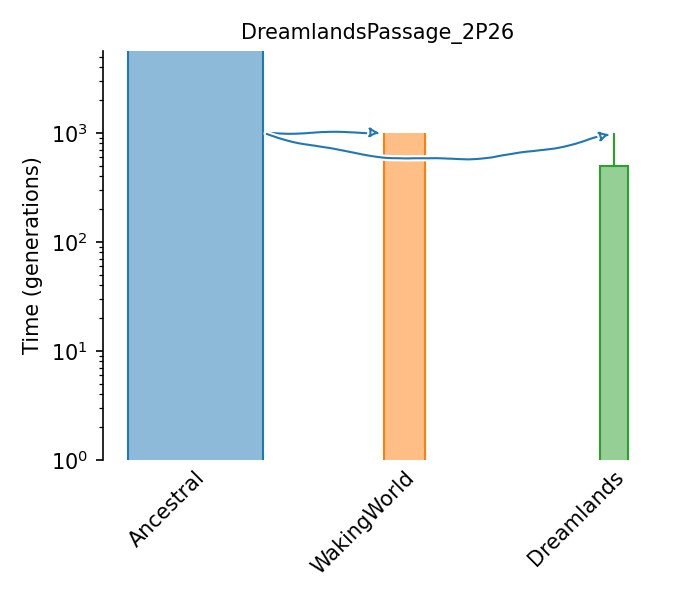
Gugs are gigantic, hairy, barrel-shaped creatures that inhabit the Dreamlands underworld. They stand roughly 20 feet tall, with enormous arms ending in paws that have vertical mouths running from wrist to elbow. Their heads bear a single pair of pink eyes and a wide, fanged mouth. Gugs were banished from the surface of the Dreamlands to the underworld for committing some unnamed blasphemy against the Great Ones. A massive stone trapdoor in the Enchanted Wood marks the boundary they are forbidden to cross. Despite their fearsome appearance and strength, gugs possess a crude civilization and worship dark gods. They prey on ghasts and anything else they can catch. First described in The Dream-Quest of Unknown Kadath (1927).
Gugus underworldis
- ID:
GugsUn
- Name:
Gugus underworldis
- Common name:
Gug
- Generation time:
- Ploidy:
2
- Separate sexes:
True
- Population size:
25000 (Lovecraft, H.P., 1928)
Genome
- Genome assembly name:
UNDERWORLD1.0 (Lovecraft, H.P., 1928)
ID |
Ploidy |
Length |
Recombination rate |
Mutation rate |
|---|---|---|---|---|
I |
2 |
200000000 |
6e-09 |
5e-09 |
II |
2 |
180000000 |
6e-09 |
5e-09 |
III |
2 |
160000000 |
6e-09 |
5e-09 |
IV |
2 |
140000000 |
6e-09 |
5e-09 |
gug_mitogenome |
1 |
35000 |
0 |
2e-08 |
Mutation and recombination rates are in units of per bp and per generation.
Citations
Lovecraft, H.P., 1928. https://en.wikipedia.org/wiki/Necronomicon
(mutation rate, recombination rate)
Lovecraft, H.P., 1928. https://en.wikipedia.org/wiki/Necronomicon
(genome assembly)
Demographic Models
ID |
Description |
|---|---|
Single population Gug vault exile model |
|
Two population vault and Tower of Koth model |
Single population Gug vault exile model
Single population of exiled Gugs. Three epochs: modern vault (N=25000), post-banishment bottleneck 3000 gen ago (N=2000), surface era before exile 30000 gen ago (N=200000).
Warning
This model has not undergone QC.
Details
- ID:
VaultExile_1C26
- Description:
Single population Gug vault exile model
- Num populations:
1
Populations
Index |
ID |
Sampling time |
Description |
|---|---|---|---|
0 |
VaultDwellers |
0 |
Gugs in the vaults of Zin |
Citations
Lovecraft, H.P., 1928. https://en.wikipedia.org/wiki/Necronomicon
Demographic Model parameters
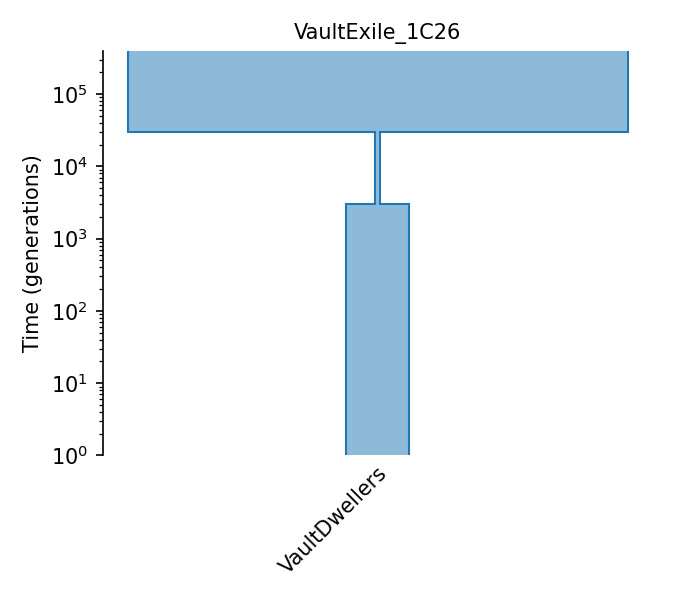
Two population vault and Tower of Koth model
Two populations: vault dwellers and Tower of Koth gugs. Ancestral N=200000. Split 10000 gen ago. Vault at 25000. Tower bottleneck to 500, grow to 10000.
Warning
This model has not undergone QC.
Details
- ID:
TowerSplit_2C26
- Description:
Two population vault and Tower of Koth model
- Num populations:
2
Populations
Index |
ID |
Sampling time |
Description |
|---|---|---|---|
0 |
VaultDwellers |
0 |
Gugs in the vaults of Zin |
1 |
TowerGugs |
0 |
Gugs near the Tower of Koth |
Citations
Lovecraft, H.P., 1928. https://en.wikipedia.org/wiki/Necronomicon
Demographic Model parameters
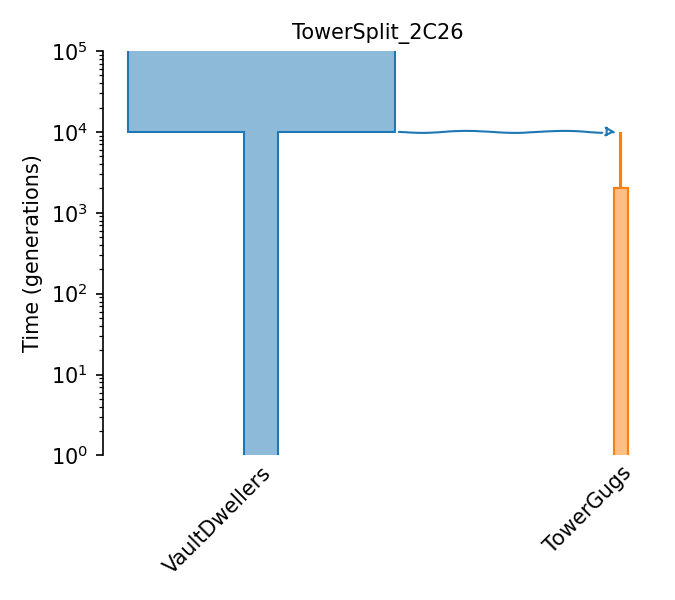
Wamps are subterranean creatures from the Mythos, dwelling in deep cave systems and underground passages. These lesser-known entities are predatory and adapted to a lightless existence, hunting by sound and vibration in the eternal darkness of the deep earth. They are generally hostile to surface dwellers and other subterranean races alike, defending their territory with ferocity.
Degeneratus subterraneus
- ID:
WamUnd
- Name:
Degeneratus subterraneus
- Common name:
Wamp
- Generation time:
- Ploidy:
2
- Separate sexes:
True
- Population size:
20000 (Lovecraft, H.P., 1928)
Genome
- Genome assembly name:
CATSKILL1.0 (Lovecraft, H.P., 1928)
ID |
Ploidy |
Length |
Recombination rate |
Mutation rate |
|---|---|---|---|---|
1 |
2 |
80000000 |
2e-08 |
3e-08 |
2 |
2 |
70000000 |
2e-08 |
3e-08 |
3 |
2 |
60000000 |
2e-08 |
3e-08 |
4 |
2 |
55000000 |
2e-08 |
3e-08 |
5 |
2 |
50000000 |
2e-08 |
3e-08 |
6 |
2 |
45000000 |
2e-08 |
3e-08 |
7 |
2 |
35000000 |
2e-08 |
3e-08 |
8 |
2 |
30000000 |
2e-08 |
3e-08 |
degenerate_mitogenome |
2 |
15000 |
2e-08 |
3e-08 |
Mutation and recombination rates are in units of per bp and per generation.
Citations
Lovecraft, H.P., 1928. https://en.wikipedia.org/wiki/Necronomicon
(mutation rate, recombination rate, genome assembly)
Demographic Models
ID |
Description |
|---|---|
Single population three-epoch model of Wamp degeneration |
|
Two-population model of Deep Warrens and Surface Raids Wamps |
Single population three-epoch model of Wamp degeneration
Single population model of Wamp demographic history. Three epochs: modern subterranean population with effective population size 20,000, a split from surface humanity beginning 500 generations ago with severe bottleneck N=50, and the ancestral Martense family era beginning 600 generations ago with N=5,000 (Necronomicon, Lovecraft).
Warning
This model has not undergone QC.
Details
- ID:
MartenseDegeneration_1M22
- Description:
Single population three-epoch model of Wamp degeneration
- Num populations:
1
Populations
Index |
ID |
Sampling time |
Description |
|---|---|---|---|
0 |
Wamps |
0 |
Wamps of the Catskill mountain warrens |
Citations
Lovecraft, H.P., 1928. https://en.wikipedia.org/wiki/Necronomicon
Demographic Model parameters
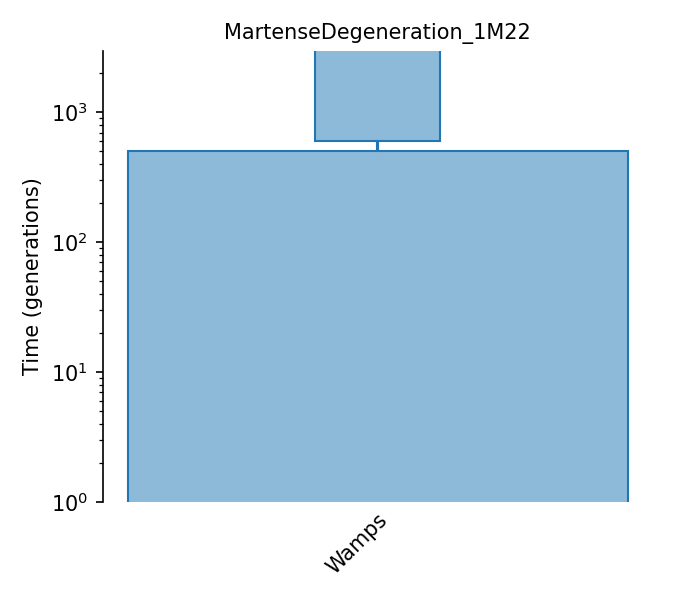
Two-population model of Deep Warrens and Surface Raids Wamps
Two-population model representing Deep Warrens Wamps and Surface Raids Wamps. An ancestral population of size 5,000 splits at 300 generations ago. The Deep Warrens population maintains a size of 20,000. The Surface Raids lineage goes through a bottleneck of 30 individuals before expanding to 3,000 in the present day. Based on the Necronomicon (Lovecraft).
Warning
This model has not undergone QC.
Details
- ID:
CatskillWarrens_2M22
- Description:
Two-population model of Deep Warrens and Surface Raids Wamps
- Num populations:
2
Populations
Index |
ID |
Sampling time |
Description |
|---|---|---|---|
0 |
DeepWarrens |
0 |
Deep Warrens Wamps – permanent subterranean dwellers |
1 |
SurfaceRaids |
0 |
Surface Raids Wamps – nocturnal surface predators |
Citations
Lovecraft, H.P., 1928. https://en.wikipedia.org/wiki/Necronomicon
Demographic Model parameters
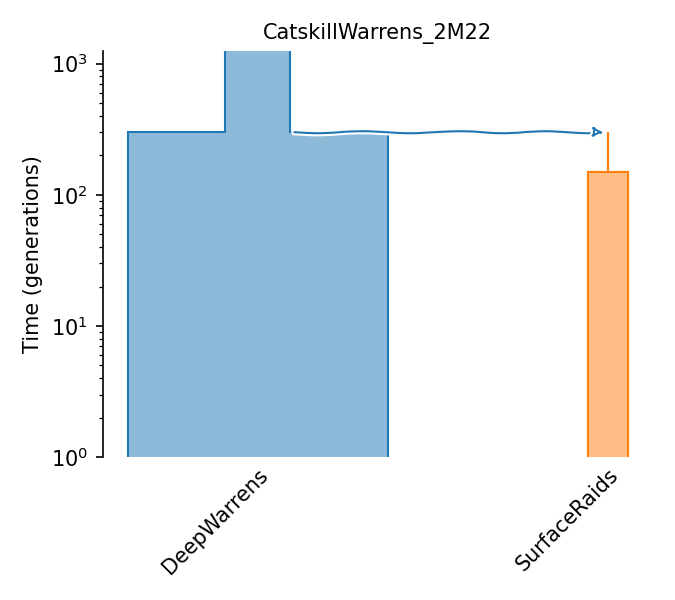
Dreamlands Creatures
Cats of Ulthar are the felines of the Dreamlands city of Ulthar, where by ancient law no man may kill a cat. This law was established after an old couple who delighted in killing cats made the mistake of taking in a kitten belonging to a traveling orphan boy. The boy prayed to the mysterious gods of the Dreamlands, and that night all the cats of Ulthar gathered and descended upon the couple. In the morning, nothing remained of the pair but two cleanly picked skeletons. The cats of Ulthar are intelligent, organized, and capable of collective action. They can leap to the moon and travel throughout the Dreamlands. First appeared in “The Cats of Ulthar” (1920).
Felis ultharensis
- ID:
CatUlt
- Name:
Felis ultharensis
- Common name:
Cat of Ulthar
- Generation time:
- Ploidy:
2
- Separate sexes:
True
- Population size:
100000 (Lovecraft, H.P., 1928)
Genome
- Genome assembly name:
ULTHAR1.0 (Lovecraft, H.P., 1928)
ID |
Ploidy |
Length |
Recombination rate |
Mutation rate |
|---|---|---|---|---|
1 |
2 |
100000000 |
1.5e-08 |
2e-08 |
2 |
2 |
85000000 |
1.5e-08 |
2e-08 |
3 |
2 |
70000000 |
1.5e-08 |
2e-08 |
4 |
2 |
55000000 |
1.5e-08 |
2e-08 |
5 |
2 |
45000000 |
1.5e-08 |
2e-08 |
6 |
2 |
40000000 |
1.5e-08 |
2e-08 |
dream_mitogenome |
2 |
17000 |
1.5e-08 |
2e-08 |
Mutation and recombination rates are in units of per bp and per generation.
Citations
Lovecraft, H.P., 1928. https://en.wikipedia.org/wiki/Necronomicon
(mutation rate, recombination rate, genome assembly)
Demographic Models
ID |
Description |
|---|---|
Single population three-epoch model of Ulthar cats |
|
Two-population model of Ulthar Temple Cats and Moon Expedition Force |
Single population three-epoch model of Ulthar cats
Single population model of Cat of Ulthar demographic history. Three epochs: modern protected era with effective population size 100,000, a pre-protection-law era beginning 1,000 generations ago with N=30,000, and an ancient dreamlands origin beginning 20,000 generations ago with N=200,000. Based on the Necronomicon (Lovecraft).
Warning
This model has not undergone QC.
Details
- ID:
UltharProtection_1C20
- Description:
Single population three-epoch model of Ulthar cats
- Num populations:
1
Populations
Index |
ID |
Sampling time |
Description |
|---|---|---|---|
0 |
UltharCats |
0 |
Cats of the city of Ulthar |
Citations
Lovecraft, H.P., 1928. https://en.wikipedia.org/wiki/Necronomicon
Demographic Model parameters
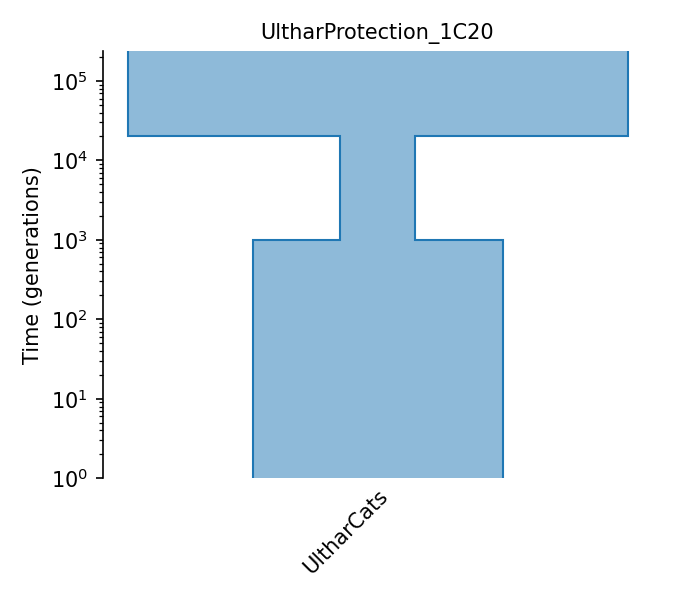
Two-population model of Ulthar Temple Cats and Moon Expedition Force
Two-population model representing Ulthar Temple Cats and the Moon Expedition Force. An ancestral population of size 200,000 splits at 5,000 generations ago. The Temple Cats maintain a size of 100,000. The Moon Expedition Force goes through a bottleneck of 500 individuals before expanding to 40,000 in the present day. Based on the dreamlands Necronomicon (Lovecraft).
Warning
This model has not undergone QC.
Details
- ID:
DreamlandsPatrol_2C20
- Description:
Two-population model of Ulthar Temple Cats and Moon Expedition Force
- Num populations:
2
Populations
Index |
ID |
Sampling time |
Description |
|---|---|---|---|
0 |
TempleCats |
0 |
Ulthar Temple Cats – sacred guardians |
1 |
MoonExpedition |
0 |
Moon Expedition Force – lunar explorers |
Citations
Lovecraft, H.P., 1928. https://en.wikipedia.org/wiki/Necronomicon
Demographic Model parameters
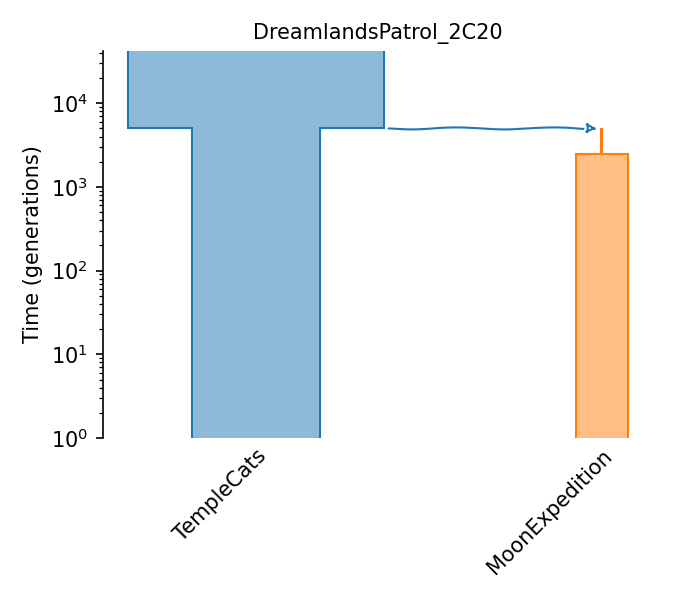
Leng Spiders are gigantic arachnids that inhabit the cold, desolate Plateau of Leng in the Dreamlands. They are bloated, purple-bodied spiders of extraordinary size – smaller specimens are the size of ponies, while the largest can tower over elephants and weigh many tons, as Leng Spiders never stop growing. They are highly intelligent, spinning webs of incredible strength with strategic cunning rather than instinct. Leng Spiders are solitary predators that will even prey on their own kind. Their venom induces deep sleep, after which victims are dragged to the spider’s lair to be consumed or used as hosts for eggs. They are thought to be the children of Atlach-Nacha, the spider god. Once rulers of the Leng plains, they were driven to gorges and caves by the people of Leng. First appeared in The Dream-Quest of Unknown Kadath (1927).
Araneus lengensis
- ID:
LenSpi
- Name:
Araneus lengensis
- Common name:
Leng Spider
- Generation time:
- Ploidy:
2
- Separate sexes:
True
- Population size:
20000 (Lovecraft, H.P., 1928)
Genome
- Genome assembly name:
LENG1.0 (Lovecraft, H.P., 1928)
ID |
Ploidy |
Length |
Recombination rate |
Mutation rate |
|---|---|---|---|---|
I |
2 |
60000000 |
8e-09 |
1e-08 |
II |
2 |
52000000 |
8e-09 |
1e-08 |
III |
2 |
45000000 |
8e-09 |
1e-08 |
IV |
2 |
38000000 |
8e-09 |
1e-08 |
V |
2 |
30000000 |
8e-09 |
1e-08 |
silk_mitogenome |
1 |
20000 |
0 |
1e-08 |
Mutation and recombination rates are in units of per bp and per generation.
Citations
Lovecraft, H.P., 1928. https://en.wikipedia.org/wiki/Necronomicon
(mutation rate)
Lovecraft, H.P., 1928. https://en.wikipedia.org/wiki/Necronomicon
(recombination rate)
Lovecraft, H.P., 1928. https://en.wikipedia.org/wiki/Necronomicon
(genome assembly)
Demographic Models
ID |
Description |
|---|---|
Three epoch model of Leng Spider plateau dominion |
|
Two population model of Plateau Core and Vale Outpost Leng Spiders |
Three epoch model of Leng Spider plateau dominion
Single population model of the Leng Spiders on the Plateau of Leng. Three epochs: (1) a modern phase with effective population size 20000, (2) a slave trade expansion beginning 5000 generations ago with N=5000, and (3) an ancient colonization era beginning 50000 generations ago with N=60000. Based on the Necronomicon (Lovecraft).
Warning
This model has not undergone QC.
Details
- ID:
PlateauDominion_1C26
- Description:
Three epoch model of Leng Spider plateau dominion
- Num populations:
1
Populations
Index |
ID |
Sampling time |
Description |
|---|---|---|---|
0 |
LengSpiders |
0 |
Leng Spiders – giant purple arachnids of the plateau |
Citations
Lovecraft, H.P., 1928. https://en.wikipedia.org/wiki/Necronomicon
Demographic Model parameters
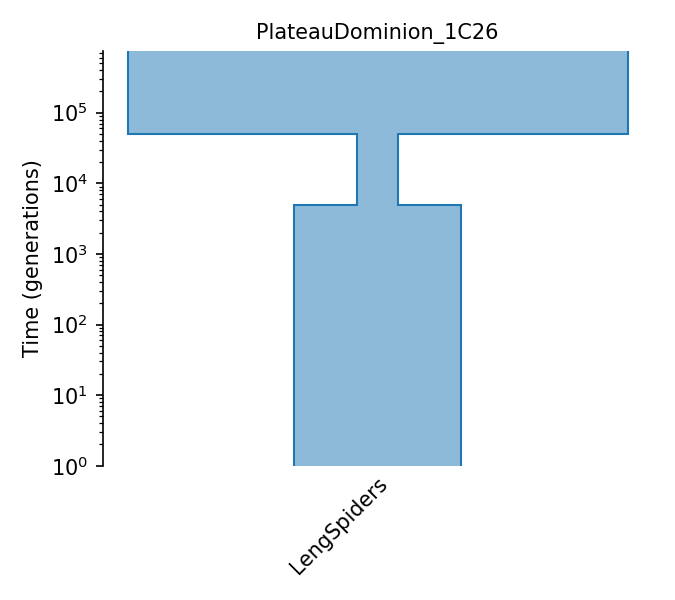
Two population model of Plateau Core and Vale Outpost Leng Spiders
Two population model describing the divergence of Plateau Core and Vale Outpost Leng Spider populations. The ancestral population of size 60000 splits at 15000 generations ago. The Plateau Core population maintains a size of 20000. The Vale Outpost lineage goes through a bottleneck of 300 individuals before expanding to 8000. Based on Necronomicon (Lovecraft).
Warning
This model has not undergone QC.
Details
- ID:
WebNetwork_2C26
- Description:
Two population model of Plateau Core and Vale Outpost Leng Spiders
- Num populations:
2
Populations
Index |
ID |
Sampling time |
Description |
|---|---|---|---|
0 |
PlateauCore |
0 |
Plateau Core – central Leng Spider civilization |
1 |
ValeOutposts |
0 |
Vale Outposts – peripheral Leng Spider settlements |
Citations
Lovecraft, H.P., 1928. https://en.wikipedia.org/wiki/Necronomicon
Demographic Model parameters
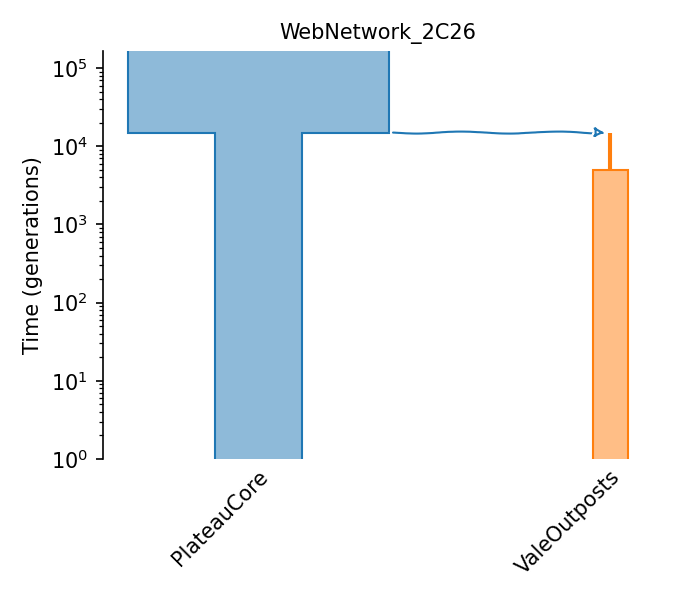
Moon-Beasts are the bloated, toad-like creatures that inhabit the dark side of the Dreamlands’ moon. They are pale, amorphous, almost faceless beings with small red tentacles or feelers where a face should be. Moon-Beasts are cruel slavers who sail black galleys crewed by their servants, the Men of Leng, and trade in slaves captured from the Dreamlands’ ports and cities. They serve Nyarlathotep and maintain a trade network that extends across the Dreamlands. Their galleys are distinctive and feared. Moon-Beasts are physically soft and relatively weak individually, but dangerous in groups. First described by Lovecraft in The Dream-Quest of Unknown Kadath (1927).
Lunaris bestialis
- ID:
MooFun
- Name:
Lunaris bestialis
- Common name:
Moon-Beast
- Generation time:
- Ploidy:
2
- Separate sexes:
- Population size:
45000 (Lovecraft, H.P., 1928)
Genome
- Genome assembly name:
DARKMOON1.0 (Lovecraft, H.P., 1928)
ID |
Ploidy |
Length |
Recombination rate |
Mutation rate |
|---|---|---|---|---|
I |
2 |
55000000 |
1.5e-08 |
1.2e-08 |
II |
2 |
50000000 |
1.5e-08 |
1.2e-08 |
III |
2 |
45000000 |
1.5e-08 |
1.2e-08 |
IV |
2 |
40000000 |
1.5e-08 |
1.2e-08 |
lunar_element |
1 |
12000 |
0 |
6e-08 |
Mutation and recombination rates are in units of per bp and per generation.
Citations
Lovecraft, H.P., 1928. https://en.wikipedia.org/wiki/Necronomicon
(mutation rate, recombination rate)
Lovecraft, H.P., 1928. https://en.wikipedia.org/wiki/Necronomicon
(genome assembly)
Demographic Models
ID |
Description |
|---|---|
Single population dark side of the moon model |
|
Two population moon and Dreamlands trading fleet model |
Single population dark side of the moon model
Single population on the moon’s dark side. Three epochs: modern slavers (N=45000), expansion from trade routes 5000 gen ago (N=10000), ancient lunar origin 50000 gen ago (N=80000).
Warning
This model has not undergone QC.
Details
- ID:
DarkSideDominion_1C26
- Description:
Single population dark side of the moon model
- Num populations:
1
Populations
Index |
ID |
Sampling time |
Description |
|---|---|---|---|
0 |
DarkSideMoon |
0 |
Moon-beasts on the dark side of the moon |
Citations
Lovecraft, H.P., 1928. https://en.wikipedia.org/wiki/Necronomicon
Demographic Model parameters
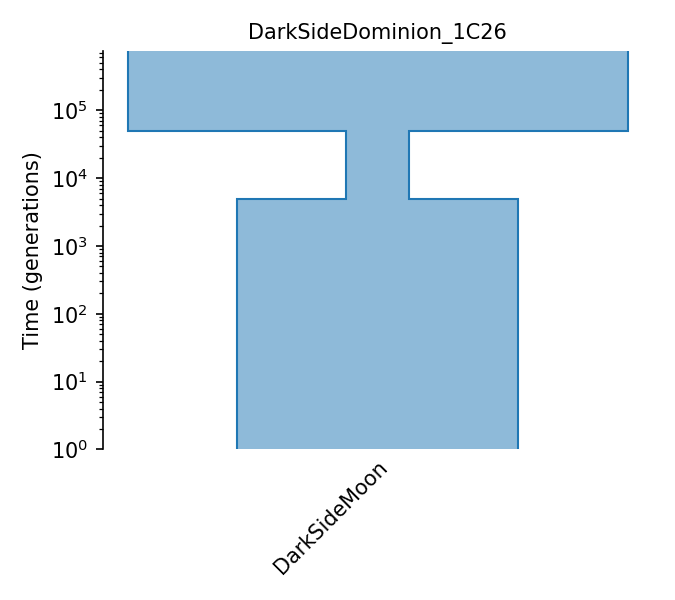
Two population moon and Dreamlands trading fleet model
Two populations: dark side homeworld and Dreamlands trading fleet. Ancestral N=80000. Split 10000 gen ago. Moon at 45000. Trading fleet bottleneck to 500, grow to 15000.
Warning
This model has not undergone QC.
Details
- ID:
TradeFleet_2C26
- Description:
Two population moon and Dreamlands trading fleet model
- Num populations:
2
Populations
Index |
ID |
Sampling time |
Description |
|---|---|---|---|
0 |
DarkSideMoon |
0 |
Moon-beasts on the dark side of the moon |
1 |
TradeFleet |
0 |
Moon-beast trading fleet in Dreamlands |
Citations
Lovecraft, H.P., 1928. https://en.wikipedia.org/wiki/Necronomicon
Demographic Model parameters
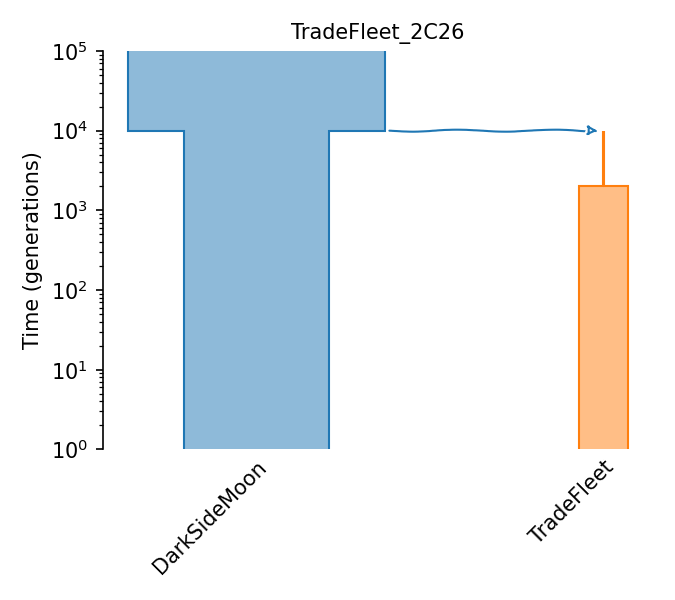
Nightgaunts are faceless, black, rubbery, winged humanoid creatures that inhabit the Dreamlands. They are lean and slippery, with bat-like wings, horned tails, and inward-curving horns on their heads. Their most distinctive and unsettling feature is their complete lack of a face – where features should be, there is only smooth, blank darkness. Nightgaunts attack by tickling their victims into helplessness, then carrying them off through the air. Despite their terrifying appearance, nightgaunts are not inherently evil and can sometimes be allied with. They guard the slopes of the Dreamlands’ highest peaks and serve Nodens, Lord of the Great Abyss. Lovecraft dreamed of nightgaunts as a child, and they appeared in The Dream-Quest of Unknown Kadath (1927).
Nightgauntus mantaformis
- ID:
NigMan
- Name:
Nightgauntus mantaformis
- Common name:
Nightgaunt
- Generation time:
- Ploidy:
2
- Separate sexes:
- Population size:
75000 (Lovecraft, H.P., 1928)
Genome
- Genome assembly name:
DREAMFLIGHT1.0 (Lovecraft, H.P., 1928)
ID |
Ploidy |
Length |
Recombination rate |
Mutation rate |
|---|---|---|---|---|
I |
2 |
45000000 |
1.8e-08 |
2e-08 |
II |
2 |
40000000 |
1.8e-08 |
2e-08 |
III |
2 |
35000000 |
1.8e-08 |
2e-08 |
IV |
2 |
30000000 |
1.8e-08 |
2e-08 |
V |
2 |
25000000 |
1.8e-08 |
2e-08 |
VI |
2 |
20000000 |
1.8e-08 |
2e-08 |
faceless_element |
1 |
15000 |
0 |
5e-08 |
Mutation and recombination rates are in units of per bp and per generation.
Citations
Lovecraft, H.P., 1928. https://en.wikipedia.org/wiki/Necronomicon
(mutation rate, recombination rate)
Lovecraft, H.P., 1928. https://en.wikipedia.org/wiki/Necronomicon
(genome assembly)
Demographic Models
ID |
Description |
|---|---|
Single population Ngranek peak colony model |
|
Two population Ngranek and dream void model |
Single population Ngranek peak colony model
Single population of nightgaunts on Ngranek. Three epochs: modern flock (N=75000), expansion from Nodens’ service 5000 gen ago (N=10000), ancient dreamlands origin 50000 gen ago (N=100000).
Warning
This model has not undergone QC.
Details
- ID:
NgranekFlock_1C26
- Description:
Single population Ngranek peak colony model
- Num populations:
1
Populations
Index |
ID |
Sampling time |
Description |
|---|---|---|---|
0 |
NophorPeaks |
0 |
Nightgaunts of Ngranek peaks |
Citations
Lovecraft, H.P., 1928. https://en.wikipedia.org/wiki/Necronomicon
Demographic Model parameters
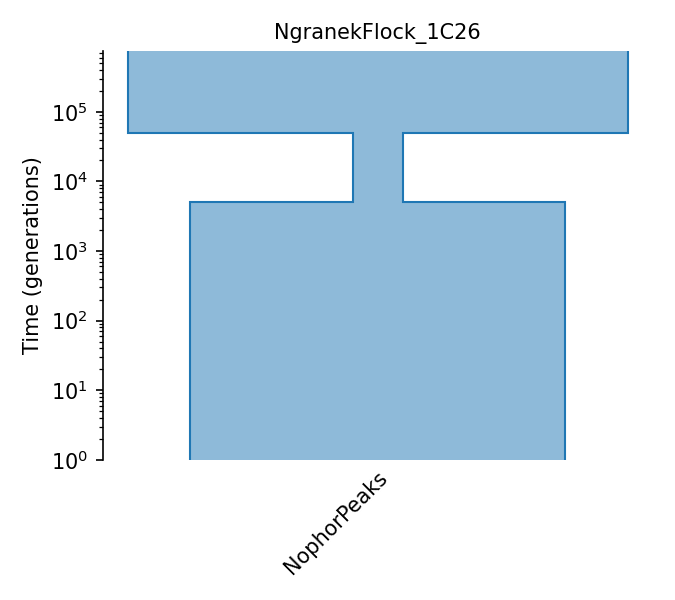
Two population Ngranek and dream void model
Two populations: Ngranek peaks and dream void colony. Ancestral N=100000. Split 20000 gen ago. Peaks stable at 75000. Void colony bottleneck to 500 then expand to 40000.
Warning
This model has not undergone QC.
Details
- ID:
DreamVoidSplit_2C26
- Description:
Two population Ngranek and dream void model
- Num populations:
2
Populations
Index |
ID |
Sampling time |
Description |
|---|---|---|---|
0 |
NophorPeaks |
0 |
Nightgaunts of Ngranek peaks |
1 |
DreamVoid |
0 |
Dream void nightgaunt colony |
Citations
Lovecraft, H.P., 1928. https://en.wikipedia.org/wiki/Necronomicon
Demographic Model parameters
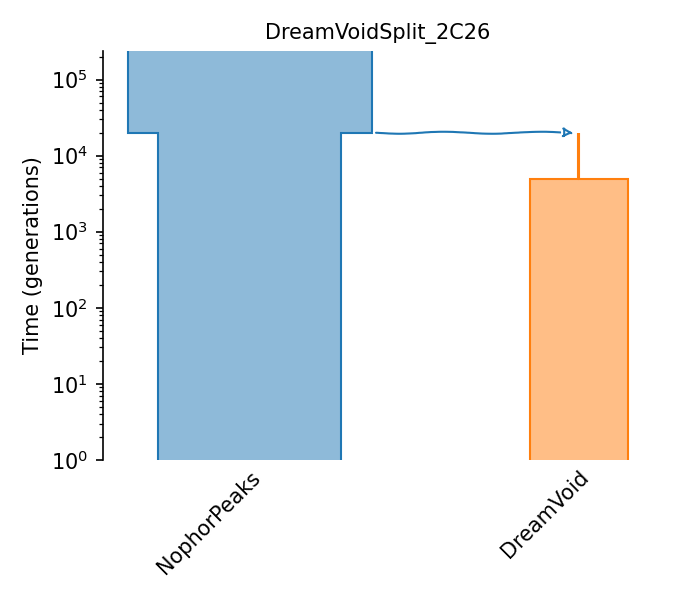
Shantaks are enormous bird-like creatures from the Dreamlands, larger than elephants, with the body of a horse and the head of a horse combined with bat-like wings. Their skin is described as slippery and scaly rather than feathered. Shantaks serve as aerial mounts in the Dreamlands and are used by various beings for transportation across vast distances. Despite their great size and power, shantaks are terrified of nightgaunts, who can easily overpower them. They nest on the peaks of the tallest mountains in the Dreamlands and are sometimes tamed by inhabitants of the Plateau of Leng. First described in The Dream-Quest of Unknown Kadath (1927).
Shantakus dreamlandis
- ID:
SanDre
- Name:
Shantakus dreamlandis
- Common name:
Shantak
- Generation time:
- Ploidy:
2
- Separate sexes:
True
- Population size:
60000 (Lovecraft, H.P., 1928)
Genome
- Genome assembly name:
KADATH1.0 (Lovecraft, H.P., 1928)
ID |
Ploidy |
Length |
Recombination rate |
Mutation rate |
|---|---|---|---|---|
I |
2 |
75000000 |
2e-08 |
1.5e-08 |
II |
2 |
65000000 |
2e-08 |
1.5e-08 |
III |
2 |
55000000 |
2e-08 |
1.5e-08 |
IV |
2 |
45000000 |
2e-08 |
1.5e-08 |
V |
2 |
35000000 |
2e-08 |
1.5e-08 |
scale_mitogenome |
1 |
22000 |
0 |
4e-08 |
Mutation and recombination rates are in units of per bp and per generation.
Citations
Lovecraft, H.P., 1928. https://en.wikipedia.org/wiki/Necronomicon
(mutation rate, recombination rate)
Lovecraft, H.P., 1928. https://en.wikipedia.org/wiki/Necronomicon
(genome assembly)
Demographic Models
ID |
Description |
|---|---|
Single population Kadath nesting colony model |
|
Two population Kadath and Leng shantak model |
Single population Kadath nesting colony model
Single population on Kadath peaks. Three epochs: modern flock (N=60000), taming by moon-beasts 3000 gen ago (N=20000), wild ancestral flock 30000 gen ago (N=150000).
Warning
This model has not undergone QC.
Details
- ID:
KadathNesting_1C26
- Description:
Single population Kadath nesting colony model
- Num populations:
1
Populations
Index |
ID |
Sampling time |
Description |
|---|---|---|---|
0 |
KadathPeaks |
0 |
Shantaks nesting on Kadath peaks |
Citations
Lovecraft, H.P., 1928. https://en.wikipedia.org/wiki/Necronomicon
Demographic Model parameters
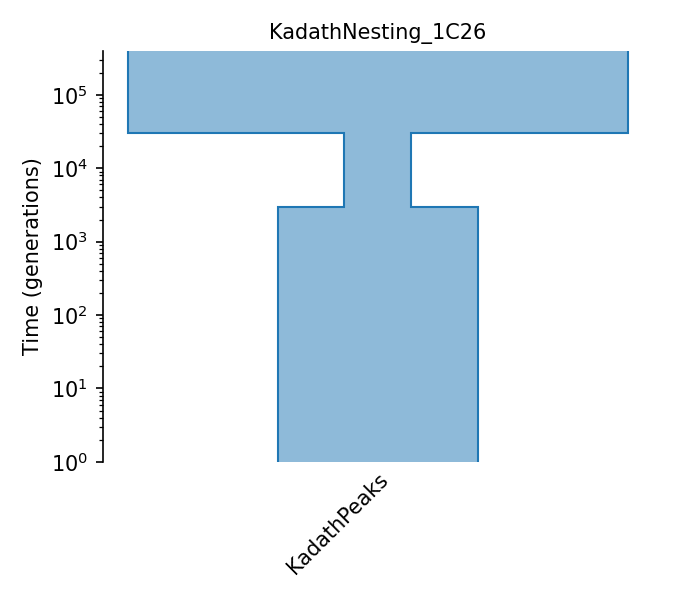
Two population Kadath and Leng shantak model
Two populations: Kadath peaks and Leng plateau. Ancestral N=150000. Split 10000 gen ago. Kadath at 60000. Leng bottleneck to 300, grow to 25000.
Warning
This model has not undergone QC.
Details
- ID:
LengSplit_2C26
- Description:
Two population Kadath and Leng shantak model
- Num populations:
2
Populations
Index |
ID |
Sampling time |
Description |
|---|---|---|---|
0 |
KadathPeaks |
0 |
Shantaks nesting on Kadath peaks |
1 |
LengPlateau |
0 |
Shantaks of the Plateau of Leng |
Citations
Lovecraft, H.P., 1928. https://en.wikipedia.org/wiki/Necronomicon
Demographic Model parameters
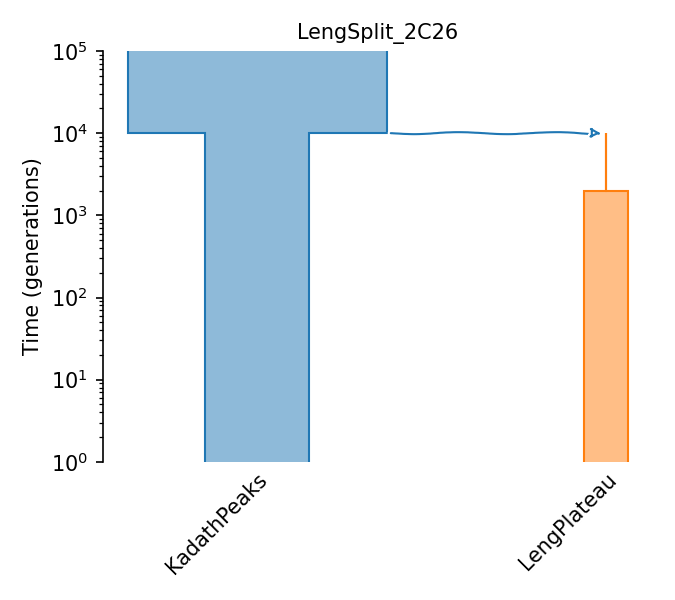
Zoogs are small, brown, mouse-like creatures that inhabit the Enchanted Wood of the Dreamlands. They are furtive, secretive beings roughly the size of a rat, with sharp teeth and a taste for mischief. Though individually insignificant, zoogs are numerous and organized into a loose tribal society led by elders. They are omnivorous and have been known to attack travelers in large groups. Zoogs are cunning negotiators and possess considerable knowledge of the Dreamlands, making them useful (if unreliable) sources of information. They maintain an uneasy truce with the cats of Ulthar, who are their natural enemies. First appeared in The Dream-Quest of Unknown Kadath (1927).
Zoogus sylvaticus
- ID:
ZooGul
- Name:
Zoogus sylvaticus
- Common name:
Zoog
- Generation time:
- Ploidy:
2
- Separate sexes:
True
- Population size:
500000 (Lovecraft, H.P., 1928)
Genome
- Genome assembly name:
ENCHANTED1.0 (Lovecraft, H.P., 1928)
ID |
Ploidy |
Length |
Recombination rate |
Mutation rate |
|---|---|---|---|---|
1 |
2 |
25000000 |
3e-08 |
2.5e-08 |
2 |
2 |
22000000 |
3e-08 |
2.5e-08 |
3 |
2 |
20000000 |
3e-08 |
2.5e-08 |
4 |
2 |
18000000 |
3e-08 |
2.5e-08 |
5 |
2 |
15000000 |
3e-08 |
2.5e-08 |
forest_mitogenome |
1 |
16000 |
0 |
8e-08 |
Mutation and recombination rates are in units of per bp and per generation.
Citations
Lovecraft, H.P., 1928. https://en.wikipedia.org/wiki/Necronomicon
(mutation rate, recombination rate)
Lovecraft, H.P., 1928. https://en.wikipedia.org/wiki/Necronomicon
(genome assembly)
Demographic Models
ID |
Description |
|---|---|
Single population Enchanted Wood zoog model |
|
Two population Enchanted Wood and upper Dreamlands model |
Single population Enchanted Wood zoog model
Single population in Enchanted Wood. Three epochs: modern thriving (N=500000), cat-war bottleneck 10000 gen ago (N=50000), ancient forest founding 100000 gen ago (N=200000).
Warning
This model has not undergone QC.
Details
- ID:
EnchantedWood_1C26
- Description:
Single population Enchanted Wood zoog model
- Num populations:
1
Populations
Index |
ID |
Sampling time |
Description |
|---|---|---|---|
0 |
EnchantedWood |
0 |
Zoogs of the Enchanted Wood |
Citations
Lovecraft, H.P., 1928. https://en.wikipedia.org/wiki/Necronomicon
Demographic Model parameters
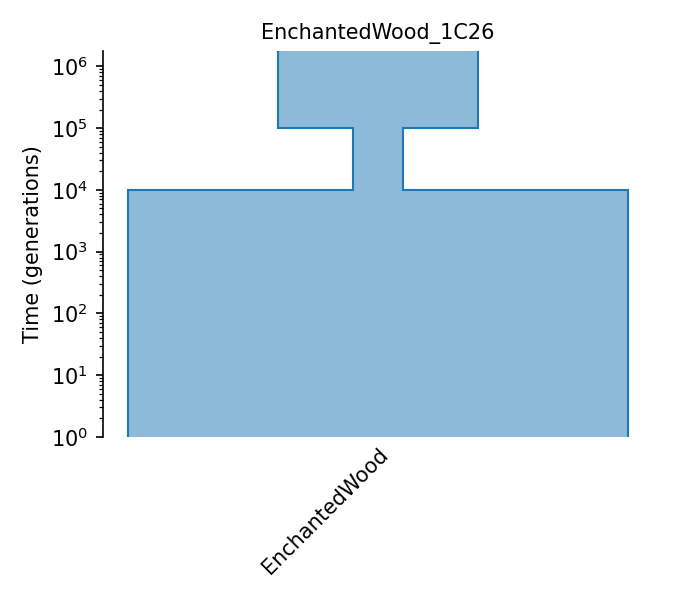
Two population Enchanted Wood and upper Dreamlands model
Two populations: Enchanted Wood core and upper Dreamlands colony. Ancestral N=200000. Split 30000 gen ago. Wood at 500000. Upper bottleneck to 1000, grow to 100000.
Warning
This model has not undergone QC.
Details
- ID:
DreamlandsSpread_2C26
- Description:
Two population Enchanted Wood and upper Dreamlands model
- Num populations:
2
Populations
Index |
ID |
Sampling time |
Description |
|---|---|---|---|
0 |
EnchantedWood |
0 |
Zoogs of the Enchanted Wood |
1 |
UpperDreamlands |
0 |
Upper Dreamlands zoog colony |
Citations
Lovecraft, H.P., 1928. https://en.wikipedia.org/wiki/Necronomicon
Demographic Model parameters
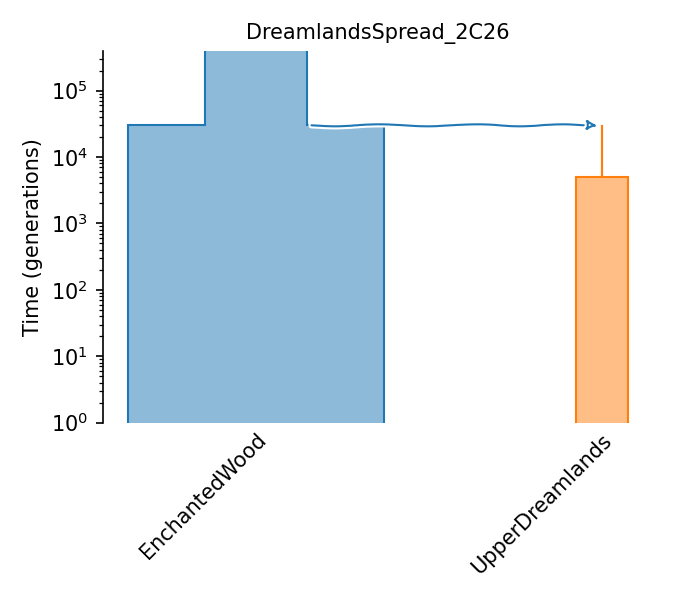
Interdimensional & Temporal
Dimensional Shamblers are interdimensional predators that move between planes of existence. They appear as roughly humanoid but deeply wrong – with coarse, wrinkled skin, long arms ending in enormous crab-like claws, and a hunched, ape-like posture. Their heads are featureless except for a mass of short, writhing tentacles where the face should be. Dimensional Shamblers can step between dimensions at will, appearing and disappearing without warning. They seize their prey and drag them into other dimensions from which there is no return. They were first described in “The Horror in the Museum” (1933), a story ghost-written by Lovecraft for Hazel Heald.
Dimensius shambleris
- ID:
DimSha
- Name:
Dimensius shambleris
- Common name:
Dimensional Shambler
- Generation time:
100 (Lovecraft, H.P., 1928)
- Ploidy:
2
- Separate sexes:
- Population size:
3000 (Lovecraft, H.P., 1928)
Genome
- Genome assembly name:
INTERPLANAR1.0 (Lovecraft, H.P., 1928)
ID |
Ploidy |
Length |
Recombination rate |
Mutation rate |
|---|---|---|---|---|
I |
2 |
70000000 |
1e-08 |
8e-09 |
II |
2 |
60000000 |
1e-08 |
8e-09 |
III |
2 |
50000000 |
1e-08 |
8e-09 |
planar_element |
1 |
8000 |
0 |
5e-08 |
Mutation and recombination rates are in units of per bp and per generation.
Citations
Lovecraft, H.P., 1928. https://en.wikipedia.org/wiki/Necronomicon
(mutation rate, recombination rate)
Lovecraft, H.P., 1928. https://en.wikipedia.org/wiki/Necronomicon
(genome assembly)
Demographic Models
ID |
Description |
|---|---|
Single population interplanar drift model |
|
Two population prime plane and interplanar void model |
Single population interplanar drift model
Single population drifting between planes. Three epochs: modern scattered (N=3000), planar convergence 1000 gen ago (N=10000), ancient unified plane 10000 gen ago (N=500).
Warning
This model has not undergone QC.
Details
- ID:
PlanarDrift_1B33
- Description:
Single population interplanar drift model
- Num populations:
1
Populations
Index |
ID |
Sampling time |
Description |
|---|---|---|---|
0 |
PrimePlane |
0 |
Shamblers on the prime material plane |
Citations
Lovecraft, H.P., 1928. https://en.wikipedia.org/wiki/Necronomicon
Demographic Model parameters
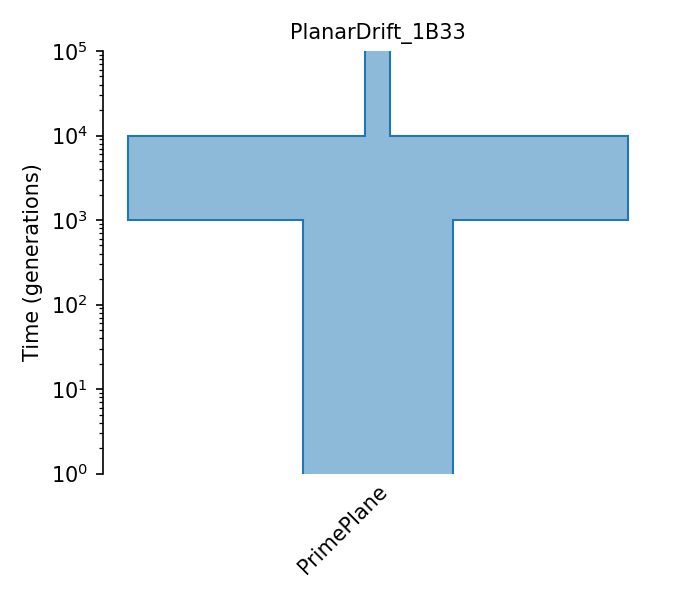
Two population prime plane and interplanar void model
Two populations: prime plane and interplanar voids. Ancestral N=10000. Split 2000 gen ago. Prime at 3000. Voids bottleneck to 50, grow to 2000.
Warning
This model has not undergone QC.
Details
- ID:
PlaneSplit_2B33
- Description:
Two population prime plane and interplanar void model
- Num populations:
2
Populations
Index |
ID |
Sampling time |
Description |
|---|---|---|---|
0 |
PrimePlane |
0 |
Shamblers on the prime material plane |
1 |
BetweenSpaces |
0 |
Shamblers in interplanar voids |
Citations
Lovecraft, H.P., 1928. https://en.wikipedia.org/wiki/Necronomicon
Demographic Model parameters
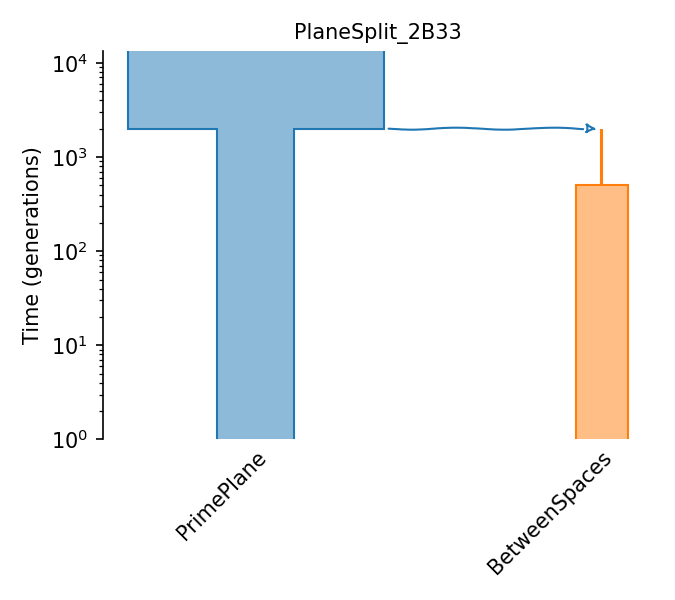
Hounds of Tindalos are extradimensional entities that inhabit the “angles” of time, as opposed to the “curves” in which normal life exists. They are lean, filthy creatures of alien geometry, described as having long, hollow tongues through which they drain their victims. The Hounds can materialize through any sufficiently sharp angle – corners of rooms, edges of furniture – anywhere that angles of 120 degrees or less exist. Once a Hound has the scent of its prey (typically someone who has traveled through time or used certain drugs), it will pursue relentlessly across any distance or dimension. The only protection is to be in a room with no angles – a perfectly curved space. They are believed to be among the oldest entities in existence. First appeared in Frank Belknap Long’s “The Hounds of Tindalos” (1929).
Houndus tindalosi
- ID:
HouFir
- Name:
Houndus tindalosi
- Common name:
Hound of Tindalos
- Generation time:
500 (Lovecraft, H.P., 1928)
- Ploidy:
2
- Separate sexes:
- Population size:
5000 (Lovecraft, H.P., 1928)
Genome
- Genome assembly name:
ANGULAR1.0 (Lovecraft, H.P., 1928)
ID |
Ploidy |
Length |
Recombination rate |
Mutation rate |
|---|---|---|---|---|
I |
2 |
60000000 |
5e-09 |
3e-09 |
II |
2 |
55000000 |
5e-09 |
3e-09 |
III |
2 |
50000000 |
5e-09 |
3e-09 |
angular_genome |
1 |
25000 |
0 |
1e-08 |
Mutation and recombination rates are in units of per bp and per generation.
Citations
Lovecraft, H.P., 1928. https://en.wikipedia.org/wiki/Necronomicon
(mutation rate, recombination rate)
Lovecraft, H.P., 1928. https://en.wikipedia.org/wiki/Necronomicon
(genome assembly)
Demographic Models
ID |
Description |
|---|---|
Single population angular time predator model |
|
Two population angular realm and corner hunters model |
Single population angular time predator model
Single population of Hounds existing in angular time. Three epochs: modern scattered hunters (N=5000), temporal convergence 500 gen ago (N=20000), primordial angular existence 5000 gen ago (N=1000).
Warning
This model has not undergone QC.
Details
- ID:
AngularTime_1L29
- Description:
Single population angular time predator model
- Num populations:
1
Populations
Index |
ID |
Sampling time |
Description |
|---|---|---|---|
0 |
AngularRealm |
0 |
Hounds dwelling in angular time |
Citations
Lovecraft, H.P., 1928. https://en.wikipedia.org/wiki/Necronomicon
Demographic Model parameters
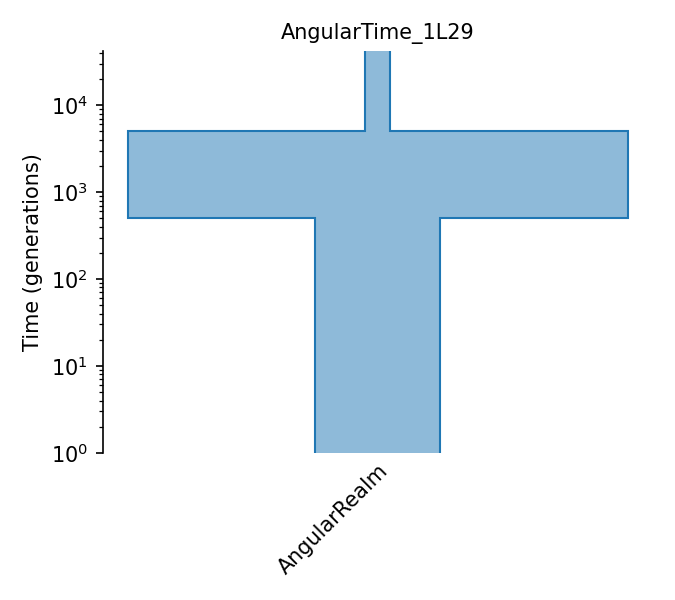
Two population angular realm and corner hunters model
Two populations: angular realm dwellers and corner-emerged hunters. Ancestral N=20000. Split 1000 gen ago. Angular realm at 5000. Corner hunters bottleneck to 100, expand to 3000.
Warning
This model has not undergone QC.
Details
- ID:
CornerEmergence_2L29
- Description:
Two population angular realm and corner hunters model
- Num populations:
2
Populations
Index |
ID |
Sampling time |
Description |
|---|---|---|---|
0 |
AngularRealm |
0 |
Hounds dwelling in angular time |
1 |
CornerHunters |
0 |
Hounds that emerged through corners |
Citations
Lovecraft, H.P., 1928. https://en.wikipedia.org/wiki/Necronomicon
Demographic Model parameters
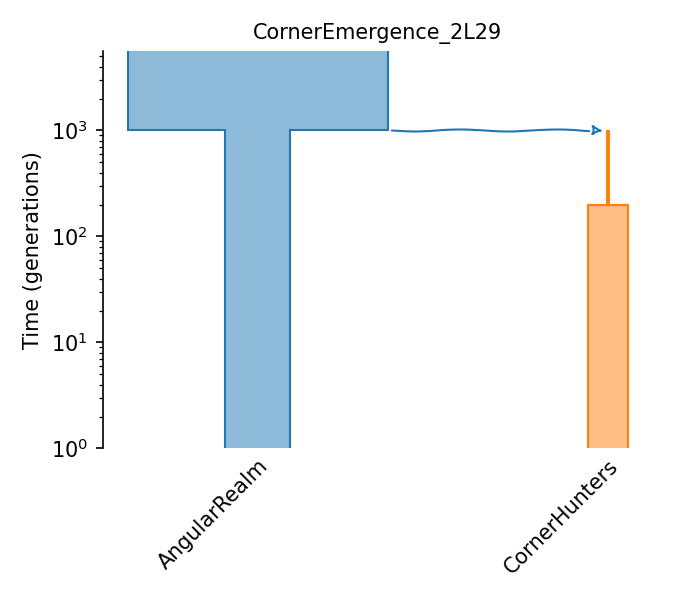
Arctic & Desert
Gnoph-Keh are fearsome arctic creatures resembling six-legged polar bears with coarse, matted white hair and a single large narwhal-like horn. They possess the ability to summon blizzards and drastically reduce temperatures in their vicinity. Gnoph-Keh are territorial, solitary, and now extremely rare, dwelling in Greenland and the Arctic Circle. In the earliest texts (such as the Book of Eibon), the Gnoph-Keh were described as a race of vicious cannibals driven from the land of Lomar by mankind and the Voormis. They are connected with Rhan-Tegoth and possibly with Ithaqua, the Wind-Walker. Legend suggests they are the remnants of a lost tribe that turned from earthly gods to serve Ithaqua, becoming something other than human.
Gnophkehus arcticus
- ID:
GnpKeh
- Name:
Gnophkehus arcticus
- Common name:
Gnoph-Keh
- Generation time:
- Ploidy:
2
- Separate sexes:
True
- Population size:
12000 (Lovecraft, H.P., 1928)
Genome
- Genome assembly name:
HYPERBOREA1.0 (Lovecraft, H.P., 1928)
ID |
Ploidy |
Length |
Recombination rate |
Mutation rate |
|---|---|---|---|---|
I |
2 |
100000000 |
3e-09 |
4e-09 |
II |
2 |
85000000 |
3e-09 |
4e-09 |
III |
2 |
70000000 |
3e-09 |
4e-09 |
IV |
2 |
60000000 |
3e-09 |
4e-09 |
V |
2 |
50000000 |
3e-09 |
4e-09 |
VI |
2 |
40000000 |
3e-09 |
4e-09 |
frost_mitogenome |
1 |
24000 |
0 |
4e-09 |
Mutation and recombination rates are in units of per bp and per generation.
Citations
Lovecraft, H.P., 1928. https://en.wikipedia.org/wiki/Necronomicon
(mutation rate)
Lovecraft, H.P., 1928. https://en.wikipedia.org/wiki/Necronomicon
(recombination rate)
Lovecraft, H.P., 1928. https://en.wikipedia.org/wiki/Necronomicon
(genome assembly)
Demographic Models
ID |
Description |
|---|---|
Hyperborean ice age model for Gnoph-Keh |
|
Two population model of Hyperborean Core and Lomar Colony |
Hyperborean ice age model for Gnoph-Keh
Single population model of Gnoph-Keh population dynamics through the Hyperborean ice ages. Three epochs: (1) a modern phase with effective population size 12000, (2) an ice age expansion period beginning 2000 generations ago with N=50000, and (3) a pre-ice founding era beginning 20000 generations ago with N=5000. Based on the Necronomicon (Lovecraft).
Warning
This model has not undergone QC.
Details
- ID:
HyperboreanIceAge_1H33
- Description:
Hyperborean ice age model for Gnoph-Keh
- Num populations:
1
Populations
Index |
ID |
Sampling time |
Description |
|---|---|---|---|
0 |
Hyperborea |
0 |
Hyperborea – arctic Gnoph-Keh homeland |
Citations
Lovecraft, H.P., 1928. https://en.wikipedia.org/wiki/Necronomicon
Demographic Model parameters
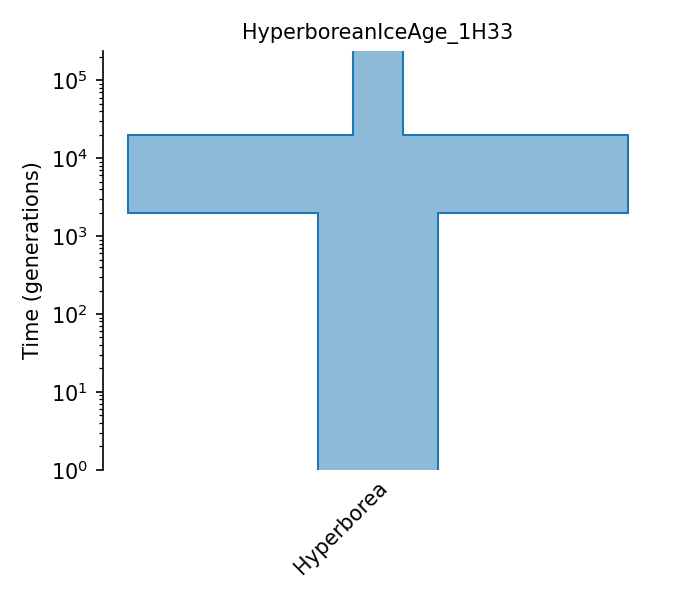
Two population model of Hyperborean Core and Lomar Colony
Two population model describing the divergence of the Hyperborean Core and Lomar Colony Gnoph-Keh. The ancestral population of size 50000 splits at 5000 generations ago. The Hyperborean Core maintains a size of 12000. The Lomar Colony lineage goes through a bottleneck of 200 individuals before expanding to 6000. Based on the work of Necronomicon (Lovecraft).
Warning
This model has not undergone QC.
Details
- ID:
ArcticSplit_2H33
- Description:
Two population model of Hyperborean Core and Lomar Colony
- Num populations:
2
Populations
Index |
ID |
Sampling time |
Description |
|---|---|---|---|
0 |
HyperboreanCore |
0 |
Hyperborean Core – primary arctic population |
1 |
LomarColony |
0 |
Lomar Colony – southern expansion population |
Citations
Lovecraft, H.P., 1928. https://en.wikipedia.org/wiki/Necronomicon
Demographic Model parameters
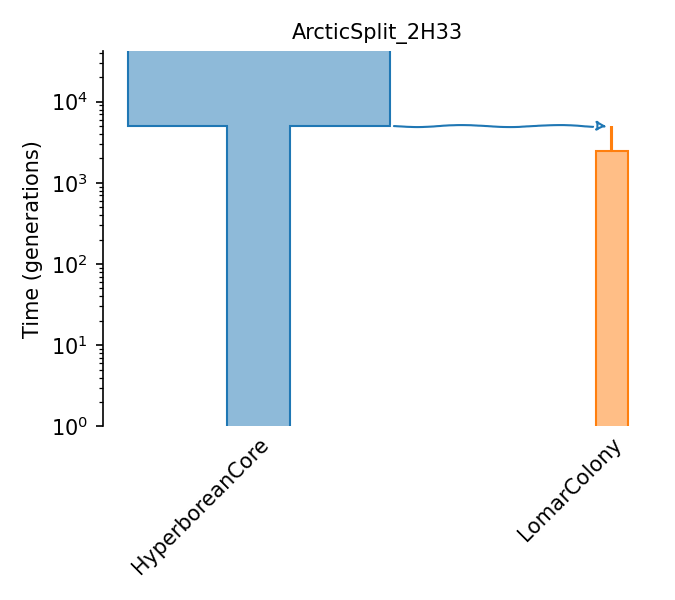
Sand Dwellers are minor creatures from the Cthulhu Mythos, originating in “The Gable Window” by August Derleth. They resemble thin, sand-encrusted humans with unusually large eyes and ears, and faces that look somewhat like those of koalas. Sand Dwellers dwell in caves during daylight and emerge at night in groups to hunt. They are associated with at least one large tentacled creature of unknown nature. In some interpretations they are literally made of sand and can combine into larger forms, while in others they are psychic parasites that grow inside the minds of their victims before manifesting physically.
Arenicola abyssalis
- ID:
SanDwl
- Name:
Arenicola abyssalis
- Common name:
Sand Dweller
- Generation time:
- Ploidy:
2
- Separate sexes:
- Population size:
40000 (Lovecraft, H.P., 1928)
Genome
- Genome assembly name:
IREM1.0 (Lovecraft, H.P., 1928)
ID |
Ploidy |
Length |
Recombination rate |
Mutation rate |
|---|---|---|---|---|
I |
2 |
55000000 |
9e-09 |
1.2e-08 |
II |
2 |
45000000 |
9e-09 |
1.2e-08 |
III |
2 |
35000000 |
9e-09 |
1.2e-08 |
IV |
2 |
30000000 |
9e-09 |
1.2e-08 |
desert_element |
2 |
9000 |
9e-09 |
1.2e-08 |
Mutation and recombination rates are in units of per bp and per generation.
Citations
Lovecraft, H.P., 1928. https://en.wikipedia.org/wiki/Necronomicon
(mutation rate, recombination rate, genome assembly)
Demographic Models
ID |
Description |
|---|---|
Single population three-epoch model of Sand Dwellers |
|
Two-population model of Deep Desert and Ruin Dwellers |
Single population three-epoch model of Sand Dwellers
Single population model of Sand Dweller demographic history. Three epochs: modern desert population with effective population size 40,000, an oasis bottleneck beginning 3,000 generations ago with N=8,000, and an ancient Irem era beginning 30,000 generations ago with N=120,000. Based on the Necronomicon (Lovecraft). (730).
Warning
This model has not undergone QC.
Details
- ID:
DesertBurrowers_1A730
- Description:
Single population three-epoch model of Sand Dwellers
- Num populations:
1
Populations
Index |
ID |
Sampling time |
Description |
|---|---|---|---|
0 |
SandDwellers |
0 |
Sand Dwellers of the Empty Quarter |
Citations
Lovecraft, H.P., 1928. https://en.wikipedia.org/wiki/Necronomicon
Demographic Model parameters
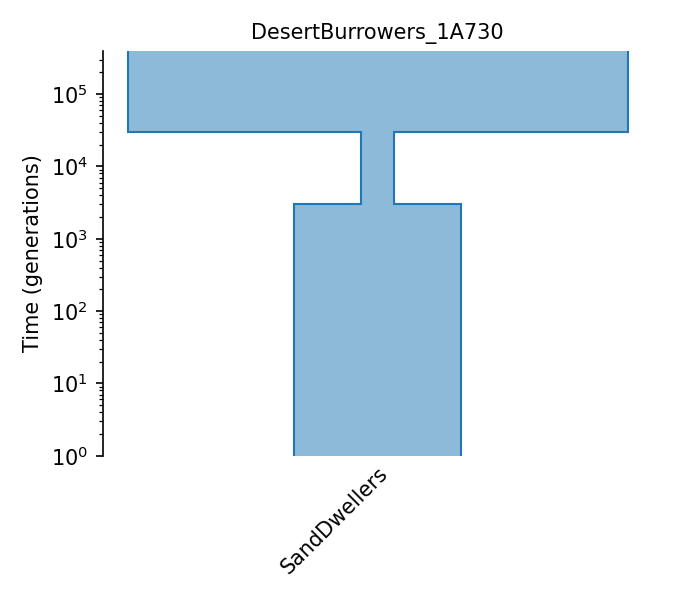
Two-population model of Deep Desert and Ruin Dwellers
Two-population model representing Deep Desert Sand Dwellers and Ruin Dwellers of Irem. An ancestral population of size 120,000 splits at 10,000 generations ago. The Deep Desert population maintains a size of 40,000. The Ruin Dwellers go through a bottleneck of 400 individuals before expanding to 15,000 in the present day. Based on the Necronomicon (Lovecraft). (730).
Warning
This model has not undergone QC.
Details
- ID:
IremRuins_2A730
- Description:
Two-population model of Deep Desert and Ruin Dwellers
- Num populations:
2
Populations
Index |
ID |
Sampling time |
Description |
|---|---|---|---|
0 |
DeepDesert |
0 |
Deep Desert Sand Dwellers – nomadic burrowers |
1 |
RuinDwellers |
0 |
Ruin Dwellers of Irem – settled colony |
Citations
Lovecraft, H.P., 1928. https://en.wikipedia.org/wiki/Necronomicon
Demographic Model parameters
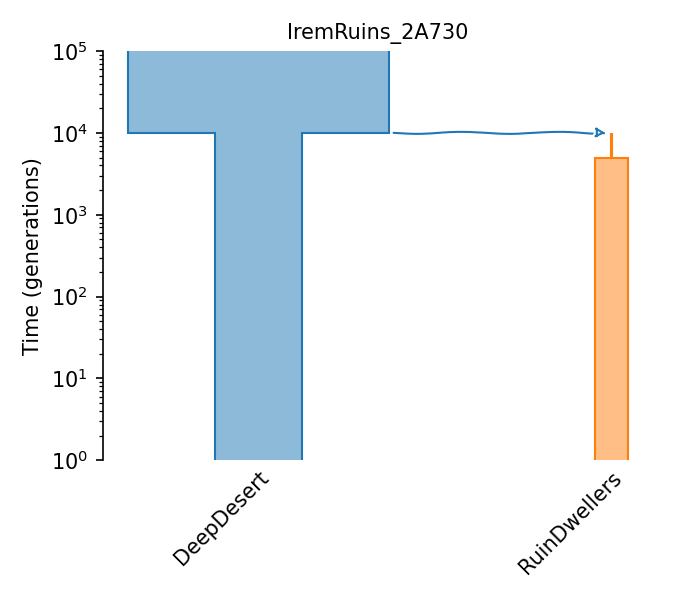
Human-Adjacent Horrors
Rat-Things (such as the infamous Brown Jenkin) are hybrid creatures with the body of a rat and a disturbing, miniature human-like face with sharp teeth. Brown Jenkin, the most famous rat-thing, served the witch Keziah Mason and could pass through dimensional barriers along angles that correspond to alien geometries. Rat-Things are familiar spirits of witches, carrying out errands between dimensions and assisting in dark rituals. They are disturbingly intelligent, possessing human-level cunning in a rodent body. Their small size makes them difficult to catch or kill, and their ability to move between dimensions makes them impossible to trap by conventional means. First appeared in “The Dreams in the Witch House” (1933).
Rattus magicus
- ID:
RatThi
- Name:
Rattus magicus
- Common name:
Rat-Thing
- Generation time:
- Ploidy:
2
- Separate sexes:
True
- Population size:
50000 (Lovecraft, H.P., 1928)
Genome
- Genome assembly name:
WITCHHOUSE1.0 (Lovecraft, H.P., 1928)
ID |
Ploidy |
Length |
Recombination rate |
Mutation rate |
|---|---|---|---|---|
1 |
2 |
50000000 |
1.5e-08 |
2e-08 |
2 |
2 |
45000000 |
1.5e-08 |
2e-08 |
3 |
2 |
40000000 |
1.5e-08 |
2e-08 |
4 |
2 |
35000000 |
1.5e-08 |
2e-08 |
5 |
2 |
30000000 |
1.5e-08 |
2e-08 |
6 |
2 |
25000000 |
1.5e-08 |
2e-08 |
7 |
2 |
20000000 |
1.5e-08 |
2e-08 |
witch_mitogenome |
1 |
16000 |
0 |
2e-08 |
Mutation and recombination rates are in units of per bp and per generation.
Citations
Lovecraft, H.P., 1928. https://en.wikipedia.org/wiki/Necronomicon
(mutation rate)
Lovecraft, H.P., 1928. https://en.wikipedia.org/wiki/Necronomicon
(recombination rate)
Lovecraft, H.P., 1928. https://en.wikipedia.org/wiki/Necronomicon
(genome assembly)
Demographic Models
ID |
Description |
|---|---|
Witch trial purge model for Rat-Things |
|
Two population model of Feral Colony and Witch-Bound Rat-Things |
Witch trial purge model for Rat-Things
Single population model of Rat-Thing population dynamics through witch trial eras. Three epochs: (1) a modern phase with effective population size 50000, (2) a witch trial purge period beginning 500 generations ago with N=1000, and (3) a colonial era beginning 2000 generations ago with N=100000. Based on the Necronomicon (Lovecraft). (1932).
Warning
This model has not undergone QC.
Details
- ID:
WitchHousePlague_1G32
- Description:
Witch trial purge model for Rat-Things
- Num populations:
1
Populations
Index |
ID |
Sampling time |
Description |
|---|---|---|---|
0 |
WitchHouse |
0 |
Witch House colony – Rat-Things in Arkham |
Citations
Lovecraft, H.P., 1928. https://en.wikipedia.org/wiki/Necronomicon
Demographic Model parameters
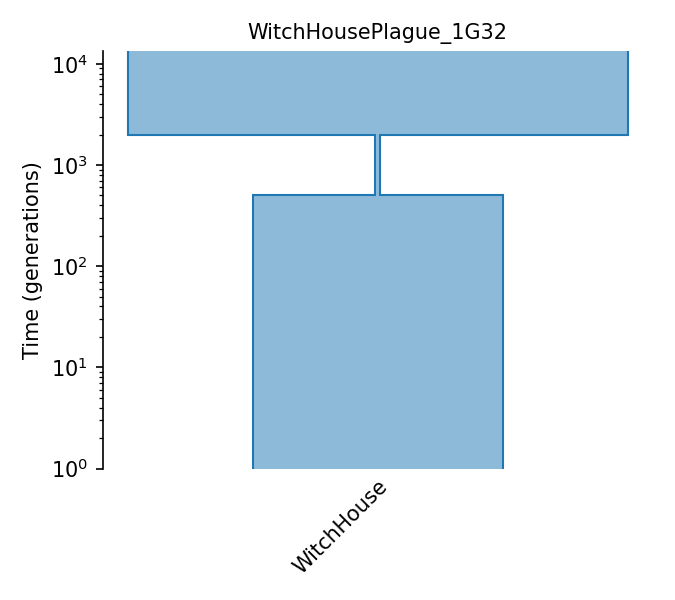
Two population model of Feral Colony and Witch-Bound Rat-Things
Two population model describing the divergence of the Feral Colony and Witch-Bound Rat-Things. The ancestral population of size 100000 splits at 1000 generations ago. The Feral Colony maintains a size of 50000. The Witch-Bound lineage goes through a bottleneck of 100 individuals before expanding to 10000. Based on the Necronomicon (Lovecraft). Necronomicon (Lovecraft).
Warning
This model has not undergone QC.
Details
- ID:
FamiliarLineage_2G32
- Description:
Two population model of Feral Colony and Witch-Bound Rat-Things
- Num populations:
2
Populations
Index |
ID |
Sampling time |
Description |
|---|---|---|---|
0 |
FeralColony |
0 |
Feral Colony – free-roaming Rat-Things |
1 |
WitchBound |
0 |
Witch-Bound – familiar Rat-Things |
Citations
Lovecraft, H.P., 1928. https://en.wikipedia.org/wiki/Necronomicon
Demographic Model parameters
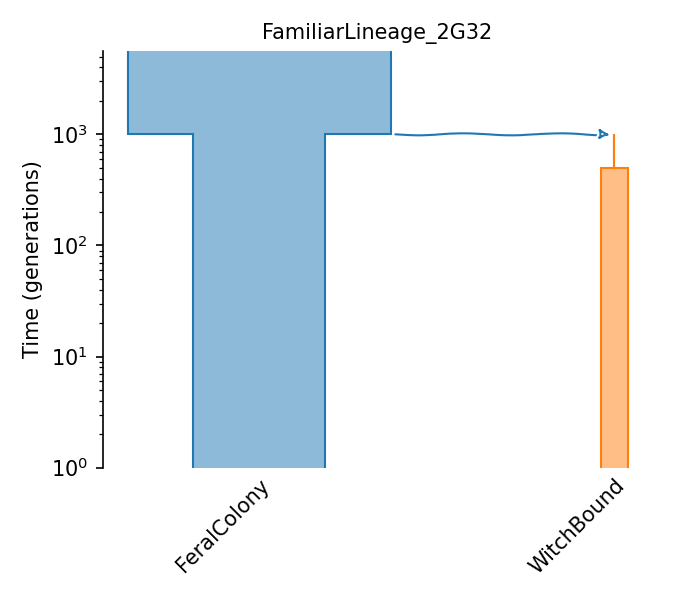
Tcho-Tcho are a species of near-human beings native to Asia, found in Burma, Tibet, Malaysia, and the Andaman Islands. Created by August Derleth and Mark Schorer, they are notably small (rarely exceeding four feet in height), with dome-shaped heads, small deep-set eyes, and livid skin. Despite their small stature, they are surprisingly strong. The Tcho-Tcho are believed to have been spawned through the genetic manipulation of pre-human ancestors by the Great Old Ones Zhar and Lloigor, with further connections to Chaugnar Faugn through the Miri Nigri. They worship various Great Old Ones including Hastur, Chaugnar Faugn, and Rhan-Tegoth. They are notorious for their cannibalistic practices and hostility toward outsiders. Lovecraft referenced them in The Shadow Out of Time (1936).
Tsathoggua choriensis
- ID:
TsaCho
- Name:
Tsathoggua choriensis
- Common name:
Tcho-Tcho
- Generation time:
- Ploidy:
2
- Separate sexes:
True
- Population size:
70000 (Lovecraft, H.P., 1928)
Genome
- Genome assembly name:
PLATEAU1.0 (Lovecraft, H.P., 1928)
ID |
Ploidy |
Length |
Recombination rate |
Mutation rate |
|---|---|---|---|---|
1 |
2 |
130000000 |
1.2e-08 |
1.5e-08 |
2 |
2 |
118000000 |
1.2e-08 |
1.5e-08 |
3 |
2 |
105000000 |
1.2e-08 |
1.5e-08 |
4 |
2 |
92000000 |
1.2e-08 |
1.5e-08 |
5 |
2 |
80000000 |
1.2e-08 |
1.5e-08 |
6 |
2 |
68000000 |
1.2e-08 |
1.5e-08 |
7 |
2 |
58000000 |
1.2e-08 |
1.5e-08 |
8 |
2 |
50000000 |
1.2e-08 |
1.5e-08 |
tainted_mitogenome |
1 |
16500 |
0 |
1.5e-08 |
Mutation and recombination rates are in units of per bp and per generation.
Citations
Lovecraft, H.P., 1928. https://en.wikipedia.org/wiki/Necronomicon
(mutation rate)
Lovecraft, H.P., 1928. https://en.wikipedia.org/wiki/Necronomicon
(recombination rate)
Lovecraft, H.P., 1928. https://en.wikipedia.org/wiki/Necronomicon
(genome assembly)
Demographic Models
ID |
Description |
|---|---|
Three epoch model of Tcho-Tcho plateau tribes |
|
Two population model of Highland Tribes and Lowland Infiltrator Tcho-Tcho |
Three epoch model of Tcho-Tcho plateau tribes
Single population model of the Tcho-Tcho people on the plateau. Three epochs: (1) a modern phase with effective population size 70000, (2) a persecution decline beginning 500 generations ago with N=20000, and (3) an ancient empire era beginning 5000 generations ago with N=200000. Based on the Necronomicon (Lovecraft).
Warning
This model has not undergone QC.
Details
- ID:
PlateauTribes_1D33
- Description:
Three epoch model of Tcho-Tcho plateau tribes
- Num populations:
1
Populations
Index |
ID |
Sampling time |
Description |
|---|---|---|---|
0 |
TchoTcho |
0 |
Tcho-Tcho – degenerate human-like tribe serving dark gods |
Citations
Lovecraft, H.P., 1928. https://en.wikipedia.org/wiki/Necronomicon
Demographic Model parameters
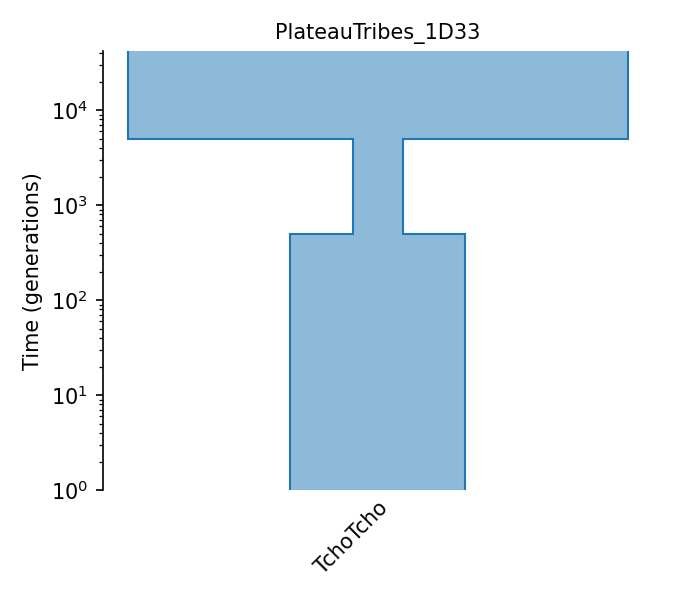
Two population model of Highland Tribes and Lowland Infiltrator Tcho-Tcho
Two population model describing the divergence of Highland Tribes and Lowland Infiltrator Tcho-Tcho populations. The ancestral population of size 200000 splits at 2000 generations ago. The Highland Tribe population maintains a size of 70000. The Lowland Infiltrator lineage goes through a bottleneck of 500 individuals before expanding to 30000. Based on the Necronomicon (Lovecraft).
Warning
This model has not undergone QC.
Details
- ID:
TaintedLineage_2D33
- Description:
Two population model of Highland Tribes and Lowland Infiltrator Tcho-Tcho
- Num populations:
2
Populations
Index |
ID |
Sampling time |
Description |
|---|---|---|---|
0 |
HighlandTribes |
0 |
Highland Tribes – traditional Tcho-Tcho plateau dwellers |
1 |
LowlandInfiltrators |
0 |
Lowland Infiltrators – Tcho-Tcho dispersed among humans |
Citations
Lovecraft, H.P., 1928. https://en.wikipedia.org/wiki/Necronomicon
Demographic Model parameters
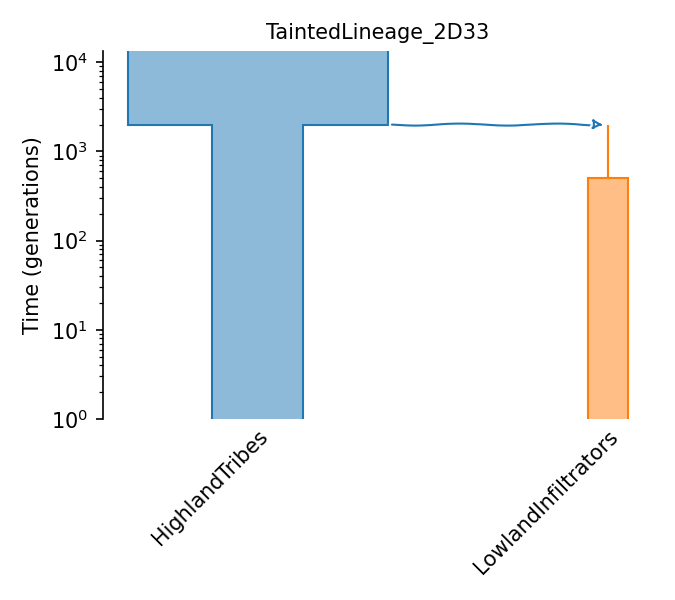
Generic models
In addition to the species-specific models listed in this catalog, stdvoidsim offers
a number of generic demographic models that can be run with any species.
These are described in more detail in the API.